This map is from the second copper plate, which contains identical geography to the first plate [1570]. On this plate, the largest ship in the Pacific is now sailing east and away from the viewer. Religious persecution forced Ortelius to leave Antwerp and there was a four-year hiatus in the publication of the Theatrum. When he re-established himself in Liège, he used Christopher Plantin’s large printing press to resume publication with several revised plates. This plate had a relatively short life of only 8 years, being replaced in 1587 by the easily distinguishable plate of the revised form of South America.
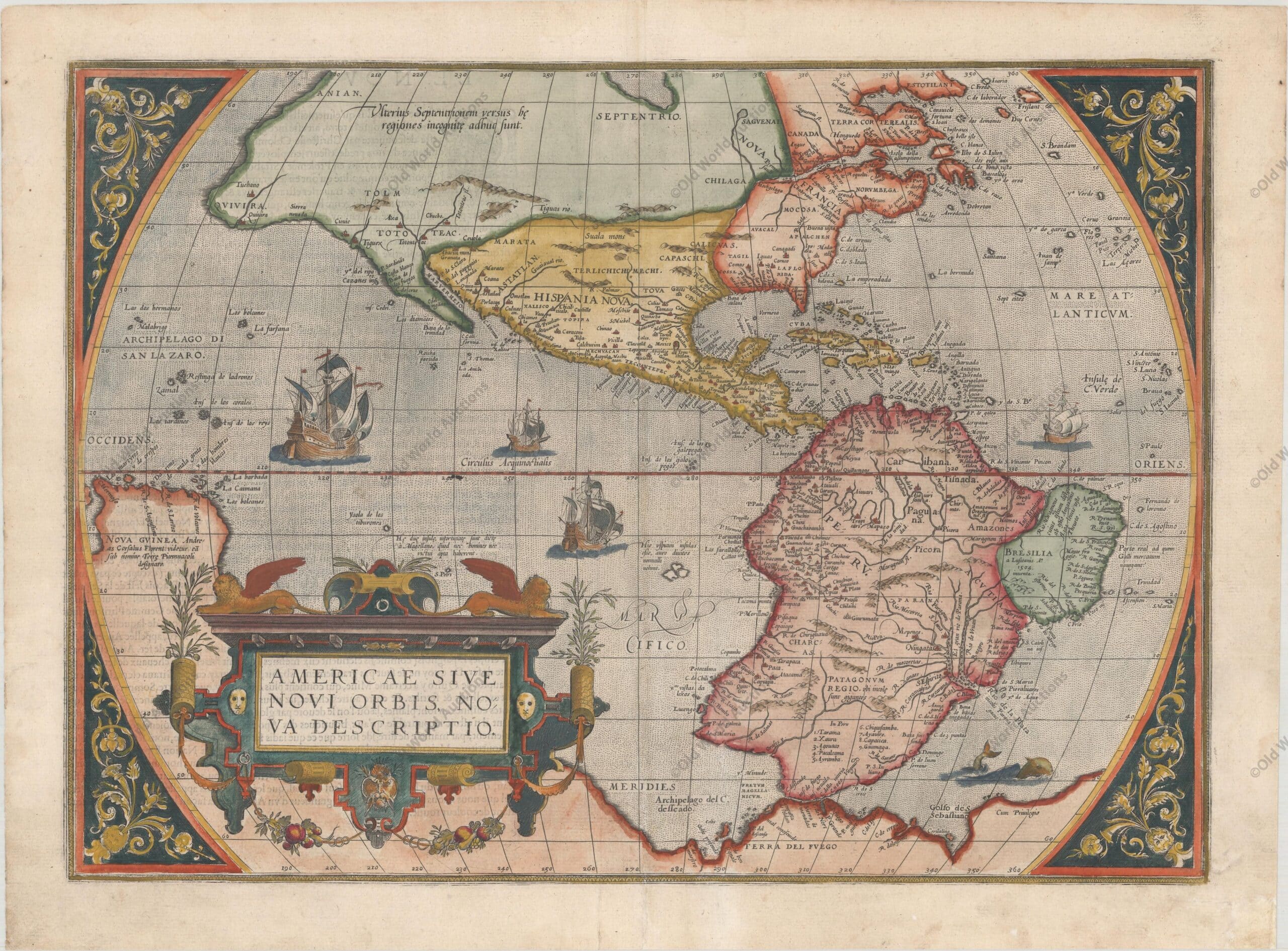
Map of the Western Hemisphere of 1581
This is one of the most famous maps of the Americas, and one that had an enormous influence on future cartography of the New World.
The map is largely based on Gerard Mercator’s large multi-sheet world map of 1569.
The most recognisable features of the map are the bulbous Chilean coastline and the exaggerated width of the North American continent.
North America shows a long St Lawrence River crossing the continent to almost meet the fictitious Tiguas River flowing westwards.
The strategically placed title cartouche hides the unknown South Pacific and thus most of the supposed great southern continent, which is shown attached to New Guinea and Tierra del Fuego.
This map is from the second copper plate containing the same geography as the first plate [1570].
On this plate, the largest ship in the Pacific is now sailing east and away from the viewer.
Religious persecution forced Ortelius to leave Antwerp and there was a four-year hiatus in the publication of the Theatrum.
When he re-established himself in Liège, he used Christopher Plantin’s large printing press to resume publication with several revised plates.
This plate had a relatively short life of only 8 years, being replaced in 1587 by the easily distinguishable plate of the revised form of South America.
1581 Map of the Western Hemisphere – Historical Map
Publicações Relacionadas
Map of Brazil 1747 - Historical Map of Brazil
1719 Map of the Western Hemisphere - Historical Map
Map of the Gulf of Mexico and the Caribbean, 1675
Map of South America from 1740: Historical Insights
1579 Map of the Western Hemisphere - Historical Map
1639 Map of Paraíba - Historical Map of Brazil
1609 Map of the Western Hemisphere - Historical Map
Map of South America, 1840
Copper Engraving of Salvador from 1748: History Explored
Historical maps showing the territorial development of Brazil
Map of the Western Hemisphere from 1700 - Historical Map
1643 Map of the Western Hemisphere - Historical Map
1584 World Map - Historical Map
1714 Map of the Western Hemisphere - Historical Map
1620 Map of Portugal and Spain - Historical Map
1575 Map of Europe - Historical Map
Map of Brazil from 1750 - Historical Map of Brazil
Engraving of the Bay of Todos os Santos from 1690 – Historical Engraving
Southeastern Colonial Map of the United States, Bahamas and Greater Antilles, 1706
Map of Africa from 1570
Map of South America and Brazil 1624 - Historical Map
1823 Map of Brazil - Historical Map
Map of Madeira and the Canary Islands from 1692
Map of the Captaincy of Pernambuco and Ceará from 1680
Map of Brazil from 1695: A Historical Overview
Engraving of the Fort of the Three Kings in Natal, 1671
Painting of the Three Kings Fort in Natal from 1647
Map of the Gulf of Mexico and the Caribbean from 1650-80
Map of Brazil 1730 - Historical Map
Map of the Brazilian coast from the Paraíba River to Cabo de Santo Agostinho
Map of Brazil from 1850: A Historical Overview
Map of All Saints Bay 1769 - Historical Maps
Map of Rio de Janeiro from 1682 - Historical Map
Map of Paraíba from 1662: An Engraved Masterpiece
Map of Rio de Janeiro, 1775 - Historical Map
1671 Map of Jamaica
This post is also on:
 Português
  English
  Deutsch
  Español
  Français