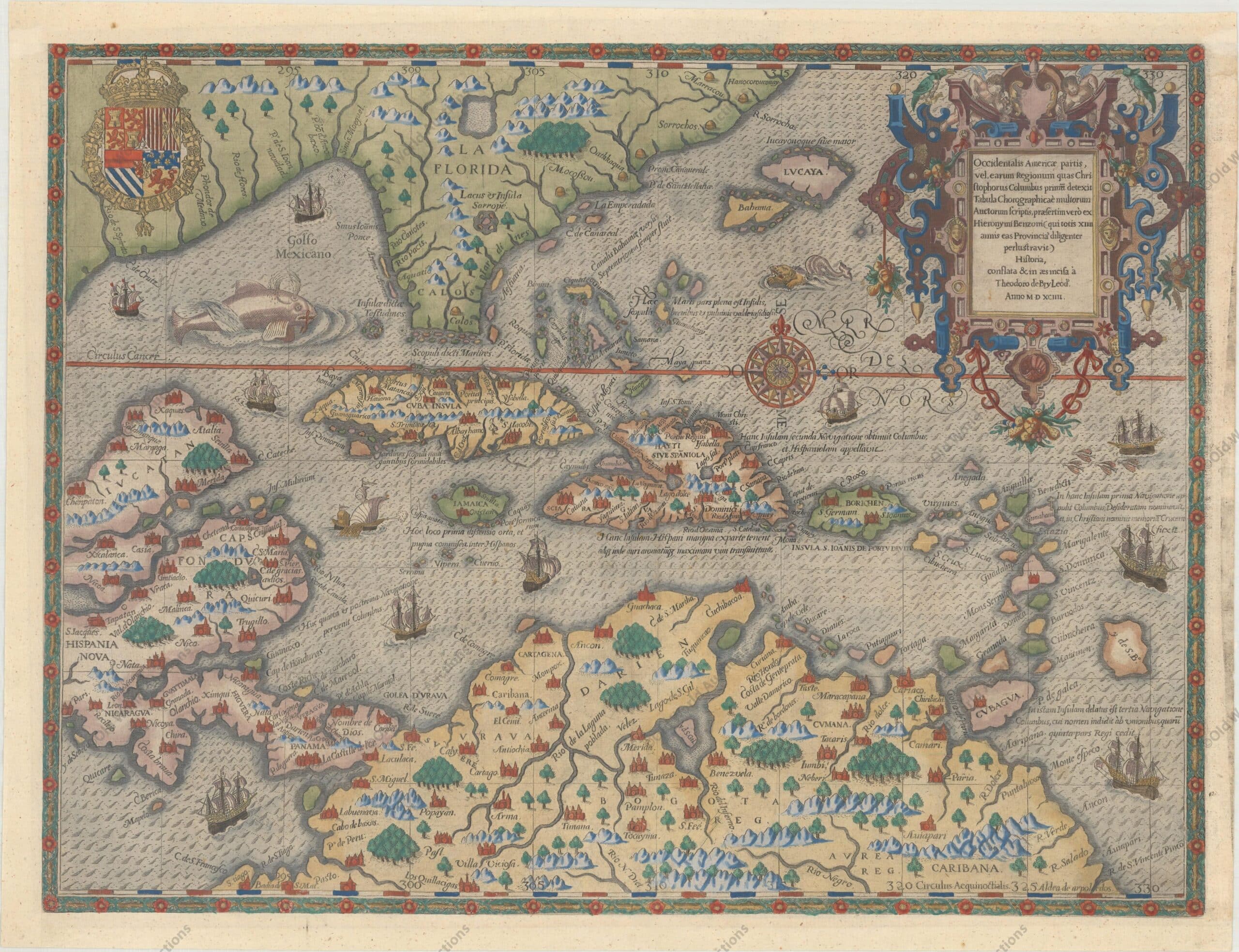
Map of the Gulf of Mexico and the Caribbean, 1594 – Grands Voyages, Part IV
De Bry’s Superb Map of the Southeastern United States, the Caribbean & Northern South America
“Occidentalis Americae Partis, vel, Earum Regionum quas Christophorus Columbus Primu Detexit Tabula Chorographicae Multorum Auctorum Scriptis…”, Bry, Theodore de.
This engraving is part of a remarkable series of publications illustrating voyages of discovery and exploration in various parts of the world.
The project was begun by Theodore de Bry of Frankfurt in 1590 and continued for another 54 years.
Together they became known as the Grands Voyages (to America and the West Indies) and the Petits Voyages (to the Orient and the East Indies).
De Bry died after completing the first six parts of the Grands Voyages.
The project was completed first by his widow and two sons, Johann Theodore de Bry and Johann Israel de Bry, and then by his son-in-law, Matthaus Merian, in 1644.
This spectacular map illustrates the region travelled by Girolamo Benzoni between 1541 and 1556.
Focusing on the disproportionately large Caribbean islands, the map also provides an early delineation of Florida derived from Le Moyne’s and is one of the first maps to detail northern South America.
The islands of the Bahamas are conspicuously oversized and placed well north of their actual location.
Several legends on the map mark Columbus’s four voyages and mention the Gulf Stream for the first time.
De Bry’s extraordinary engraving skills and artistic style are evident in the large and elaborate cartouche, the coat of arms, the compass rose, the sea monsters, the Spanish galleon and the intricate border.
References: Burden #83; Potter p.164.
Map of the Gulf of Mexico and the Caribbean, 1594
Publicações Relacionadas
Map of Rio de Janeiro of 1764 - Historical Map
1643 Map of the Western Hemisphere - Historical Map
Map of the Bay of All Saints and Pernambuco, 1700
1639 Map of Paraíba - Historical Map of Brazil
Map of South America and Brazil 1624 - Historical Map
Map of South America from 1615: Explore the Details
Map of Brazil 1747 - Historical Map of Brazil
Map of South America from 1740: Historical Insights
1579 Map of the Western Hemisphere - America - Historical Map
Map of Recife in Pernambuco from 1679: Historical Insights
1713 Map of the Western Hemisphere - Historical Map
1744 Map of the Western Hemisphere - Historical Map
Map of the Brazilian coast from the Paraíba River to Cabo de Santo Agostinho
The Catalan Atlas: Redrawing the Medieval World and Asia
1607 Map of the Western Hemisphere - Historical Map
Map of the Gulf of Mexico and the Caribbean from 1650-80
Map of Africa 1593 - Historical Map
Map of Southern South America, 1668 - Historical Map
Map of Brazil from 1850 - Historical Map of Brazil
Painting of the Three Kings Fort in Natal from 1647
Engraving of the Bay of Todos os Santos from 1690 – Historical Engraving
Map of West Africa and the Cape Verde Islands from 1699
1832 Map of Brazil - Historical Map
Maritime chart of the east coast of Brazil Ilha Grande and Sapetiba Bay 1884
Map of Rio de Janeiro, 1775 - Historical Map
1719 Map of the Western Hemisphere - Historical Map
Map of the Gulf of Mexico, the Caribbean and the Southern United States, 1682
1628 Historical Map of the Western Hemisphere
Map of All Saints Bay 1769 - Historical Maps
Map of the Captaincy of Espírito Santo and Porto Seguro from 1698
Map of Panama 1699 - Historical Map
Engraving of the town of Olinda in 1633 - Historical Engraving
1659 Map of the Western Hemisphere - Historical Map
Map of South America, 1840
1638 Map of the Gulf of Mexico and the Caribbean - Historical Map
Map of the Captaincy of Pernambuco from 1698 Overview
This post is also on:
 Português
  English
  Deutsch
  Español
  Français