Engraving of Salvador from 1671: A Historical Insight

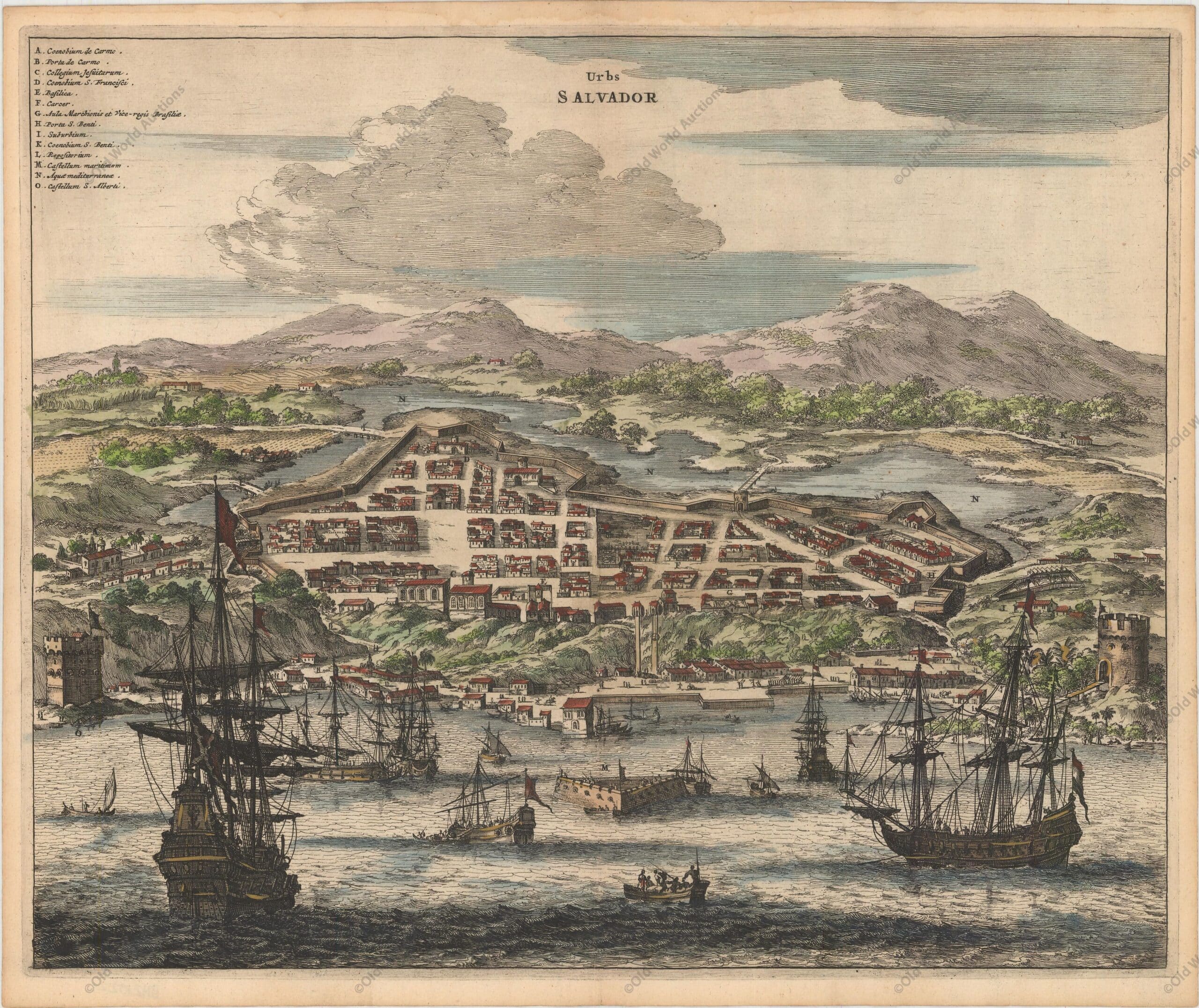
Gravura da Salvador da Bahia em 1671 - A obra de Montanus foi talvez o maior livro ilustrado sobre o Novo Mundo produzido no século XVII. Continha mais de cem placas, vistas e mapas lindamente gravados da América do Norte e do Sul. As placas retratam vividamente fortes, festivais, ocupações, frotas holandesas, batalhas, ritos religiosos e costumes dos habitantes nativos. Esta importante obra foi traduzida para o alemão por Olivier Dapper e para o inglês por John Ogilby. Várias das placas foram posteriormente adquiridas por Pierre Vander Aa. Bela gravura em cobre da cidade murada de Salvador com navios e barcos enchendo o porto em primeiro plano. Uma chave com letras no canto superior esquerdo identifica vários locais. "Urbs Salvador", Montanus, Arnoldus
Engraving by Salvador da Bahia, 1671 – Montanus’ work was perhaps the greatest illustrated book of the New World produced in the 17th century. It contained over a hundred beautifully engraved plates, views and maps of North and South America. The plates vividly depicted forts, festivals, occupations, Dutch fleets, battles, religious rites and native customs. This important work was translated into German by Olivier Dapper and into English by John Ogilby. Some of the plates were later acquired by Pierre Vander Aa. Beautiful engraving of the walled city of Salvador with ships and boats filling the harbour in the foreground. A key of letters in the upper left corner identifies various locations. “Urbs Salvador”, Montanus, Arnoldus

Engraving of Salvador from 1671

Montanus’s work was perhaps the greatest illustrated book on the New World produced in the 17th century.

It contained over a hundred beautifully engraved plates, views and maps of North and South America.

The plates vividly depicted forts, festivals, occupations, Dutch fleets, battles, religious rites and native customs.

This important work was translated into German by Olivier Dapper and into English by John Ogilby.

Some of the plates were later acquired by Pierre Vander Aa.

Beautiful engraving of the walled city of Salvador with ships and boats filling the harbour in the foreground. A key of letters in the upper left corner identifies various locations. Urbs Salvador, Montanus, Arnoldus
Publicações Relacionadas

1757 Map of the Western Hemisphere

Map of Brazil from 1630: Cartography's Legacy

1579 Map of the Western Hemisphere - America - Historical Map

1659 Map of the Western Hemisphere - Historical Map

Map of Brazil from 1695: A Historical Overview

1575 Map of Europe - Historical Map

Map of Recife in Pernambuco from 1679: Historical Insights

1744 Map of the Western Hemisphere - Historical Map

1620 Map of Portugal and Spain - Historical Map

1643 Map of the Western Hemisphere - Historical Map

Map of South America from 1750 - Historical Maps of Brazil

Map of Brazil 1698 - Historical Map

1609 Map of the Western Hemisphere - Historical Map

1719 Map of the Western Hemisphere - Historical Map

The Catalan Atlas: Redrawing the Medieval World and Asia

Map of the Cape Verde Islands, 1697

Map of the East Coast of Brazil, 1647 - Historical Maps

1671 Map of Mexico and Central America - Historical Map

Map of Rio de Janeiro of 1810 - Historical Map

Copper Engraving of Salvador from 1748: History Explored

Map of Paraíba from 1662: An Engraved Masterpiece

Map of South America from 1619: A Historical Insight

1679 Map of Recife - Historical Map

Engraving of the town of Olinda in 1633 - Historical Engraving

Engraving of Sirinhaém from 1671

Map of the Gulf of Mexico and the Caribbean, 1675

Map of the Gulf of Mexico and the Caribbean, 1681

1713 Map of the Western Hemisphere - Historical Map

1660 Map of the Western Hemisphere - Historical Map

Map of Brazil from 1798: Explore Historical Details

Map of Brasil from 1757: Historic Coastal Views

Reis Magos Fort Engraving from 1690 - Engravings Stories

Map of Madeira and the Canary Islands from 1692

Map of eastern Brazil 1664 - Historical Map of Brazil

Map of South America 1601 - Historical Map

View of Rio de Janeiro in 1840: Beauty Captured

This post is also on: Português English Deutsch Español Français