Travel guides for Bahia, Alagoas, Ceará and the whole of the North-East of Brazil: beaches, ready-made itineraries, culture and accommodation tips. Get inspired and plan your trip.
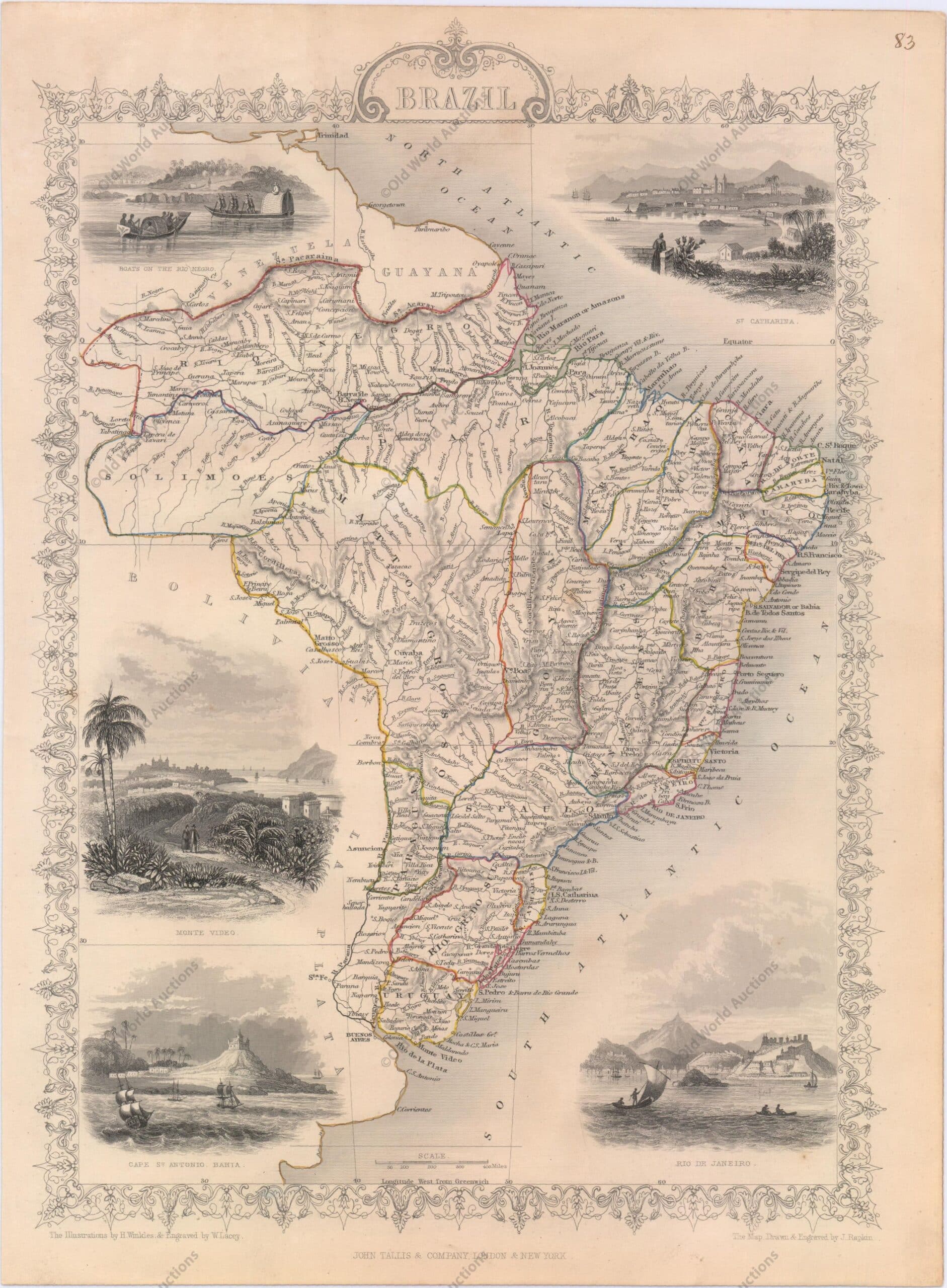
Map of Brazil from 1850 – Historical Map of Brazil
Map of Brazil, 1850 – Illustrated atlas maps were first published in serial form for an audience isolated by the cost and difficulty of travel. All this changed as the 19th century brought rapid and dramatic changes in public awareness of distant places. Undoubtedly, Tallis’s maps played an important role in this dramatic awakening. These maps not only provided up-to-date geographical knowledge, but also used vignettes in map design to show indigenous peoples and their occupations, towns and points of interest. The maps are in the cartographic tradition of 17th century Dutch cartographers, with finely engraved decorative borders. The maps were drawn and engraved by John Rapkin, with views drawn and engraved by several prominent artists. The maps were published as a complete set from 1851 to about 1865. Some of the maps were also published in other Tallis history books, including British Colonies, and, without the vignettes, in geographical dictionaries and encyclopaedias until about 1880. A beautiful and decorative steel engraved map showing the region in great detail. It contains five vignettes designed by H. Winkles and engraved by W. Lacey: “Boats on the Rio Negro”, “Santa Catharina”, “Monte Vídeo”, “Cabo Santo Antônio, Bahia” and “Rio de Janeiro”. Surrounded by a finely engraved decorative border. The map was drawn and engraved by J. Rapkin. “Brazil”, Tallis, John
Map of Brazil from 1850
The maps in The Illustrated Atlas were first published in serial form for an audience isolated by the cost and difficulty of travel.
All this changed as the 19th century brought rapid and dramatic changes in public awareness of distant places.
Tallis’s maps undoubtedly played an important part in this dramatic awakening.
These maps not only provided up-to-date geographical knowledge, but also used vignettes in map design to show indigenous peoples and their occupations, towns and points of interest.
The maps are in the cartographic tradition of 17th century Dutch cartographers, with finely engraved decorative borders.
The maps were drawn and engraved by John Rapkin, with views drawn and engraved by several prominent artists.
The maps were published as a complete set from 1851 to about 1865.
Some of the maps were also published in other Tallis history books, including British Colonies, and, without the vignettes, in geographical dictionaries and encyclopaedias until about 1880. A fine and decorative steel engraved map showing the region in great detail.
It contains five vignettes drawn by H. Winkles and engraved by W. Lacey: “Boats on the Rio Negro”, “Santa Catharina”, “Monte Vídeo”, “Cabo Santo Antônio, Bahia” and “Rio de Janeiro”. Surrounded by a finely engraved decorative border.
The map was drawn and engraved by J. Rapkin. “Brazil, Tallis, John
Written by Willy Sievert
Editor of Bahia.ws since its founding in 2009. Based in Salvador, he travels frequently across the Northeast and all of Brazil to keep the guides up to date. Learn more about Willy Sievert →