1671 Map of Jamaica

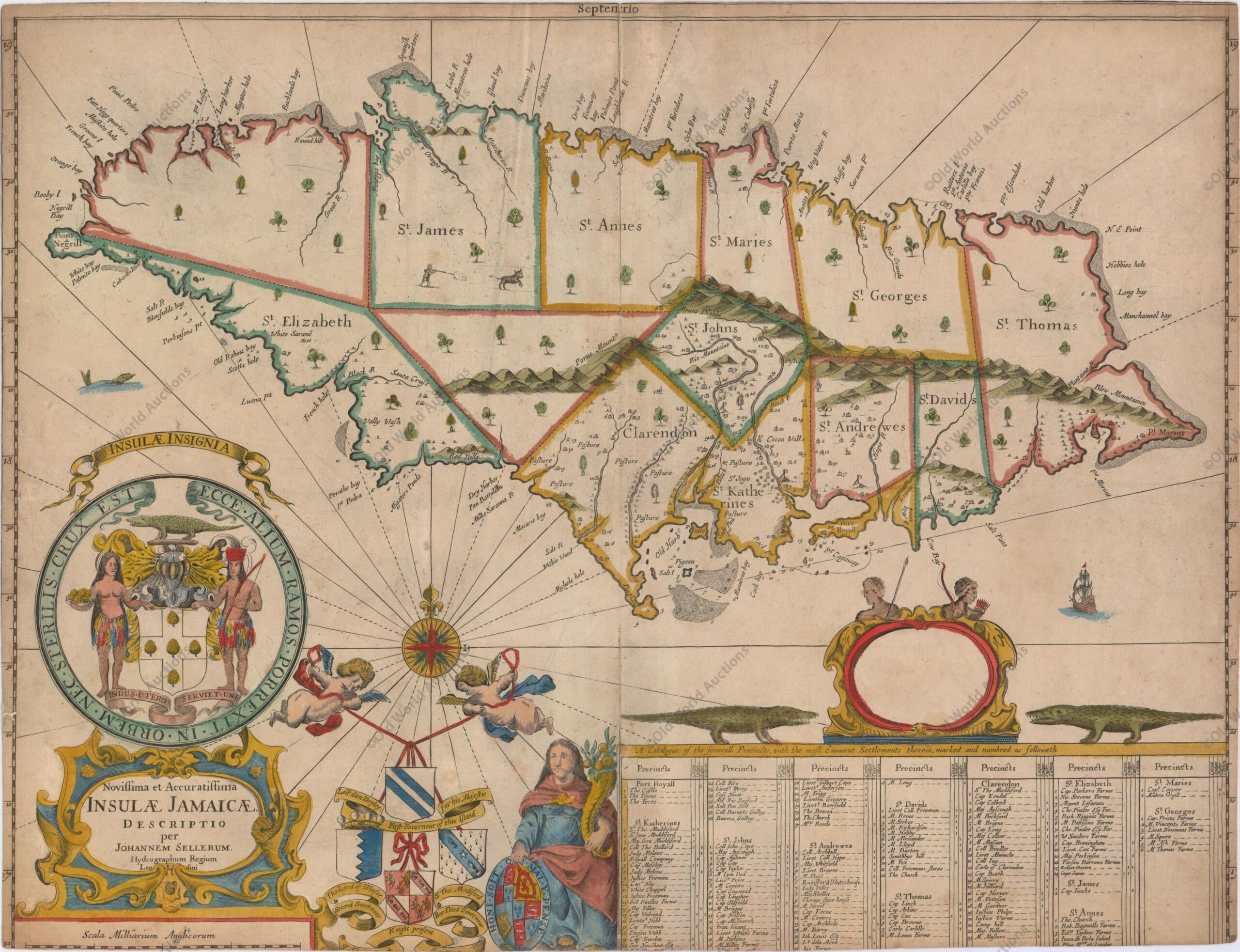
Mapa da Jamaica de 1671 - Atlas Maritimus"Novissima et Accuratissima Insulae Jamaicae Descriptio", Seller, John  Este é o primeiro estado de um mapa inglês muito raro que mostra a ilha dividida em distritos. Em 1670, Sir Thomas Modyford encomendou um levantamento da ilha, que foi concluído por John Man, o inspetor-geral da Jamaica de 1661 a 1671. No ano seguinte, John Seller, John Ogilby e Richard Blome utilizaram o levantamento para publicar mapas da Jamaica. O mapa de Seller, que se assemelha muito à versão de Ogilby, apresenta as povoações mais proeminentes com os proprietários de terras nomeados na legenda grande na parte inferior. Port Royal está corretamente localizado e existem numerosas povoações na parte sul da ilha. Ao longo da linha costeira são identificados ancoradouros, rochedos, baixios e sondagens de profundidade. O mapa está magnificamente ornamentado com uma cartela de título em cinta com o brasão de armas da Jamaica e putti segurando no alto os brasões dos governadores da ilha: Doyley, Winsor, Modiford e Lynch. A grande cartela de dedicatória é deixada em branco, encimada por índios e ladeada por crocodilos. Os elementos decorativos adicionais incluem um homem a disparar contra um touro, uma rosa dos ventos, um monstro marinho e um barco à vela. John Seller foi um editor britânico pioneiro de cartas náuticas e uma das figuras mais importantes do início da história da cartografia britânica. A loja de Seller, situada perto da Torre de Londres, em Wapping, tornou-se um ponto de encontro para os marinheiros que chegavam com as últimas notícias de lugares distantes e forneceu a Seller informações essenciais para o seu negócio de cartas náuticas. Para além das cartas náuticas, produziu uma vasta gama de material cartográfico, o primeiro a rivalizar com as grandes empresas holandesas, como Blaeu e Jansson. Seller foi nomeado Hidrógrafo Real por Carlos II em 1671, tendo também prestado serviço sob a direção de Jaime II e Guilherme III. Infelizmente, o seu negócio foi construído sobre uma base instável e, embora tenha feito várias tentativas para evitar a falência, incluindo uma parceria de consórcio com outros cartógrafos, como William Fisher e John Thornton, acabou por não ter êxito.
Map of Jamaica 1671 – Atlas Maritimus “Novissima et Accuratissima Insulae Jamaicae Descriptio”, Seller, John This is the first edition of a very rare English map showing the island divided into districts. In 1670 Sir Thomas Modyford commissioned a survey of the island, which was completed by John Man, Surveyor General of Jamaica from 1661 to 1671. The following year, John Seller, John Ogilby and Richard Blome used the survey to publish maps of Jamaica. Seller’s map, which is very similar to Ogilby’s version, shows the most prominent settlements with the landowners named in the large legend at the bottom. Port Royal is correctly located and there are numerous settlements in the southern part of the island. Anchorages, rocks, shoals and soundings are shown along the coast. The map is splendidly decorated with a title cartouche showing the coat of arms of Jamaica and putti holding aloft the coats of arms of the island’s governors: Doyley, Winsor, Modiford and Lynch. The large dedication cartouche is left blank, crowned by Indians and flanked by crocodiles. Other decorative elements include a man shooting a bull, a compass rose, a sea monster and a sailing ship. John Seller was a pioneering British publisher of nautical charts and one of the most important figures in the early history of British cartography. Seller’s shop, located near the Tower of London in Wapping, became a meeting place for sailors who arrived with the latest news from faraway places, providing Seller with essential information for his nautical chart business. As well as nautical charts, he produced a wide range of cartographic material, the first to rival the major Dutch companies such as Blaeu and Jansson. Seller was appointed Royal Hydrographer by Charles II in 1671, having also served under James II and William III. Unfortunately, his business was built on an unstable foundation and although he made several attempts to avoid bankruptcy, including a consortium partnership with other cartographers such as William Fisher and John Thornton, he was ultimately unsuccessful.

Map of Jamaica of 1671 – Atlas Maritimus

“Novissima et Accuratissima Insulae Jamaicae Descriptio”, Seller, John

This is the first edition of a very rare English map showing the island divided into districts.

In 1670, Sir Thomas Modyford commissioned a survey of the island, which was completed by John Man, the Surveyor General of Jamaica from 1661 to 1671.

The following year, John Seller, John Ogilby and Richard Blome used the survey to publish maps of Jamaica.

Seller’s map, which is very similar to Ogilby’s version, shows the most prominent settlements with the landowners named in the large legend at the bottom.

Port Royal is correctly located and there are numerous settlements in the southern part of the island.

Anchorages, rocks, shoals and soundings are shown along the coast.

The map is splendidly decorated with a title cartouche showing the coat of arms of Jamaica and putti holding aloft the coats of arms of the island’s governors: Doyley, Winsor, Modiford and Lynch.

The large dedication cartouche is left blank, crowned by Indians and flanked by crocodiles. Other decorative elements include a man shooting a bull, a compass rose, a sea monster and a sailing ship.

John Seller was a pioneering British publisher of nautical charts and one of the most important figures in the early history of British cartography.

Seller’s shop, located near the Tower of London in Wapping, became a meeting place for sailors who arrived with the latest news from faraway places, providing Seller with essential information for his nautical chart business.

As well as nautical charts, he produced a wide range of cartographic material, the first to rival the major Dutch companies such as Blaeu and Jansson.

Seller was appointed Royal Hydrographer by Charles II in 1671, having also served under James II and William III.

Unfortunately, his business was built on an unstable foundation and although he made several attempts to avoid bankruptcy, including a consortium partnership with other cartographers such as William Fisher and John Thornton, he was ultimately unsuccessful.

Publicações Relacionadas

Map of Rio de Janeiro, 1775 - Historical Map

1719 Map of the Western Hemisphere - Historical Map

Engraving of the town of Olinda in 1633 - Historical Engraving

Map of the Gulf of Mexico and the Caribbean, 1594

Southeastern Colonial Map of the United States, Bahamas and Greater Antilles, 1706

Engraving of the Fort of the Three Kings in Natal, 1671

Map of the Gulf of Mexico and the Caribbean, 1681

Map of Rio de Janeiro, 1794 - Historical Map

Map of Europe from 1644: A Classic Antique

Map of Mexico and Central America, 1671 - Historical Map

Map of Brazil 1747 - Historical Maps of Brazil

Painting of the Three Kings Fort in Natal from 1647

Engraving of Salvador from 1671: A Historical Insight

Map of Southern South America, 1668 - Historical Map

1666 Map of the Gulf of Mexico and the Caribbean - Historical Map

1592 Map of the Western Hemisphere - Historical Map

1697 Map of the Western Hemisphere - Historical Map

Map of Brazil from 1798: Explore Historical Details

1730 Map of the Western Hemisphere - Historical Map

Map of Brazil from 1606 - Historical Map

1832 Map of Brazil - Historical Map

1713 Map of the Western Hemisphere - Historical Map

Map of South America from 1740: Historical Insights

Map of Africa 1593 - Historical Map

Map of Brazil 1747 - Historical Map of Brazil

1643 Map of the Western Hemisphere - Historical Map

Map of Brazil from 1850: A Historical Overview

1587 Map of the Western Hemisphere - Historical Map

Map of Brazil from 1652: A Historical Perspective

Map of South America and the Caribbean 1596 - Historical Map

Map of the Western Hemisphere from 1700 - Historical Map

Map of South America from 1619: A Historical Insight

Map of Paraíba from 1662: An Engraved Masterpiece

View of Rio de Janeiro in 1840: Beauty Captured

Map of the Brazilian coast from the Paraíba River to Cabo de Santo Agostinho

Map of Cabo Santo Agostinho from 1645 - Historical Map of Brazil

This post is also on: Português English Deutsch Español Français