Map of the Province of Paraíba from 1698 Overview

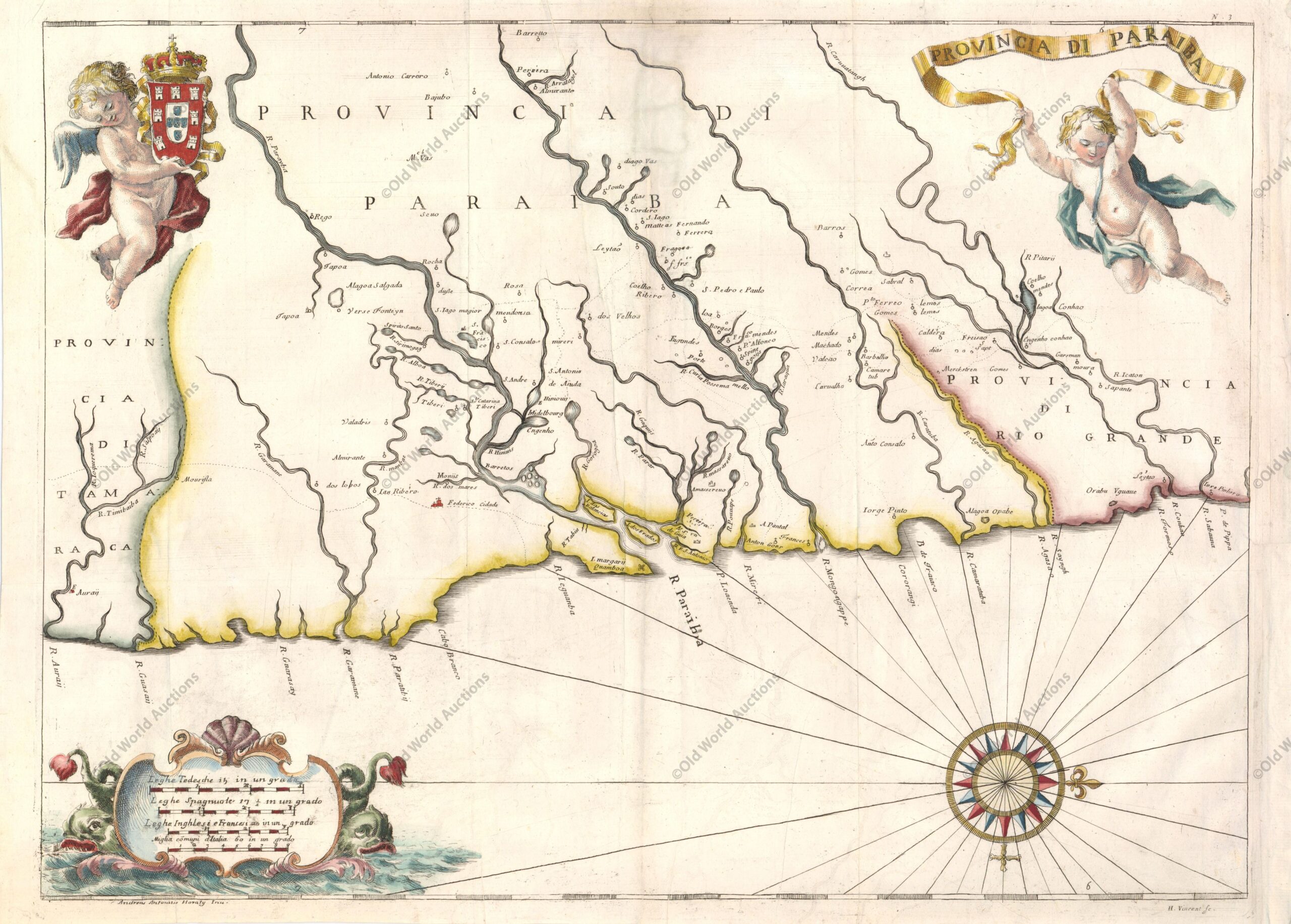
Mapa da Provincia da Paraíba de 1698 - Este impressionante mapa cobre a província da Paraíba e ilustra seus importantes rios e prósperas plantações de cana-de-açúcar. Foi um dos 23 mapas deste raro relato da guerra colonial holandesa-portuguesa. Escrita por João José de Santa Teresa, e conhecida entre os bibliófilos como a Santa Teresa, é considerada uma das mais suntuosas obras do século XVII no Brasil, em parte devido aos incríveis mapas. Santa Teresa, carmelita portuguesa, passou doze anos nas missões jesuítas da América do Sul e depois voltou para a Europa onde se tornou bibliotecário do colégio dos jesuítas em Roma. Sua conta foi fortemente subsidiada por Pedro II de Portugal, e alguns dos principais artistas e gravadores do período, incluindo Antonio Horacio Andreas, foram contratados para trabalhar no projeto. Foi publicado por Giacomo Giovanni Rossi. O mapa em si é lindamente desenhado e oferece uma excelente visão da região com baías, rios e córregos cuidadosamente delineados. Existem numerosos assentamentos e igrejas localizadas, bem como uma rede de estradas antigas. Uma grande rosa dos ventos orienta o mapa com o norte à direita. O mapa é elaboradamente adornado com putti sustentando a cartela do título em forma de fita e o brasão real, e monstros marinhos sustentando a cartela de escalas de distância em forma de concha. "Provincia di Paraiba", Horatius, Andreas Antonius
Map of Paraíba Province, 1698 – This impressive map covers the province of Paraíba, illustrating its major rivers and flourishing sugar cane plantations. It was one of 23 maps in this rare account of the Dutch-Portuguese colonial war. Written by João José de Santa Teresa, and known to bibliophiles as the Santa Teresa, it is considered one of the most sumptuous works of the 17th century in Brazil, partly because of its incredible maps. Santa Teresa, a Portuguese Carmelite, spent twelve years in the Jesuit missions of South America before returning to Europe to become librarian of the Jesuit College in Rome. Her account was heavily subsidised by Pedro II of Portugal, and some of the leading artists and engravers of the time, including Antonio Horacio Andreas, were commissioned to work on the project. It was published by Giacomo Giovanni Rossi. The map itself is beautifully drawn and offers an excellent view of the region, with bays, rivers and streams carefully delineated. There are numerous settlements and churches, as well as a network of ancient roads. A large compass rose orients the map with north to the right. The map is elaborately decorated with putti supporting the ribbon-shaped title cartouche and the royal coat of arms, and sea monsters supporting the shell-shaped distance scale cartouche. “Provincia di Paraiba”, Horatius, Andreas Antonius

Map of the Province of Paraíba from 1698

This impressive map covers the province of Paraíba, showing its major rivers and flourishing sugar cane plantations.

It was one of 23 maps in this rare account of the Dutch-Portuguese colonial war.

Written by João José de Santa Teresa, known to bibliophiles as Santa Teresa, it is considered one of the most sumptuous works of the 17th century in Brazil, partly because of its incredible maps.

Saint Teresa, a Portuguese Carmelite nun, spent twelve years in the Jesuit missions in South America and then returned to Europe, where she became librarian at the Jesuit College in Rome.

His account was heavily subsidised by Pedro II of Portugal, and some of the leading artists and engravers of the time, including Antonio Horacio Andreas, were commissioned to work on the project. It was published by Giacomo Giovanni Rossi.

The map itself is beautifully drawn and offers an excellent view of the region, with carefully delineated bays, rivers and streams. There are numerous settlements and churches, as well as a network of ancient roads. A large compass rose orients the map with north to the right.

The map is elaborately decorated with cherubs holding the ribbon-shaped title cartouche and the royal coat of arms, and sea monsters holding the shell-shaped distance scale cartouche. “Provincia di Paraiba”, Horatius, Andrew Anthony

Map of the Province of Paraíba from 1698 – Historical Maps of Brazil

Publicações Relacionadas

Map of South America, 1840

Engraving of Sirinhaém from 1671

1671 Map of Jamaica

Map of Brazil 1698 - Historical Maps of Brazil
Maritime chart of the east coast of Brazil Ilha Grande and Sapetiba Bay 1884

Map of the Captaincy of Pernambuco from 1698 Overview

Gravura da Baia de Todos os Santos de 1690

Map of the Western Hemisphere from 1700 - Historical Map

1592 Map of the Western Hemisphere - Historical Map

1757 Map of the Western Hemisphere

1823 Map of Brazil - Historical Map

1607 Map of the Western Hemisphere - Historical Map

Map of Southern South America, 1656 - Historical Map

Map of Brazil from 1850 - Historical Map of Brazil

Map of Paraíba of 1690 - Historical Maps of Brazil

Engraving of the Fort of the Three Kings in Natal, 1671

Map of the Cape Verde Islands, 1697

1620 Map of Portugal and Spain - Historical Map

1666 Map of the Gulf of Mexico and the Caribbean - Historical Map

Map of Brazil from 1850: A Historical Overview

1713 Map of the Western Hemisphere - Historical Map

Map of Mexico and Central America, 1671 - Historical Map

Painting of the Three Kings Fort in Natal from 1647

Map of South America from 1650: A Historical Overview

Map of Rio de Janeiro, 1775 - Historical Map

View of Rio de Janeiro in 1840: Beauty Captured

1643 Map of the Western Hemisphere - Historical Map

Map of South America from 1615: Explore the Details

Map of Santa Catarina Island 1777: A Historical Treasure

Engraving of Salvador de Bahia from 1770 - Historical Maps

1587 Map of the Western Hemisphere - Historical Map

Map of the Azores from 1584

Map of the Gulf of Mexico and the Caribbean, 1594

Map of Brazil 1698 - Historical Map

Map of the Gulf of Mexico and the Caribbean, 1675

1727 Map of the Western Hemisphere - Historical Map

This post is also on: Português English Deutsch Español Français