When the Portuguese colonists arrived in southern Bahia in 1500, the Brazilian coastal lands were occupied by the Tupi-Guarani Indians.
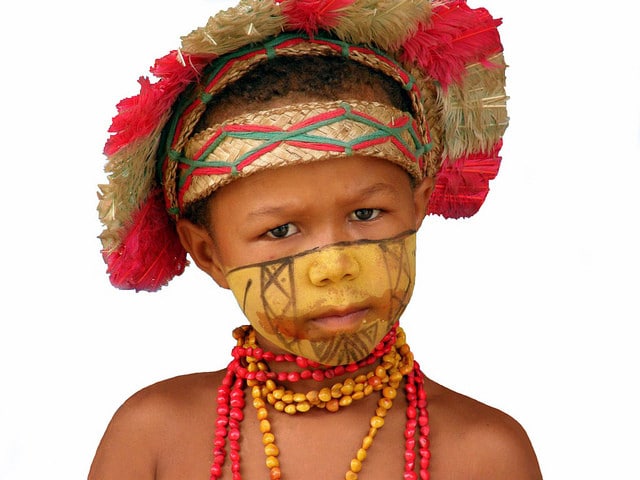
Indigenous groups of the Bahian coast
The predominant indigenous groups on the Bahian coast were the Tupiniquins and the Tupinambás.
- The Tupiniquins inhabited the strip from Camamu to Espírito Santo.
- The Tupinambás dominated the vast coastal area from Sergipe to Ilhéus.
The interior of the state was dominated by the Aimorés or Botocudos, who were not known to the Portuguese until many years later.
Barter relations
From the beginning, there was a peaceful bartering relationship between the colonists and the natives. The Indians provided the colonists with food, wood for construction and labour to cut down trees.
In return, they received tools, clothing and other utensils, which were incorporated into their consumption from the moment they came into contact with the Portuguese.
Changing relationships
According to anthropologist Maria Hilda Baqueiro Paraíso, as the colonisation process became more extensive and demanding, the colonists began to change their relationship with the indigenous peoples. Attempts to enslave the indigenous peoples became more effective.
On the other hand, this provoked reactions from the indigenous peoples, who did not accept the new type of relationship. The Tupiniquins were gradually wiped out in battles against the colonists.
Consequences of colonisation
Combined with ecological and biotic factors, such as epidemics of smallpox, this process led to the death of more than two-thirds of the indigenous population of Far South Bahia in the second half of the 16th century.
Reserva Pataxó Porto do Boi05:58

Índios Pataxós25:16

Indios do litoral sul da Bahia25:49

Índios Kuikuro na região do Xingu06:37
Indigenous peoples in Bahia
Most indigenous people live in southern Bahia, where villages of the Pataxó and Truká peoples are located.
According to the 2010 census, about 17,741 indigenous people live in the cities of Porto Seguro, Ilhéus, Santa Cruz Cabrália, Pau Brasil and Prado.
The capital, Salvador, is the city with the largest concentration of indigenous people in Bahia, with around 7,500, followed by municipalities in the southern region.
At least 14 indigenous peoples live in Bahia.
- Pataxó
- Truká
- Tuxá
- Atikun
- Xucuru-Kariri
- Pankararé
- Tumbalala
- Kantaruré
- Kaimbé
- Tupinambá
- Payayá
- Kiriri
- Pankaru
- Pataxó Ha Ha Hae
Bahia has at least 11 recognised indigenous territories.
Most are located in the south and extreme south of the state and belong to the Pataxó people.
Demarcated indigenous territories or villages
In the process of regularisation
- Barra Velha do Monte Pascoal (Porto Seguro), of the Pataxó ethnic group
- Tupinambá of Olivença (Ilhéus, Una and Buararema), of the Tupinambá ethnic group
- Tupinambá of Belmonte (Belmonte), of the Tupinambá ethnic group
Regularised in the cities of
- Prado
- Pau Brazil
- Santa Cruz Cabrália
- Safe haven
- Camamu, Funai recognises the territory of Fazenda Bahiana as an indigenous reserve
Indigenous peoples of Bahia – Bahia Salvador tourism and travel guide
Publicações Relacionadas
Rural Maracatu: A carnival tradition in the interior of Pernambuco
History and Chronology of the Portuguese Tile Industry
The Rhythm of Candomblé and the Invocation of the Orixás
Biography of Victor Meirelles and analysis of the work "The First Mass in Brazil"
Diógenes Rebouças and His Architectural Legacy
Plastic Arts of the Northeast: A Cultural Journey
Popular Art from the Northeast of Brazil
King Momo, Pierro, Harlequin and Colombina - Carnival characters
History and Chronology of the Carnival of Salvador de Bahia
Jorge Amado's Life and Literary Contributions
History of Northeast Brazil - Chronology and Summary
Bobbin lace and embroidery: predominant handicrafts in Ceará
Extreme sports in the Northeast of Brazil: Destinations not to be missed
Iemanjá: Discover the Orixá and the Traditional Festival in Salvador
History of the introduction of Portuguese tiles in Brazil
Geography and Climate Regions of Northeast Brazil
História e Evolução do Trio Elétrico no Carnaval
José Américo de Almeida: A Brazilian Literary Icon
The Origins of Umbanda: Brazilian History, Beliefs and Practices
Jean-Baptiste Debret: biography and works in Brazil
The dress of the Baianas is influenced by African culture
Influences and main dishes of northeastern cuisine
Northeastern Literature: A Rich Cultural Tapestry
Iemanjá Festival: Meaning and Celebrations
Casa Grande & Senzala: The Work of Gilberto Freyre
History of Baroque Architecture in the Northeast and Minas Gerais
The origins of Afro hairstyles in Salvador, Bahia
Northeastern architecture with typical colonial features
Origin and history of Acarajé: Discover the Afro-Brazilian tradition
Cultural Aspects of Northeast Brazil Explained
Colours of houses and buildings in the colonial architecture of the northeast
Candomblé: A Blend of African and Catholic Traditions
Brazil's historic moments illustrated in great works
Lampião and the Cangaço: Between History and Mythology
Rapadura: A Sweet Treat from Northeastern Brazil
Franciscans in Brazil: Urban, architectural and artistic heritage
This post is also on:
 Português
  English
  Deutsch
  Español
  Français