Maria Bethânia: The queen bee of Brazilian popular music and her enduring legacy Maria Bethânia Viana Teles Veloso, better known as Maria Bethânia, was born on 18 June 1946 in Santo Amaro da Purificação, Bahia. She is one of the most important Brazilian singers, the second best-selling female artist in […]
Posts — Travel Guides and Tips for the North-East and Brazil | Bahia.ws
Simone Bittencourt: The Journey of a Brazilian Music Star
Full biography of Simone Bittencourt: The star of Brazilian music Birth and name The singer Simone Bittencourt was born on Christmas Day 1949 in Salvador, the capital of Bahia. For this reason she was to be christened Natalina, but in the end the name Simone Bittencourt de Oliveira prevailed. Family […]
Novos Baianos: A Journey Through Brazilian Music
The New Bahians: The musical revolution of Bahia in the 1960s and 1970s The Novos Baianos were formed in Bahia in the 1960s by Paulinho Boca de Cantor, Pepeu Gomes, Moraes Moreira, Dadi, Galvão, Jorginho, Baixinho, Bolacha and Baby. The group made their debut with the show “Desembarque dos Bichos […]
The evolution of carnival: traditions and stories
The fascinating history and evolution of carnival: from ancient times to today The origin of Carnival is a controversial subject. Some historians associate the beginning of Carnival celebrations with ancient rituals performed to praise good harvests, ten thousand years before Christ. Historical influences Others say it began later, in Egypt, […]
Morais Moreira’s Evolution from os Novos Baianos
Biography of Morais Moreira: The career of the Bahian singer and composer Antônio Carlos Moreira Pires (Morais Moreira) was born on 8 July 1947 in Ituaçú, Bahia. Early career Growing up in the hinterland of Bahia, Morais Moreira began playing the accordion at an early age, later switching to the […]
Carmen Miranda: Icon of Brazilian Music History
The influence of Carmen Miranda on Brazilian music: From the popularisation of samba to its internationalisation in Hollywood When, in 1939, Carmen Miranda (born on 9 February 1909 and died on 5 August 1955) recorded one of her most famous songs, “O Que É Que a Baiana Tem” (What Does […]
Biography of Raul Seixas: Life and Musical Career
Biography of Raul Seixas: The journey of a Brazilian rock legend Childhood and influences Raul Seixas (Raul dos Santos Seixas) was born in Salvador, Bahia, on 28 June 1945, the son of Raul Varella Seixas and Maria Eugênia Seixas. He comes from the same region and generation as Gilberto Gil, […]
Tourist Areas in Bahia – Tourist Guide
Tourism in Bahia is characterised by the fact that the state is one of the most important tourist centres in Brazil. Bahia has an immense variety of landscapes, cultural traditions and attractions, allowing it to be divided into tourist areas, each with a name characteristic of its main physical and […]
Origin and History of Capoeira in Brazil Explained
Capoeira: an Afro-Brazilian cultural expression Capoeira is an Afro-Brazilian cultural expression that combines elements of martial arts, dance, music and acrobatics. Origin of Capoeira The origins of Capoeira are closely linked to the history of the African slaves brought to Brazil. From the 16th century, thousands of Africans were forced […]
Candomblé: Origins, History and Traditions
Candomblé: An Afro-Brazilian religion Candomblé is an Afro-Brazilian religion that developed in the 19th century, particularly in Brazil, from a mixture of African religious traditions brought by slaves, mainly from the region of modern-day Benin and Nigeria, with elements of Catholicism and indigenous traditions. Origins and cultural resistance Its origins […]
Discover the History of Capoeira in Salvador
Capoeira in Salvador: An authentic martial art Salvador, in Bahia, is one of the birthplaces of capoeira and offers numerous opportunities to see this martial art in its most authentic setting. The city is home to many renowned capoeira groups and historical sites where capoeira is practised regularly. The history […]
Iemanjá Festival: Meaning and Celebrations
Iemanjá, thousands of Bahians and tourists flock to the beaches of Rio Vermelho in Salvador every year on 2 February. The goddess Iemanjá Iyemanjá, Yemanjá, Yemaya, Iemoja or Yemoja is an African orisha whose name derives from the Yoruba expression “Yèyé omo ejá” (“Mother whose children are fish”). Identified in […]
The Origins of Umbanda: Brazilian History, Beliefs and Practices
Umbanda, by virtue of its origins, is a genuinely Brazilian religion Umbanda is a Brazilian religion, which emerged in the early 20th century, characterised by syncretism between elements of spiritualism, Afro-Brazilian cults, indigenous traditions and influences from popular Catholicism. Its core purpose is charity, peace and harmony, emphasising the connection […]
Itineraries focused on religious tourism in Salvador, Bahia
Salvador: A destination for religious tourism Salvador, the capital of Bahia, is one of the main destinations for religious tourism in Brazil, reflecting its rich historical and cultural heritage. Church and Spirituality Religious tourism in Salvador takes place in more than 300 secular churches. It is often said in the […]
The Rhythm of Candomblé and the Invocation of the Orixás
The importance of music in Candomblé In Candomblé, music plays a fundamental role in the invocation of the orixás, who act as intermediaries between humans and the gods. Spiritual connection Through rhythms and chants, followers establish a spiritual connection that allows the orixás to manifest. In the Bahia de Todos […]
The Baiana costume in Salvador, Bahia: Origin and Significance
The Baiana costume in Salvador, Bahia: a cultural expression The Baiana costume is one of the most recognisable symbols of Salvador and the whole of Bahia. Combining African, Portuguese and Islamic influences, it reflects the strength of African culture in Brazil and complements the rebolado and ginga of the Baianas as they move through the city’s streets, hills and festivals. In […]
The War of Canudos: Rescuing historical memory
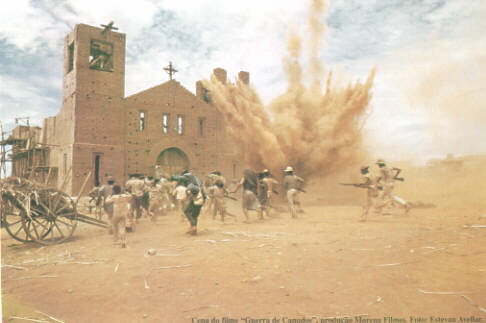
War of Canudos: Bahia revives the village of Canudos Bahia will build its first scenographic city in honour of Canudos. The State Secretary for Tourism, Domingos Leonelli, announced that the project to build the city will represent the village of Canudos, in the hinterland, and also aims to revive the […]
The Origins and History of Acarajé: Discover the Afro-Brazilian Tradition
Acarajé: An Expression of Afro-Brazilian Tradition Acarajé is much more than just a dish from Bahian cuisine; it is a true expression of the rich Afro-Brazilian tradition. With roots stretching back to Africa, this delicacy symbolises the fusion of cultures and the resilience of Afro-descendant communities over the centuries. Street Trading in Salvador Sold on the streets […]
Afro-Brazilian Religions: History of Candomblé and Umbanda
The history of Afro-Brazilian religions begins with the forced encounter between the African peoples brought over by slavery and the Indigenous and European cultures of Brazil. Out of this coexistence, distinct traditions were born, such as candomblé and umbanda, which are linked by common roots and by a long path […]
History of the indigenous peoples of Bahia
When the Portuguese colonists arrived in southern Bahia in 1500, the Brazilian coastal lands were occupied by the Tupi-Guarani Indians. Indigenous groups of the Bahian coast The predominant indigenous groups on the Bahian coast were the Tupiniquins and the Tupinambás. The Tupiniquins inhabited the strip from Camamu to Espírito Santo. […]