Olinda Cathedral: History and Architecture
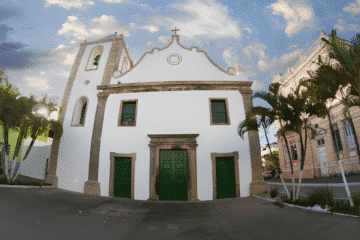
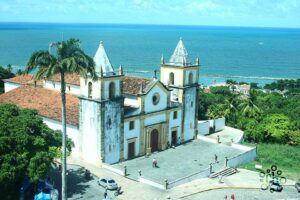
The Olinda Cathedral, also known as the Church of Saint Saviour of the World, is located in the Historic Site of Olinda and occupies a prominent position in the city’s landscape.
As well as being the first religious building constructed by the Portuguese on their arrival in the Captaincy of Pernambuco, the church rises from the top of a hill and enjoys a privileged view of both the historic site and the neighbouring city of Recife.

History and architecture of Olinda Cathedral

See also Tourist attractions in Olinda PE.
1. Religious festivals and the patron saint
The month of August is dedicated to the patron saint, Saint Saviour of the World, and religious festivals are held in his honour.
2. Foundation and first buildings
Founded in 1540 as the Matriz do São Salvador, the church is the oldest religious temple in the city of Olinda, marking the Portuguese presence in northeastern Brazil.
The original construction was simple, made of wood and rammed earth, with a structure consisting of a nave, chancel and sacristy.
3. Architectural evolution and renovations
The church has been renovated and extended several times. In 1584 it already had three naves and side-chapels. The vault of the choir was then designed and the nave, sacristy and bell tower were enlarged, the work being completed in 1621.
4. Effects of the Dutch invasion
With the Dutch Invasion in 1630, the church was partially destroyed in the fire of 1631, but continued to be used for Catholic worship, as evidenced by the works of the painter Frans Post.

Reconstruction of the church began in 1656, after the Pernambuco Restoration, and was completed in 1676, when the church was elevated to cathedral status.
5. Changes over time
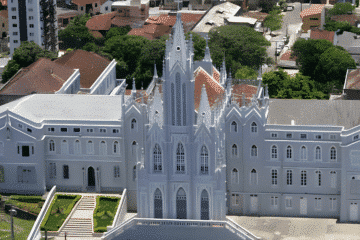
In 1740, Portuguese tiles were introduced on the side walls of the nave, although they no longer exist. In 1911, the church underwent a remodelling that radically changed its interior decoration, main façade and volumetry, completed in 1919, following the design of the architect Rodolfo Lima, who opted for the Neo-Gothic style.
6. Recent restorations
Between 1974 and 1978, the church underwent its most extensive restoration, coordinated by the architect José Luiz da Mota Menezes. This intervention was based on historical and archaeological research, resulting in the current appearance of the temple.
7. Heritage loss and conservation
Although renovations and interventions over time have led to the loss of many important heritage items, the church still retains an architectural design and historical significance that is unique to Olinda. Many valuable items such as tiles, carvings and paintings have been lost or given to museums.


8. Architectural aspects of Olinda Cathedral
8.1 Style and structure
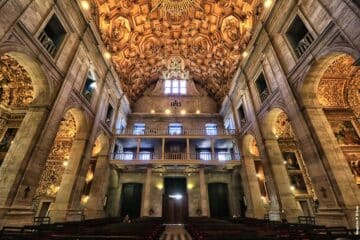
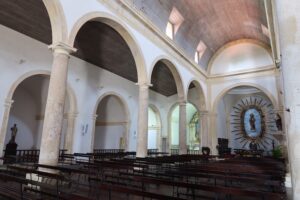
The church of São Salvador do Mundo follows an Italian Mannerist style, with a three-nave structure. The main nave is wider and stands out from the side naves, which are bordered by large arcades. The main nave also has a wooden ceiling with a barrel vault.
8.2 Side chapels and ornamentation
There are four deep chapels on each side of the nave. The church has no narthex or choir, nor tributaries on the side walls. The floor of the church is tiled and the roof of the three naves is reinforced concrete, with the side naves having sloping wooden ceilings.
8.3 Lighting and special details
The main nave receives natural light through openings in the ceiling and an oculus on the main facade, providing a bath of light on the high altar. The transept of the church contains the remains of D. Hélder Câmara, former Archbishop of Olinda and Recife.
8.4 Main chapel and sacristy
The present Chapel is simple, unadorned and has a domed roof. Its highlights are the Crucifix and the wooden Armchair. The Sacristy is large and well decorated, with rosewood furniture and a marble washbasin.
8.5 Main facade and bell towers
The main façade was designed on the basis of iconographic records from the 19th century and shows architectural symmetry and balance. The bell towers are tall, with elements of neogothicism.
History and architecture of Olinda Cathedral

Publicações Relacionadas
Kahal Zur Israel Synagogue — Jewish Museum and Cultural Centre (Recife)
Goiana: A Historical Treasure in Pernambuco
Pernambuco's Rural Tourism Route: A Traveler's Guide
Tracunhaém and Its Rich Clay Handicraft Tradition
Ricardo Brennand Institute — Castle Museum, Armory, and Art Gallery
Museu do Homem do Nordeste: A Cultural Journey
Cabo de Santo Agostinho: A Complete Tourist Guide
Sights in Recife: 5 must-see attractions
History and architecture of the Palácio do Campo das Princesas in Recife
Tamandaré: Explore the Best of Pernambuco
Monastery of São Bento de Olinda: A Historic Landmark
Recife: The Brazilian Venice and its Cultural Heritage
Maria Farinha Beach: Activities and Attractions
Gravatá: Your Guide to the Best Attractions
Porto de Galinhas: Your Guide to Perfect Beaches
Santo Aleixo Island: A tourist paradise in Pernambuco
The Stage of the Passion of Christ in New Jerusalem: A Guide
Olinda: A Journey Through Colonial Architecture
Mata Sul Region of Pernambuco: Waterfalls to Explore
Serra Talhada: A Journey Through Pernambuco's Culture
The best beaches in Pernambuco — a 5-day itinerary
Vale do Catimbau National Park: Your Guide to Ecotourism
Carne de Vaca Beach: A Hidden Gem in Pernambuco
Golden Chapel: A Jewel of Brazilian Baroque
Tourist Attractions in Agreste de Pernambuco
7-Day Itinerary in Pernambuco with Historical Highlights
Main tourist towns in Pernambuco's Zona da Mata
Route of the Sugar Mills and Maracatus in Pernambuco
São José da Coroa Grande: A Coastal Paradise
Pernambuco's best beaches and their attractions
North coast of Pernambuco: beaches, history and attractions
Beaches on the South Coast of Pernambuco: A Complete Guide
History of the Basilica of Our Lady of Mount Carmel in Recife
Giant Puppets and Their Role in Olinda Carnival
Praia dos Carneiros voted one of the most beautiful beaches in the Northeast
Main Tourist Attractions in Recife You Must Visit
This post is also on:
 Português
  English
  Deutsch
  Español
  Français