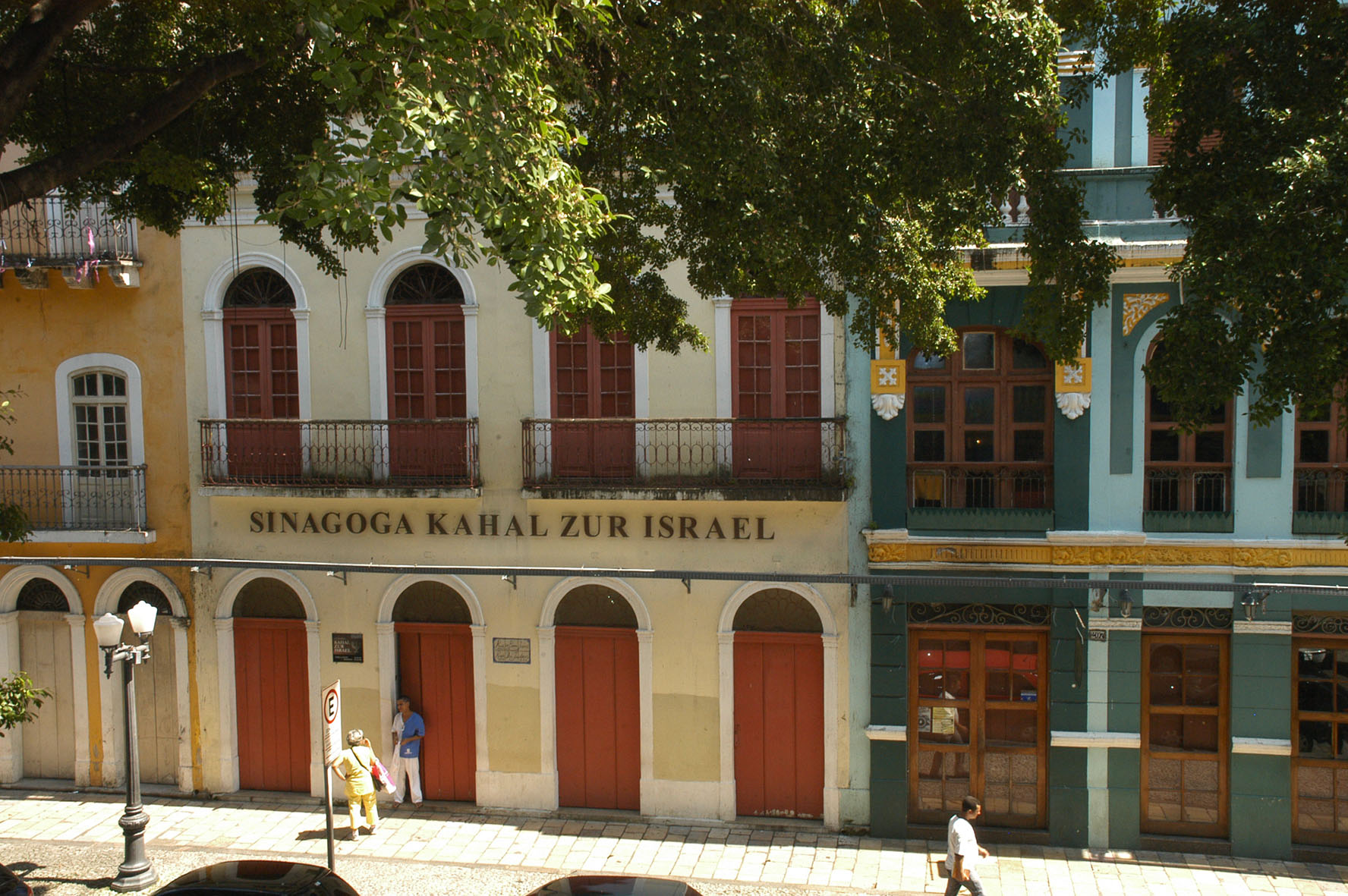
The Kahal Zur Israel Synagogue, also known as the Rock of Israel Congregation, is situated on the historic Rua do Bom Jesus in Recife.
It is recognised as the first formally documented synagogue in the Americas, having operated during the Dutch period of rule in Pernambuco (approximately 1630–1654).
The discovery of archaeological remains between 1999 and 2000 resulted in the establishment of a museum and cultural centre on the site.

A video about the history of the Kahal Zur Israel Synagogue.

1. The history of the Jewish community in Pernambuco.
Early presence and crypto-Judaism
The Jewish community has been present in Pernambuco since colonial times.
In the 17th century, many of them were Sephardic Jews from the Iberian Peninsula. Some of them had converted to Christianity under pressure from the Inquisition and were known as New Christians or crypto-Jews, practising their rites in secret.
The Dutch period and religious freedom.
During the Dutch occupation (approximately 1630–1654), greater religious tolerance was permitted, enabling the public practice of Judaism in Recife.
In this context, community institutions emerged, including the Kahal Zur Israel Synagogue. Its headquarters on Rua do Bom Jesus are commonly dated to between 1638 and 1641.
Rabbi Isaac Aboab de Fonseca’s presence is cited as a milestone in the city’s rabbinical leadership.
Portuguese recovery and dispersion
Following the Portuguese Reconquest, many Jews dispersed to the interior, especially the hinterland, in order to preserve their religious practices. Others left the region.
Once again, the Inquisition posed a threat to those who practised their religion openly.
The second migration (19th–20th century).
A new wave of migration occurred at the end of the 19th century and beginning of the 20th century, this time involving Ashkenazi Jews from Eastern Europe. They settled in Pernambuco, engaging in commercial activities and forming communities in neighbourhoods such as Boa Vista.
2. Religion and practices
membership and conversion
In traditional Jewish communities, affiliation is passed down through the mother. Liberal communities, however, have different rules.
The formal conversion process involves study and evaluation by a Beit Din, or rabbinical court. The requirements and duration vary depending on the community.
rites of passage
- Brit Milah (Circumcision): traditionally performed on the eighth day of a boy’s life.
- Bar/Bat Mitzvah: a religious rite of passage marking the transition to adulthood (aged approximately 13 for boys and 12–13 for girls), with variations according to tradition.


3. Architecture, Excavations and Museography
archaeological discoveries
Excavations carried out in the 1990s and again in 1999–2000 uncovered the foundations of the historic synagogue, as well as artefacts associated with it.
It was these remains that provided the basis for the preservation work and construction of the current museum space.
intervention and exhibition
The site now combines architectural references to the colonial period with a contemporary museum design.
The museum displays archaeological finds and documents that recount the history of the Jewish community in Recife, and it also has a space for religious celebrations on special occasions.


4. Cultural and tourist importance
memory and diversity
The Kahal Zur Israel Synagogue is a landmark of Jewish heritage in Brazil, symbolising Recife’s religious diversity. It attracts visitors interested in colonial and Jewish history, as well as the city’s cultural heritage.
tourism and education
The museum organises educational and cultural activities that promote the local Jewish heritage and encourage inter-religious and intercultural dialogue.
5. Current community
Contemporary estimates suggest that there are around 1,500 Jews living in Pernambuco, mainly in Recife. However, figures vary depending on the source and year. The community runs religious, educational and cultural institutions to preserve traditions and promote social integration.
Read – The Jews who built Brazil – Unpublished sources for a new view of history.

Publicações Relacionadas
Beaches on the South Coast of Pernambuco: A Complete Guide
São José da Coroa Grande: A Coastal Paradise
Porto de Galinhas: Your Guide to Perfect Beaches
Basilica of Our Lady of Penha: A Historical Overview
Porto de Galinhas: beaches, natural pools and travel tips
Goiana: A Historical Treasure in Pernambuco
Sights in Recife: 5 must-see attractions
The history of the Golden Chapel and the Third Order of Recife
Sertão of Pernambuco: A Cultural Diversity Hub
Ricardo Brennand Institute — Castle Museum, Armory, and Art Gallery
Triunfo: The Oasis of the Sertão in Brazil
Pernambuco's best beaches and their attractions
Tamandaré: Explore the Best of Pernambuco
Monastery of São Bento de Olinda: A Historic Landmark
Graça Church and Olinda Seminary Historical Significance
Recife: The Brazilian Venice and its Cultural Heritage
Pernambuco: History and must-see attractions
Carne de Vaca Beach: A Hidden Gem in Pernambuco
Giant Puppets and Their Role in Olinda Carnival
Olinda: A Journey Through Colonial Architecture
Olinda Cathedral: A Historical Landmark in Brazil
Tracunhaém and Its Rich Clay Handicraft Tradition
Interior of Pernambuco: Nature, Wine, and Tradition
Pernambuco's Rural Tourism Route: A Traveler's Guide
The oldest churches in Pernambuco and the first church in Brazil
Museu do Homem do Nordeste: A Cultural Journey
Tourist Attractions in Agreste de Pernambuco
History of the Church of Our Lady of the Rosary of the Black Men
The Stage of the Passion of Christ in New Jerusalem: A Guide
Cabo de Santo Agostinho: A Complete Tourist Guide
Cais do Sertão Museum: Discover Sertanejo Culture
Gravatá: Your Guide to the Best Attractions
Praia dos Carneiros voted one of the most beautiful beaches in the Northeast
Sugar mills on the outskirts of Porto de Galinhas PE
Santo Aleixo Island: A tourist paradise in Pernambuco
Vale do Catimbau National Park: Your Guide to Ecotourism
This post is also on:
 Português
  English
  Deutsch
  Español
  Français