Exploring Brazil’s Islands: Oceanic and Continental Diversity
If you’ve ever wondered which is the largest island in Brazil, the answer is Marajó Island, in Pará, which covers an area of around 40,100 km². But Brazil has an enormous variety of islands, divided into two main groups: oceanic and continental.
The terminological distinction between these two types – oceanic and continental islands – relates to their greater or lesser distance from the mainland.
If the island is close to the mainland coast, it is a continental island; if it is far away, lost in the middle of the oceans, it is called an oceanic island.

1. Oceanic Islands
Brazil’s oceanic islands are
- Fernando de Noronha Archipelago
- The Islands of Trindade and Martim Vaz
- The Rocks of St Peter and St Paul
- Atoll of Rocks
They are situated more than 150 km off the Brazilian coast, in the middle of the Atlantic.
1.1. Fernando de Noronha Archipelago

It is situated 360 km off the coast of Rio Grande do Norte and consists of several volcanic islands. In 1988, it was reincorporated into the state of Pernambuco as a state district, and it is the only Brazilian oceanic archipelago inhabited by a permanent population.
The climate in the archipelago is tropical semi-arid, the vegetation is sparse, and the terrain is mountainous and volcanic.

Tubarões no Arquipelago de Fernando de Noronha
1.2. Trindade and Martim Vaz Islands

Of volcanic origin, these islands are situated 1,200 km from Espírito Santo. They are uninhabited, although the Brazilian Navy has a base on Trindade Island.
1.3. The Rocks of St Peter and St Paul

It consists of a group of small islands of volcanic origin, each no more than 600 metres in length, and no higher than 20 metres above sea level. They are devoid of any vegetation and are used by seabirds as a resting place.
1.4. Rocas Atoll

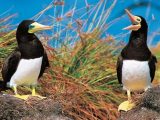
It is situated between Fernando de Noronha and the coast of Rio Grande do Norte. It is surrounded by reefs and coral, and is home to a wide variety of plant and animal species.
Since 1979, the site has been a biological reserve dedicated to conservation, study and research. Access to this area is restricted; it is only open to small groups conducting research, accompanied by Ibama rangers.
2. Continental Islands
Continental islands are those that form as a sort of extension of the mainland; they are also known as residual islands.
They are almost always formed by the erosion of continental areas, which causes parts of the land to be flooded by the sea, isolating certain areas.
In some cases, they are classified as estuarine islands, where there is the sea on one side and a river on the other, as is the case with Marajó Island.
2.1. Island of Santa Catarina (SC)
The island is the largest in an archipelago comprising more than 30 islands, the majority of which belong to the municipality of Florianópolis. In addition to these, the archipelago includes islands belonging to neighbouring municipalities, such as Anhatomirim Island, Cabras Island, Arvoredo Island, Deserta Island and Galés Island, amongst others.
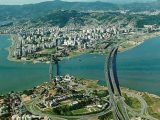
The island of Santa Catarina is linked to the mainland by three bridges: the Hercílio Luz Bridge, the Colombo Salles Bridge and the Pedro Ivo Campos Bridge. These bridges span a channel that is around 500 metres wide and up to 28 metres deep. The strait formed by the channel gives its name to one of the city’s mainland neighbourhoods and marks the boundary between the South and North bays.
2.2. Marajó Island (PA) — Brazil’s largest island
With an area of around 40,100 km², it is Brazil’s largest coastal island and the largest river-ocean island on the planet (bathed simultaneously by both river and ocean waters), bordered by the Amazon River to the west and north-west, by the Atlantic Ocean to the north and north-east, by Marajó Bay to the east and south-east, and by the network of distributary channels of the Tocantins and Pará rivers to the south.
2.3. São Luís Island (MA)
São Luís (often referred to as São Luís do Maranhão) is a Brazilian municipality and the capital of the state of Maranhão.
2.4. Ilhabela (SP)
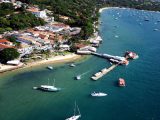
Ilhabela is one of the few Brazilian municipalities comprising a marine archipelago and is situated on the northern coast of the state of São Paulo.
2.5. Ilha do Mel (PR)
Ilha do Mel is a Brazilian island situated at the mouth of Paranaguá Bay, in the state of Paraná.
2.6. Itamaracá Island (PE)
Itamaracá Island is a Brazilian municipality in the state of Pernambuco, within the Recife Metropolitan Area. The municipality covers the entire island of the same name, situated on the northern coast of Pernambuco and separated from the mainland by the Santa Cruz Channel, which, according to some scholars, gave rise to the name ‘Pernambuco’.
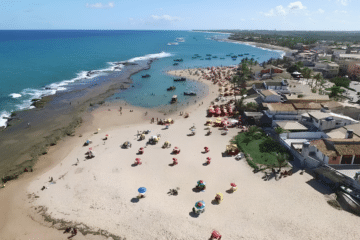
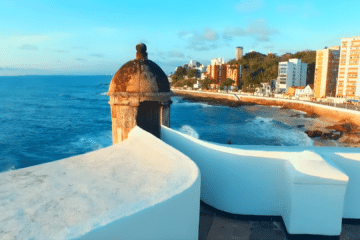
2.7. Itaparica Island (BA) — Brazil’s largest island situated entirely at sea
Itaparica Island is Brazil’s largest exclusively maritime island — unlike Marajó, which is both riverine and maritime. It is situated in the Bay of Todos os Santos, in the state of Bahia, and its 246 square kilometres of land area are divided between the municipalities of Itaparica and Vera Cruz. It is over 36 kilometres long.
Frequently asked questions about Brazil’s islands
Which is the largest island in Brazil?
Marajó Island, in Pará, is Brazil’s largest island, covering an area of around 40,100 km² — comparable in size to countries such as Switzerland. It is classified as a fluvial-maritime island, as it is bordered by rivers (the Amazon, Tocantins and Pará) as well as the Atlantic Ocean.
What is the difference between Marajó Island and Itaparica Island?
Marajó is Brazil’s largest island overall and the largest river-and-sea island on the planet. Itaparica, in Bahia, holds a different title: it is Brazil’s largest exclusively maritime island, that is to say, surrounded only by salt water, with no influence from rivers.
What is the largest river island (freshwater only) in Brazil?
It is Bananal Island, in the state of Tocantins, covering an area of around 20,000 km² — considered the world’s largest genuine river island, surrounded by the Araguaia and Javaés rivers.
What are Brazil’s main oceanic islands?
The four main ones are the Fernando de Noronha Archipelago, the Trindade and Martim Vaz Islands, the São Pedro and São Paulo Rocks, and the Rocas Atoll — all more than 150 km from the Brazilian coast.
Is it possible to visit all of Brazil’s oceanic islands?
No. Fernando de Noronha is the only one with tourist facilities and a permanent population. The others (Trindade and Martim Vaz, Penedos de São Pedro and São Paulo, and Atol das Rocas) have restricted access, intended mainly for scientific research and the Brazilian Navy.
Brazil has oceanic islands and continental islands

Publicações Relacionadas
Alcatrazes Archipelago: Secrets of Evolution Revealed
Jararaca-ilhoa: Endemic Species of Queimada Grande
Trindade and Martim Vaz: Discovering the Archipelago

Anchieta Island: History, Beaches, and Nature
Ponta do Boi Lighthouse: History and Significance
Marajó Archipelago: A Unique Ecological Paradise

Ilha de Itamaracá (PE): beaches, Forte Orange and things to do

São Pedro e São Paulo Archipelago: An Overview
Ilha Grande: The Ultimate Tropical Paradise
Florianópolis: Guide to Beaches, Tours and Nightlife
Ilhabela: A Tropical Paradise Awaiting You
Atol das Rocas - Origin, biology, climate and shipwrecks

History of Itaparica Island: Forts, Churches and Heritage
This post is also on:
 Português
  English
  Deutsch
  Español
  Français