Discover the culture, history and gastronomy of São Luís do Maranhão
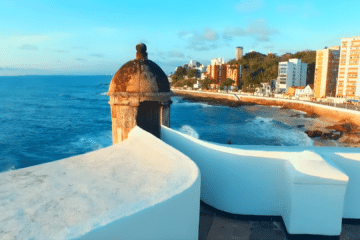
São Luís do Maranhão, often simply called São Luís, is a charming destination in the northeastern region of Brazil.

Cultural heritage and city name
Known for its rich cultural heritage, historic architecture and vibrant traditions, São Luís offers a unique mix of attractions for tourists.
The origin of the name “São Luís do Maranhão” dates back to 1612, when the city was founded by the French.
The name “São Luís” was chosen in honour of the French king, Louis XIII, who was monarch at the time.
The “do Maranhão” part refers to the captaincy, the region where the city was founded. São Luís do Maranhão” thus combines homage to the French king with the geographical location of the city. After the French invasion, the city was administered by the Portuguese, but the name remained throughout history.
Saint Louis was the first name of Saint Louis, a town in the western part of the island of the same name, which already hints at its origins.
In 1612, the year of the French invasion, the noblemen Daniel de La Touche, lord of La Ravardière, and François de Rasilly, lord of Rasilly and Aunelles, landed here and named the place in honour of King Louis XIII.
French rule over St Louis was short-lived: by 1615 it was back in Portuguese hands.
Portuguese influence and development
From then on, the capital of Maranhão became increasingly Lusitanian – an influence visible in many aspects, from the original layout designed by the engineer Francisco Frias de Mesquita (1578-1645) to the tiled facades of the buildings in the historic centre.
Cut through by rivers and surrounded by the sea, São Luís has undergone a long and successful regeneration plan, the government’s Reviver project.
The inauguration of the José Sarney Bridge in 1970 helped to revitalise the city by integrating the new part of the city into the centre, where there are modern buildings and luxury hotels.
To walk around São Luís is to move between these two sides, between the past and the present.

City division: São Luís do Maranhão has 2 main parts
- Modern part
- Historic Part (Historic Centre)
These two areas reflect different periods and styles of urban development, offering visitors a varied experience.

The modern part of São Luís do Maranhão
Spanning the Anil River, the José Sarney Bridge marks the beginning of the expansion of “New São Luís”.
Without the attractions of the Historic Centre, this part of the city stands out for its high concentration of skyscrapers, luxury hotels, good restaurants and busy shopping centres.
After the José Sarney, three more bridges were built that now link the oldest part of the capital to the modern districts – Ponta d’Areia, São Francisco and Renascença – including the São Luís district, where the elite live.
The urban beaches don’t attract much attention: the water is dark.
The modern part of São Luís reflects the urban growth and recent expansion of the city.

Characteristics of the Modern Part
- Contemporary Infrastructure: The modern part has wide avenues, shopping centres, luxury hotels and planned residential areas.
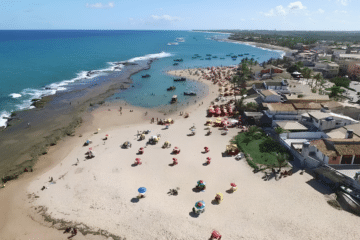
- Urban Beaches: Some of the most popular beaches, such as Praia de São Marcos, Praia do Calhau and Praia da Ponta d’Areia, are located in this part of the city. These beaches are well known for their tourist facilities, restaurants and lively nightlife.
- Modern Neighbourhoods: Neighbourhoods such as Renascença, Cohama and Turu are examples of newer and more developed areas with entertainment, shopping centres and a variety of services.
- Shopping and Entertainment Centres: The modern part is the centre of the city’s shopping and leisure activities, with many shopping centres, cinemas, restaurants and bars.

Historic Centre of São Luís do Maranhão
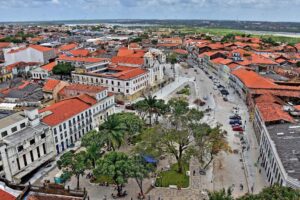
Recognised as one of the greatest collections of Portuguese, urban and architectural tradition in Brazil, the Historic Centre of São Luís is more than an open-air museum: it’s a living heritage where people live, work and move.
Most of the museums, restaurants, bars and shops in the old part of the capital are located near the Praia Grande Market and the Maritime Terminal, between the old streets of Trapiche, Giz, Estrela and Portugal.
The best time to visit is in the afternoon, when the main attractions are open – although the tiled facades of the colonial buildings alone are worth the trip.
The historic part of São Luís, also known as the Historic Centre, is a UNESCO World Heritage Site due to its rich cultural and architectural heritage.

Characteristics of the Historic Centre
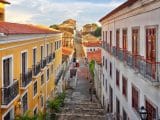
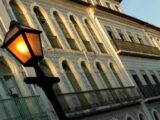
- Colonial architecture: The colonial buildings, many of which are decorated with Portuguese tiles, are a trademark of the area. The narrow cobbled streets and colourful buildings take visitors back to the colonial era.
- Monuments and Museums: Many of the city’s museums and historical sites are located here, such as the Palácio dos Leões, the Museu Histórico e Artístico do Maranhão and the Casa de Nhozinho.
- Squares and churches: The squares, such as Praça Benedito Leite and Praça Nauro Machado, are places for social and cultural gatherings. The historic churches, such as Igreja da Sé and Igreja do Desterro, are also important places.
- Culture and festivities: The Historic Centre is the heart of cultural festivities, including Bumba Meu Boi, Tambor de Crioula and the June Festivals, which are celebrated with music, dance and folk traditions.
Maranhão’s gastronomy
The gastronomy of São Luís is rich and varied, reflecting the mix of cultural influences. Typical dishes include
- Carne de Sol: usually accompanied by rice and beans, this is a traditional dish that highlights the north-eastern cuisine.
- Torta de Camarão: A local delicacy that combines the flavours of the sea with typical local ingredients.
- Arroz de Cuxá: Made with cuxá leaves (vinegar), this is a typical dish of Maranhão cuisine.
Linking the Modern and the Historic (Historic Centre)
- Transport: The city has a public transport network that makes it easy to travel between the historic and modern parts, including buses and taxis.
- Events and festivals: Many cultural events and festivities begin or have components in both the historic and modern parts of the city, promoting integration between the two.
This division between the historic and modern parts gives visitors the opportunity to experience the past and present of São Luís, making it a city of contrasts and diverse experiences.
Tourist Attractions in the Historic Centre of São Luís

São Luís do Maranhão - Centro Histórico04:49

São Luís do Maranhão - Drone02:45

São Luís do Maranhão - Guia de Turismo14:57
São Luís do Maranhão - Drone02:39:33
On this tour, the architecture stands out. The façades of the houses even inspired architects in Lisbon in the 18th century.
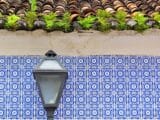
Contrary to popular belief, it was the Portuguese living in Brazil who first decorated the facades of their houses with tiles before the trend spread to Portugal.

The technique of covering facades with ceramic tiles not only had an aesthetic function; it also helped to minimise internal heat by reflecting sunlight. There are about 150 different models of Portuguese tiles, most of them in blue and white.
Among the common features of the mansions are the ceramics and the iron balconies. The large windows and doors underlined the economic prosperity brought by the cotton industry in the 18th century.
Merchants generally used the first floor to set up their businesses while living with their families on the upper floor.
Over time, decay and deterioration set in, but hopes of recovery began to take shape with the restoration process that began in the late 1970s. However, the path to restoration of all the buildings is still uncertain.
The tour usually starts at Praça Dom Pedro II, descends the Catarina Mina Stairs and arrives at Rua Portugal, in Praia Grande.

Continue on to the Largo do Comércio, where you’ll be tempted by the Bars and the Casa das Tulhas, an ideal place to taste and buy typical products.
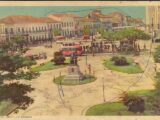
If you prefer to continue on your own, when you reach Rua da Paz, walk towards Praça João Lisboa and from there to Rua do Sol, where you’ll find the Arthur de Azevedo Theatre, which offers guided tours and shows.
Straight ahead is the Rua do Ribeirão, which leads to the Ribeirão Fountain and its fascinating legends.
The Ribeirão Fountain, dating from 1796 and decorated with Christian and Pagan symbols, was used to supply the city and still inspires popular myths and beliefs.

One of these legends tells of a sleeping serpent that grows incessantly in the underground tunnels of São Luís. One day, when its size reaches its limit and its head meets its butt, it will wake up in a rage, spewing fire and threatening to sink the city.
Obviously these stories were encouraged by the city’s powerful to keep the curious away from the underground tunnels that were used as secret passages. These tunnels are said to connect the main churches in São Luís.

1 São Luís Building
The large, three-storey corner mansion is considered to be the largest colonial brick building in the country. Built in the 19th century, its interior was completely destroyed by fire in 1969.
In 1976, the Caixa Econômica Federal restored the building and opened a branch there. R. de Nazaré, corner of Rua do Egito.
2. Rua Portugal
The two blocks of tiled colonial buildings, bars and cafés make up the bohemian centre of São Luís.

Rua Portugal, in São Luís, is the urban portrait of the 19th century, with townhouses with facades decorated with Portuguese tiles.
Things get even busier on Thursdays, when the street hosts the Dia de Festa, a night of music of all styles. When they perform in town, the MPB stars often stop by.
3. House of Maranhão
Located in the former headquarters of Alfândega, a building dating from 1873, the Casa do Maranhão displays objects related to the various manifestations of bumba-meu-boi.
On the ground floor, a shop sells souvenirs, while a big screen shows recordings of past festivals and televisions show landscapes of the state.

On the top floor, there is a room dedicated to each rhythm – or accent, as the Maranhenses say – that the bumba-meu-boi takes on: instruments, costumes, and so on.
There is also a room where the legend that gave rise to the tradition is explained, one for rehearsals and another where people are taught how to make the costumes used in the festivities. The whole visit takes about an hour. R. do Trapiche, s/n, Praia Grande.
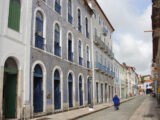
4. Nhozinho’s House
In this three-storey house, with eaves covered in French tiles, visitors can learn about the way of life of both the inland and coastal Maranhão people.

On the first floor, there is a room with objects used in agriculture, especially cotton – wooden pestles, seed grinders and looms – and products made from them, such as quilts and carpets; another room contains objects related to the coast, such as fishing traps and a canoe carved from a single tree trunk.
On the second floor is the room dedicated to the craftsman who gave the town its name, Antonio Bruno Pinto Nogueira (1904-74), or Nhozinho, born in Curupu, who made a name for himself making toys.
On the top floor, the Indigenous Room displays material from eight ethnic groups that still live in the interior of Maranhão.
Outside, there are life-size replicas of dwellings common in the state, such as carnauba and rammed earth houses. Guided tours. R. Portugal, 185, Praia Grande.
Learn about the history of the Casa de Nhozinho in São Luís do Maranhão.
5. DOMINGOS VIEIRA FILHO POPULAR CULTURE CENTRE
Known as the Casa da Festa, the room dedicated to the Maranhão folklorist brings together material related to popular, rites and folklore.
On the first floor, where pieces representing the religious practices of the state are exhibited, the highlight is the wing dedicated to the Casa das Minas – a terreiro founded in the 19th century for the practice of the tambor-de-mina, a cult of African origin similar to the Bahian candomblé.

On the second floor you’ll find records of the Festa do Divino – with a focus on Alcântara – and a room dedicated to another popular Afro-Brazilian festival, the tambor-de-crioula.
The third floor is devoted to Christmas. Guided tours with bilingual guides. R. do Giz, 205, Praia Grande.
6. Mercês Monastery
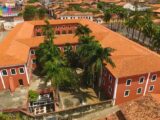
It was Father Antônio Vieira who inaugurated this building in 1654 to house the Order of the Mercedarians, of Spanish origin.

Today it houses the Republican Memory Foundation, which includes the José Sarney Memorial – with documents and objects belonging to the former president – the Model Centre for the Study of Republican History, the Latin American Friendship Institute and the Friendship Institute for Portuguese Speaking Peoples. R. da Palma, 506, Centre.
7. Cathedral of Sé
The Church of Nossa Senhora da Vitória was built by the Jesuits, probably with local labour, and consecrated in 1699. A series of renovations altered the original design: the current façade dates from 1922; the chancel ceiling was painted by João de Deus in the 1950s.

The main altarpiece, however, is a magnificent example of Baroque and well worth a visit: the elaborate gilded woodwork, dating from the end of the 18th century, is considered by experts to be the best in the city.
Listed by Iphan in 1954, the altarpiece was restored in the 1990s. Av. D. Pedro II, s/n, Historic Centre.
8. OTHER CHURCHES
Present in Maranhão since the foundation of São Luís, the Jesuits and other religious orders have built churches of great beauty in the city.
The Church of Nossa Senhora do Carmo (pç. João Lisboa, 350, Centro) was begun in 1627. It was plundered by the Dutch in 1641 and passed into the hands of the Capuchins in 1894.
Its extraordinary façade and main door have been preserved and remain true to the original design.

It is believed that the Igreja do Desterro stands exactly on the site of the city’s first church, which was destroyed during the Dutch invasion.
It was built in 1893 after local people raised money. It was closed for renovation in October 2007 (p. do Desterro, s/n, Praia Grande).
10. and 11. FONTS
Built in 1796, the Ribeirão Fountain (Fonte do Ribeirão, s/n, Historic Centre) has five spouts of water coming out of the mouths of frowns and sculptures representing fish and gods; in front of it is a courtyard lined with stonework.

The water of the Ribeirão Fountain comes from a spring that used to supply many houses in the centre and the ships that docked in São Luís.
Its underground tunnels cut through the historic centre of São Luís.
Legend has it that a giant serpent sleeps beneath one of them and will swallow the city the day it awakens.
Even older – it was inaugurated in 1640, using the springs that supplied the Portuguese troops during the fight against the French – the poorly preserved Pedras Fountain (Rua de São João, s/n, Historic Centre), surrounded by a walled square, has imposing stone fountains from which water gushes.
12. The Arthur de Azevedo Theatre
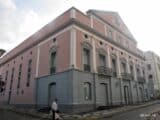
The idea of creating the Arthur de Azevedo Theatre was born in 1815 on the initiative of two Portuguese merchants, Eleutério Lopes da Silva Varela and Estevão Gonçalves Braga.
This was the golden age of the cotton cycle, when Maranhão was rich from the export of this product and the city needed more cultural life.

Construction began in 1816 and it was inaugurated on 1 July 1817, after a year of work.
It was originally called the União Theatre, in honour of the creation of the United Kingdom of Portugal, Brazil and the Algarve (1815), the result of the arrival of the Portuguese royal family in Brazil.
This was the fourth theatre in the history of São Luís, but it stood out for its comfort and size, with a capacity of 800 spectators. Its neoclassical style was also a novelty for the time.
In 1852 it was renamed the São Luiz Theatre, and in the 1920s it was renamed after the great Maranhão playwright Artur de Azevedo (1855-1908).
In the 20th century, the theatre became a cinema, but it has now been restored and is fully operational.
13. Palace of the Lions
The Palácio dos Leões marks the rise of the Portuguese colony in Maranhão.
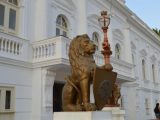
The Palácio dos Leões, the seat of Maranhão’s government, is one of the most impressive monuments in the country. A symbol of the living history of the people of Maranhão, the palace attracts tourists from all over the world, who marvel at the grandeur of the building, located in the Historic Centre of the capital, São Luís.

The Palácio dos Leões has a built area of 3,000 square metres, divided into three wings: residential, administrative and visitor.
With its neoclassical architecture, the monument houses a collection of 1,300 objects, accessible to the public in five magnificent halls with permanent exhibitions.
They include works from the 15th to the 20th centuries, furniture, paintings, porcelain and sculptures that reflect the power and wealth of the 17th century when it was built.
The Palácio dos Leões dates from 1612 and was built by the French, who occupied the city and built Fort São Luís at the confluence of the Bacanga and Anil rivers.
It was named in honour of the King of France, Louis IX. A few years later, the French were expelled and the Portuguese took over, influencing the customs and culture of the people of Maranhão.
The legacy of the Portuguese colonisers can be found throughout the Historic Centre São Luís.
The expansion of the city has not affected the 17th century urban fabric and its original architectural ensemble. The capital was declared a World Heritage Site in 1974 by the National Institute of Historical and Artistic Heritage (IPHAN) and in 1997 by the United Nations Educational, Scientific and Cultural Organisation (UNESCO).

This monument is one of the largest public buildings in the country and has undergone dozens of renovations and a major restoration. Today it is an example of conservation and preservation. Av. D. Pedro II, s/n, Historic Centre.
14. The Palais de La Ravardière
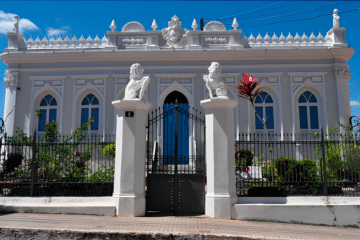
The Palais de La Ravardière is the seat of the City Hall of São Luís do Maranhão, Brazil. Dating from the 17th century, it is an important landmark in the city’s historic centre, which has been declared a World Heritage Site by UNESCO.

Around 1689, the City Hall and Prison of São Luís was built on the site, but the current palace is the result of several later renovations. The building has a symmetrical façade with a small stucco pediment in the centre.
The windows on the first floor have curved lintels, while those on the second floor have straight lintels with stucco decoration and balconies. Inside, an elegant staircase leads to the second floor.
The palace was named in honour of Daniel de la Touche, Lord of La Ravardière, who was considered the founder of the city in 1612. In front of the building is a bronze bust of the French captain, sculpted by Antão Bibiano Silva.
It is located on Avenida D. Pedro II, next to the Palácio dos Leões, the seat of the State Government.
15. Cultural centres
European films, theatre classes and art workshops. These are some of the attractions at the Odylo Costa Filho Creativity Centre, a cultural space frequented by the people of São Luís.

It also houses the Ferreira Gullar Reading Room (Rampa do Colégio, 200, Praia Grande).
The Casa de Cultura Josué Montello is intended for the general public and researchers, especially in the fields of literature, history and the performing arts (327 r. das Hortas, Centro).
16. Historical and Artistic Museum of Maranhão
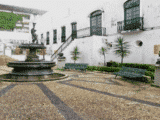
Dating from 1836, the Gomes de Sousa Manor House was transformed into the Historical and Artistic Museum of Maranhão in 1973.

Furniture, porcelain and crystal reconstruct the characteristic living environments of the state in the 19th century. R. do Sol, 302, Centre.
17. Museum of Sacred Art
The Museum of Sacred Art, housed in a colonial mansion on Rua de São João, has a valuable collection of images and ornaments that tell the story of the Church of Maranhão.

The collection, part of which belongs to the Archdiocese of São Luís, is made up of pieces from the 18th and 19th centuries in mannerist, rococo and neoclassical styles. It includes everything from sculptures to objects used in religious celebrations, such as chalices and crucifixes.
18. Solar dos Vasconcelos Historic Centre
The mansion houses an exhibition of photographs and objects showing the changes the Historic Centre has undergone. There is also a collection of models and miniatures of typical boats used by the people of Maranhão.
A permanent exhibition of models displays some of the boats used by the people of Maranhão. R. da Estrela, 562, Praia Grande.
19. Museum of Fine Arts
A visit to the Museum of Fine Arts is worth a lesson in European tiles, which have a strong presence in the capital of Maranhão.

Most of the tiles on the first floor, dating from the 18th and 19th centuries, are blue and white and come from Portugal.
There are also tiles from France, Germany and England. On the second and third floors are works by artists from Maranhão and beyond, such as Cícero Dias, Tarsila do Amaral and Alfredo Volpi.
From the third floor there are beautiful views over the Historic Centre, São Marcos Bay and the Praia Grande Market. R. Portugal, 273, Praia Grande.
20. Cafua das Mercês
The site of the city’s former slave market has been transformed into the Museu do Negro (Black Museum), dedicated to the preservation of Afro-Brazilian memory and culture.

Its collection includes images, musical instruments, clothes and objects used in festive or religious rituals. In the courtyard of the sobrado there is a replica of a pillory. R. Jacinto Ihaia, s/n, Desterro.
21 and 22. Praia Grande Market and Handicraft Centre
Throughout the old part of the city, tourists will find shops selling typical Maranhão products, especially drinks, sweets and handicrafts.
One such place is the Praia Grande Market (Rua da Estrela, s/n, Historic Centre), built in 1820 and housed in the Casa das Tulhas complex.
Here you’ll find tiquira – manioc cachaça – and all sorts of grains and spices that give it an unmistakable aroma; old men meet here to play cards and dominoes. On Friday nights, the market is packed.
Another place to visit is the Ceprama Handicrafts Centre, which sells painted tiles, lace, wood and fibre pieces from all over the state (Rua São Pantaleão, 1232, Madre de Deus).
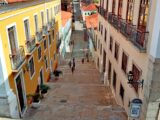
25. Rua do Giz in São Luís do Maranhão – history and architecture.
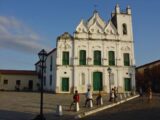
26. Church of São José do Desterro in São Luís do Maranhão – History.
27. Cine Eden in São Luís do Maranhão.
Maranhão Culture
1. Religiosity
The Religiosity of the Maranhão is characterised by syncretism, mixing Catholic beliefs with Afro-Brazilian and indigenous practices. Religious festivals, such as the Festival of the Holy Spirit, are important cultural and social events.
These elements make up a diverse and rich panorama of Maranhão culture, which is unique and has its own identity within the Brazilian cultural scene.
2. Afro-Brazilian cults
After Bahia, Maranhão is the Brazilian state in which religions of African origin are most strongly represented.
One of its strongest manifestations is the tambor-de-mina, similar in many ways to the candomblé of Bahia and the xangô of Pernambuco, but based on a specific mythology.
The rites and music vary from terreiro to terreiro, but are always marked by the trance of the participants, who seem to be incorporated by supernatural beings.
The orishas, associated with nature, take on the features of characters known to the people of Maranhão, such as King Sebastião, who lives on the Lençóis island and is said to have built a castle on the sea bed for his beloved, Princess Ina.
The largest and most traditional terreiro is <
The largest and most traditional terreiro is Casa das Minas (Rua de São Pantaleão, 857, Centro), built in the 19th century. There is also the Casa Fanti-Ashanti (Rua Militar, 1158, Cruzeiro do Anil).
3. Bumba-Meu-Boi
Maranhão is the state that celebrates bumba-meu-boi the most.
The tradition, which is linked to the June festivities and whose origins go back to the games played by slaves working in the cattle industry, mixes African, Portuguese and indigenous influences, combining theatre, music and dance in the same rite.
It all begins with the story of Catirina, a farm slave who, when pregnant, wants to eat the tongue of an ox – but not just any ox, but her master’s favourite.
To this end, Catirina summons her husband – Father Francisco or Nego Chico or Preto Velho – to kill the animal and bring her the delicacy.
The man obeys; discovered by his boss, he is ordered to resurrect the ox if he doesn’t want to die. A shaman helps him: “Get up, ox; dance, ox,” he shouts. The animal finally gets up and dances away.
Preparations for the festival begin in January, but the rehearsals take place in May.
On 23 June, the eve of St. John’s Day, the ox is baptised by a priest – outside the church. The presentation of its hide to the community – decorated with velvet, satin, pearls and sequins – is the starting point for the dances.
There are different “accents”, or rhythms, such as matraca (with an indigenous influence), zabumba (with African features) and orchestra (with a European influence).
Other important folkloric events in the state are the Divino Espírito Santo Festival, the tambor-de-crioula, the coconut dance, the lump dance and the São Gonçalo dance.
4. Reggae and radiolas
In the mid-1970s, Jamaican reggae arrived in the capital of Maranhão and stayed.
As well as being a constant presence on radio and television, the rhythm permeates everyday life in the city, especially thanks to the radiolas – a kind of travelling DJ studio whose huge equipment spreads the sound of Bob Marley, Peter Tosh and other classics of the genre.
In 2005, more than fifty radiolas enlivened São Luís with the “stones”, the good reggae songs of the 1970s.
To stock their repertoire, the radiola owners commissioned recordings from Brazilian singers known as Dub Brown, Henry Murvin and Ronnie Green.
Maranhão exports Célia Sampaio and the band Tribo de Jah to the international scene.
Radiolas sell CDs, but if you want to dance to the rhythm outside your home – either alone, like your Jamaican idols, or in the forró style favoured by the people of Maranhão – there are plenty of options: the Roots Bar brings together the most authentic “regueiros” and the most skilled dancers (Rua da Palma, 85, Centro).
Nelson’s Bar is frequented by the city’s middle and upper classes (Av. Litorânea, s/n, Calhau beach).
Bar do Porto is popular with tourists (Rua do Trapiche, Centro Histórico).
Bar do Léo, which plays Brazilian music as well as reggae, often features Maranhão artists Zeca Baleiro and Rita Ribeiro (Mercado de Vinhaes, s/n, Centre).
Tourist guide to São Luís do Maranhão in the Northeast.

Publicações Relacionadas
7-day itinerary through Maranhão
Tiles from São Luís do Maranhão: History, Art and Heritage

Best Time to Visit Lençóis Maranhenses for Water Fun
Historical and Artistic Museum of Maranhão Overview

Fonte do Ribeirão (São Luís): history, galleries and legends
Arthur Azevedo Theatre and its Rich History
History of João Lisboa Square in São Luís do Maranhão

Maranhão Natural History and Archaeology Research Centre
Casa de Nhozinho: A Journey Through Maranhão Culture
Rua do Giz in São Luís do Maranhão - History and Architecture
História da Igreja de São José do Desterro em São Luís do Maranhão
João do Vale Theatre and Its Rich History
Convento das Mercês: Historical Significance Unveiled
Cine Éden: A Historic Cinema in São Luís

Barreirinhas: the gateway to Lençóis Maranhenses

Santo Amaro do Maranhão: The Paradise of the Lagoons

Exploring Caburé: The Enchanting Peninsula of Maranhão

Atins: A Hidden Gem on the Maranhão Coast
Historical curiosities about São Luís do Maranhão
History and Colonial Architecture of São Luís do Maranhão

Access to the Lençóis Maranhenses National Park
Maranhão Beaches: the 10 Most Beautiful on the Coast

Pedra Caída Complex: Your Guide to Adventure

Chapada das Mesas National Park Adventure Guide

Cafua das Mercês: Preserving Black Memory Today

Convent and the Church of Nossa Senhora do Carmo History

Benedito Leite Public Library's Rich History

Cristo Rei Palace: Architecture of the 19th Century

Josué Montello House of Culture in Maranhão History

Church of Nossa Senhora dos Remédios History

Gonçalves Dias Square: A Historic Landmark

Church of Our Lady of Victory: Historical Significance
Catarina Mina: The Story Behind the Alley

Casa Real Empório: History and Culture Combined

La Ravardière Palace: A Historic Monument in the City
Palácio dos Leões: A Historical Landmark Tour
This post is also on:
 Português
  English
  Deutsch
  Español
  Français