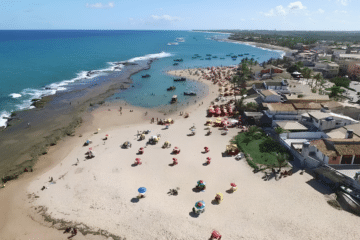
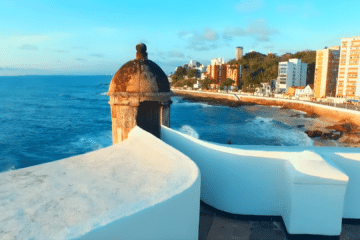
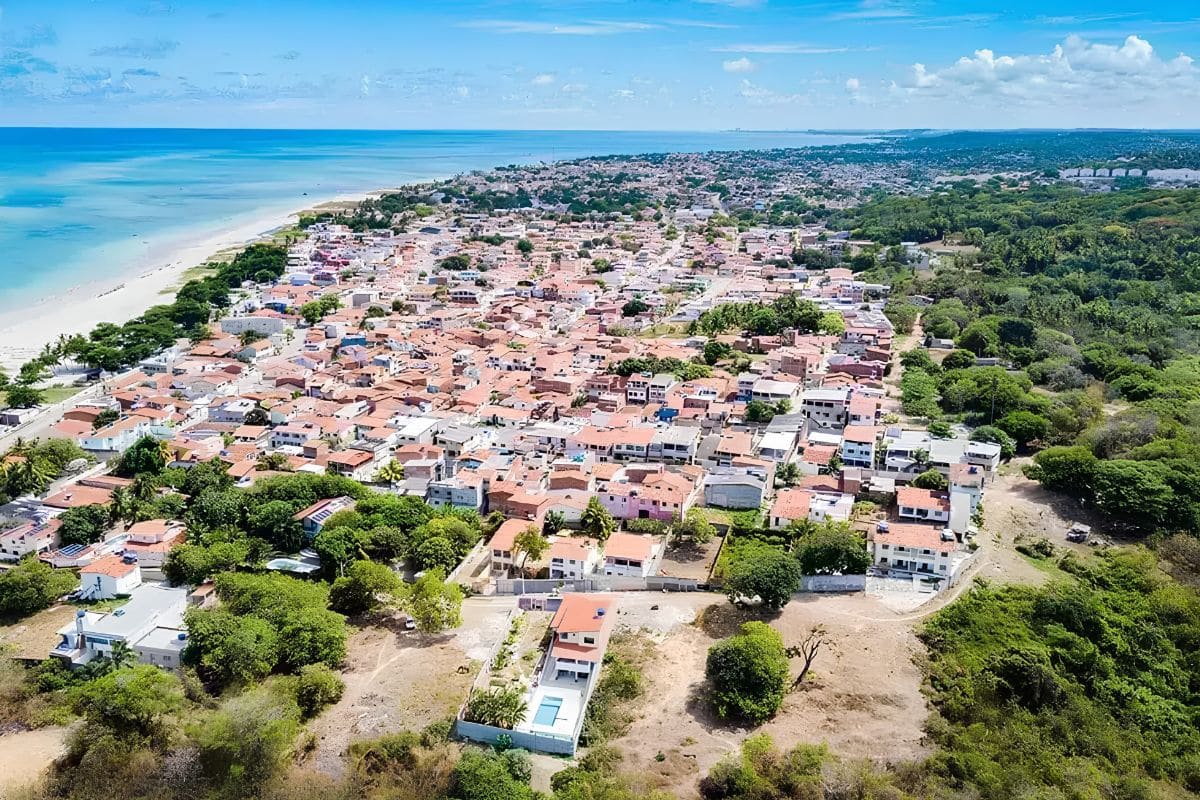
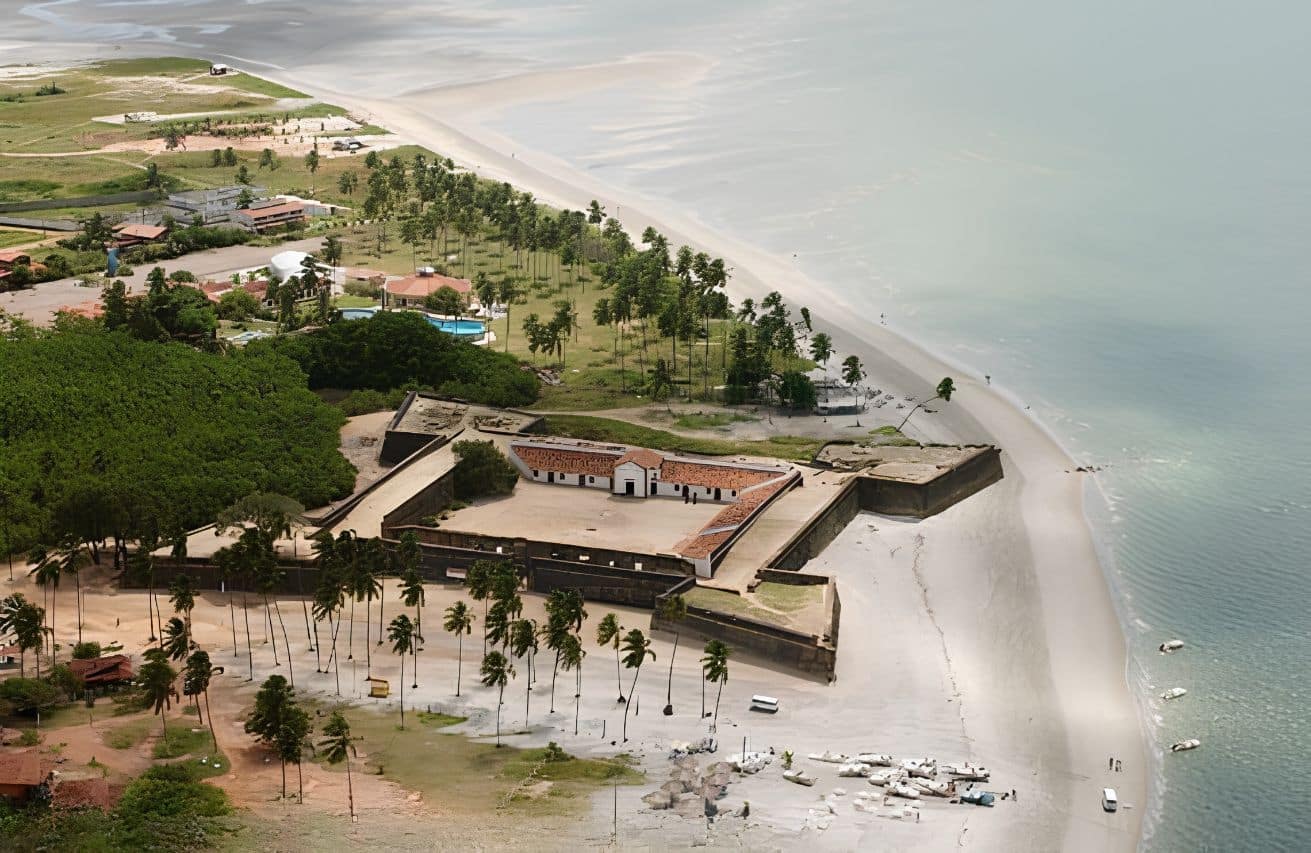
Ilha de Itamaracá lies on the north coast of Pernambuco, about 45 km from Recife. It has calm-water beaches, natural pools, coconut groves and sandbanks, such as the famous Coroa do Avião. In addition, it is home to Forte Orange, built by the Dutch in 1631, and to Vila Velha, one of the oldest settlements in Brazil.
- Location: north coast of Pernambuco, linked to the mainland by a bridge.
- Distance: about 45 km from Recife and 55 km from the airport.
- Population: 24,540 inhabitants (IBGE 2022 Census), across about 66 km².
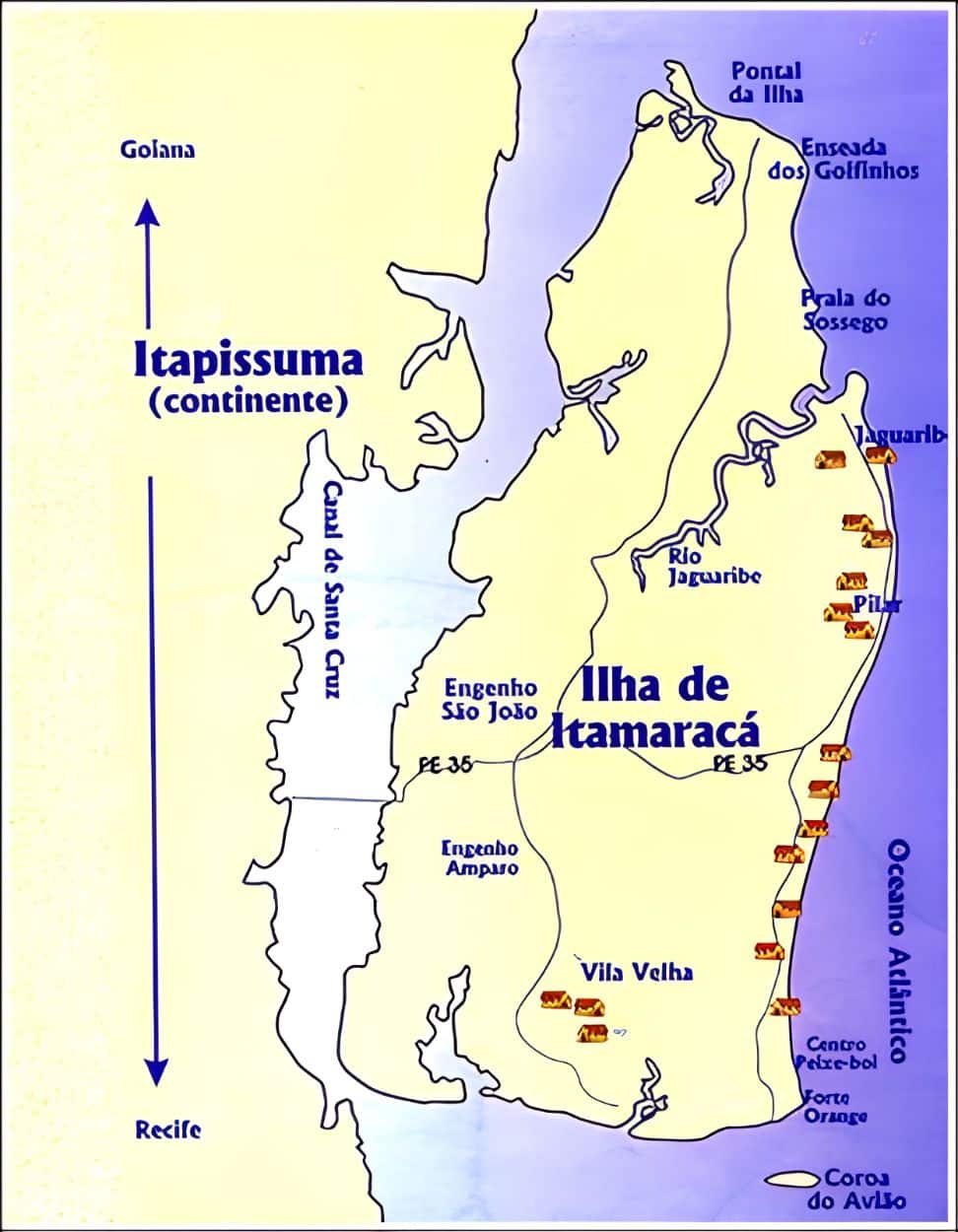
- Beaches: Forte Orange, Pilar, Jaguaribe, Sossego, Enseada dos Golfinhos and Pontal.
- Highlights: Forte Orange, Coroa do Avião, Vila Velha and Projeto Peixe-Boi.
- Best time to go: from September to March, during the dry season.
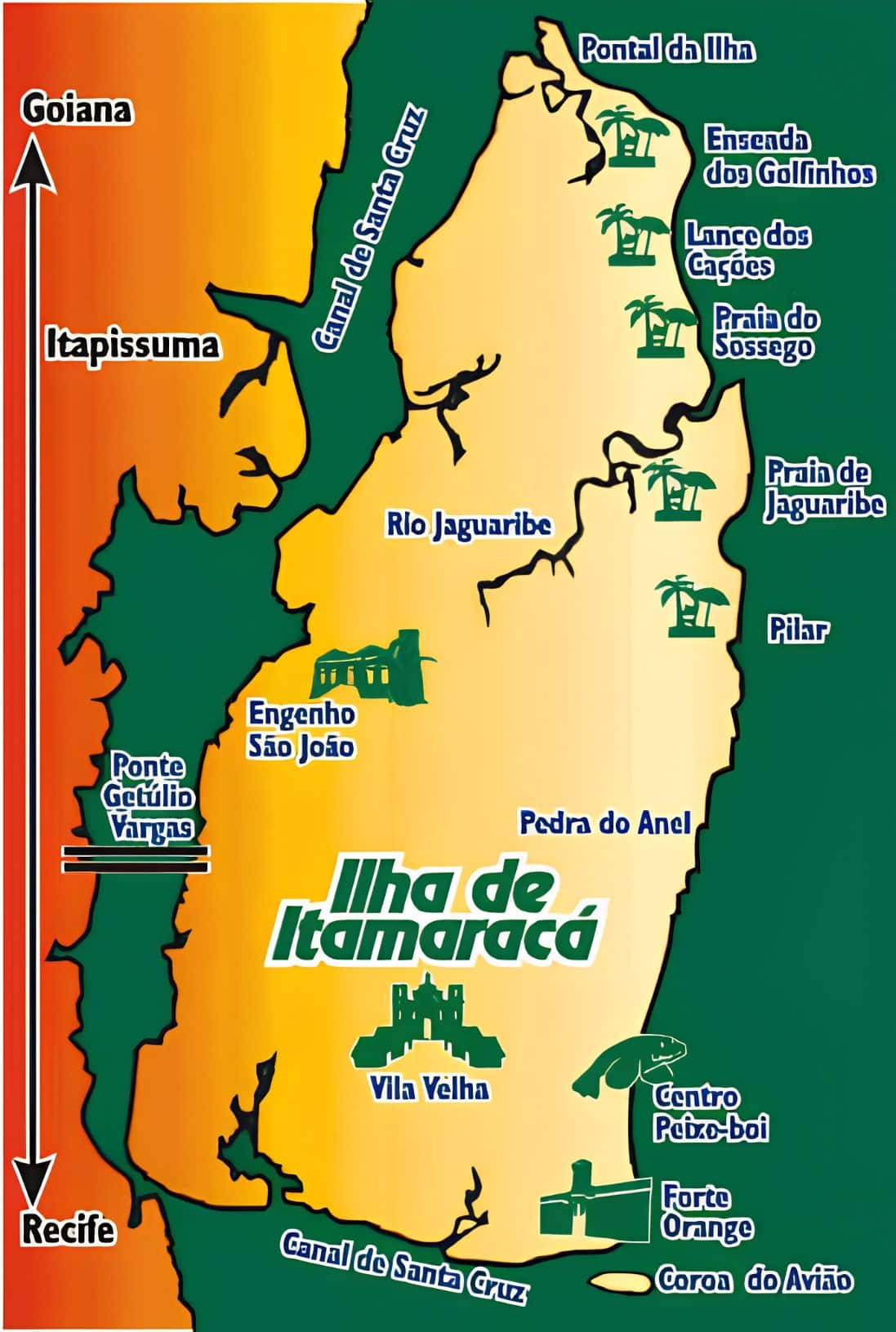
Where it is and map of Ilha de Itamaracá
In short, the island lies on the north coast of Pernambuco, separated from the mainland by the canal de Santa Cruz. Accordingly, access is via the Ponte Presidente Getúlio Vargas, starting from Itapissuma. As a result, you can get there by car in about an hour from Recife.
The municipality has coastal restinga, mangroves and patches of forest, as well as the rios Paripe e Jaguaribe and the lagoa Pai Tomé. For this reason, it is also a good destination for ecotourism.
Video about Ilha de Itamaracá
Ilha de Itamaracá Guia Turismo04:00

Ilha de Itamaracá Guia Viagem03:05

Ilha de Itamaracá - Drone

Cheguei na Ilha de Itamaracá e ME SURPREENDI08:28:06
Beaches of Ilha de Itamaracá
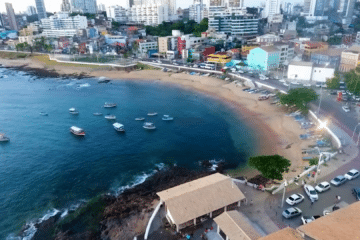
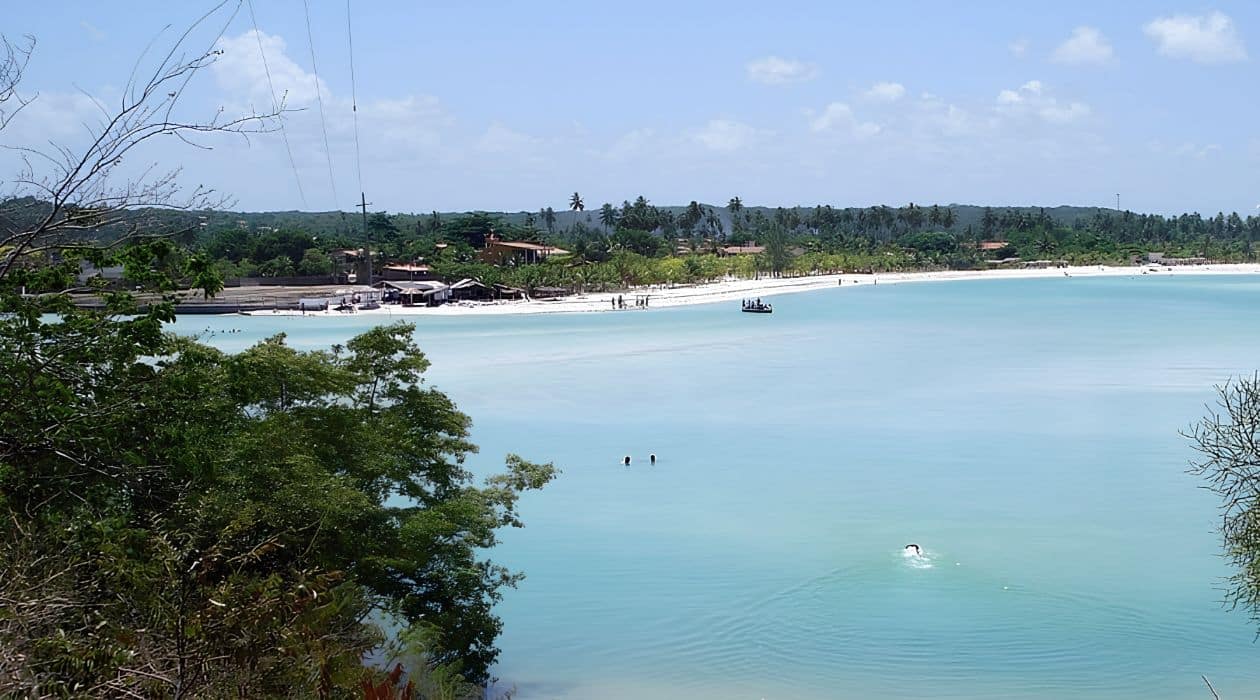
The island’s beaches generally have calm sea, sheltered by reefs. Moreover, at low tide natural pools and sandbanks form.
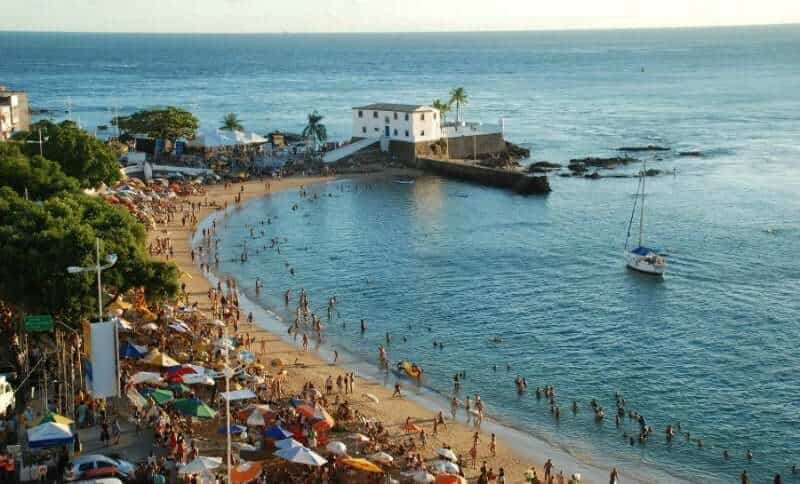
- Praia do Forte Orange: one of the most famous, with calm waters, light sand and plenty of beach stalls and restaurants; therefore, it is ideal for families.
- Praia do Pilar: it lies in the municipal seat, close to the small town center.
- Praia de Jaguaribe: known for its low-tide natural pools, so it is good for swimming and snorkeling.
- Praia do Sossego: quieter and more secluded, perfect for relaxing.
- Enseada dos Golfinhos and Pontal: at the far end of the island, with fewer crowds.

Attractions on Ilha de Itamaracá
Forte Orange
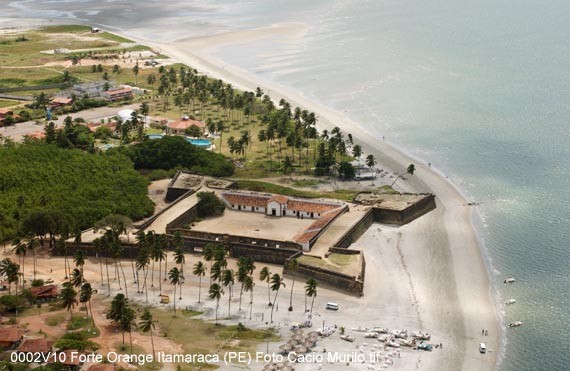
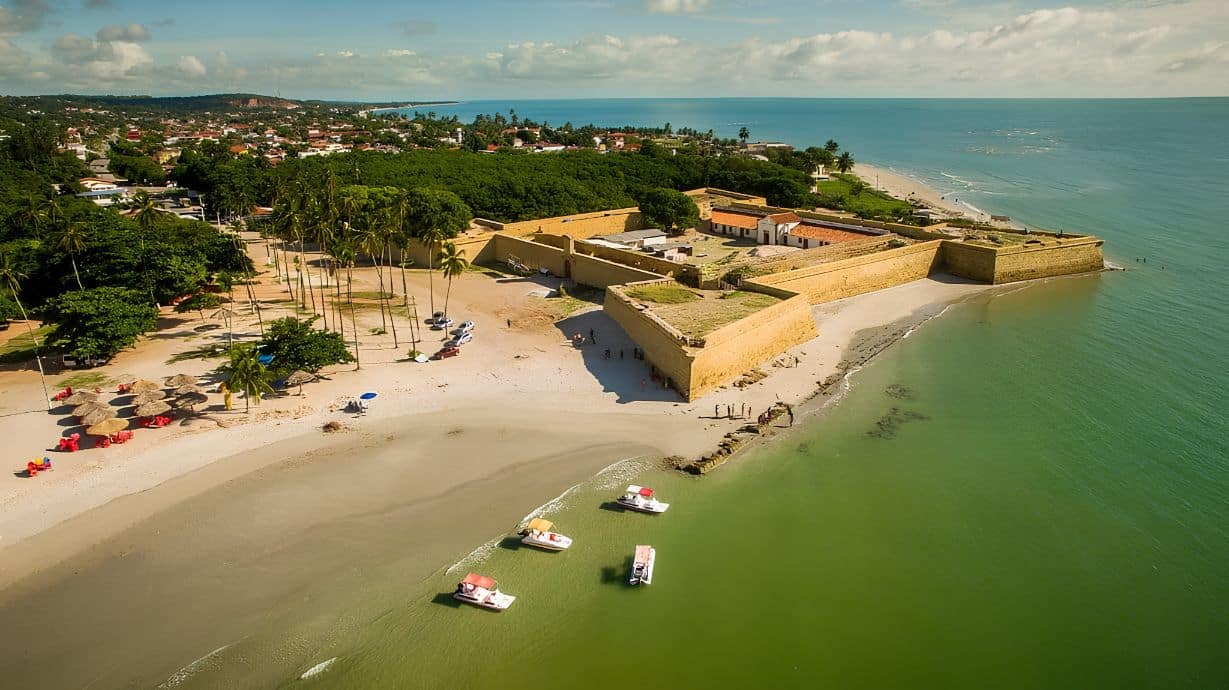
Forte Orange is the island’s main historical attraction. First, the Dutch built it in 1631 at the southern entrance of the canal de Santa Cruz, with earthen walls. Incidentally, the name honors Prince Frederick Henry of Orange. After the Dutch were expelled, the Portuguese rebuilt it in stone and renamed it Fortaleza de Santa Cruz.

Today, you can also visit the interior and climb up to the cannon area, which offers a lovely view of the sea and Coroa do Avião. However, opening hours change; so check before you go.
Coroa do Avião
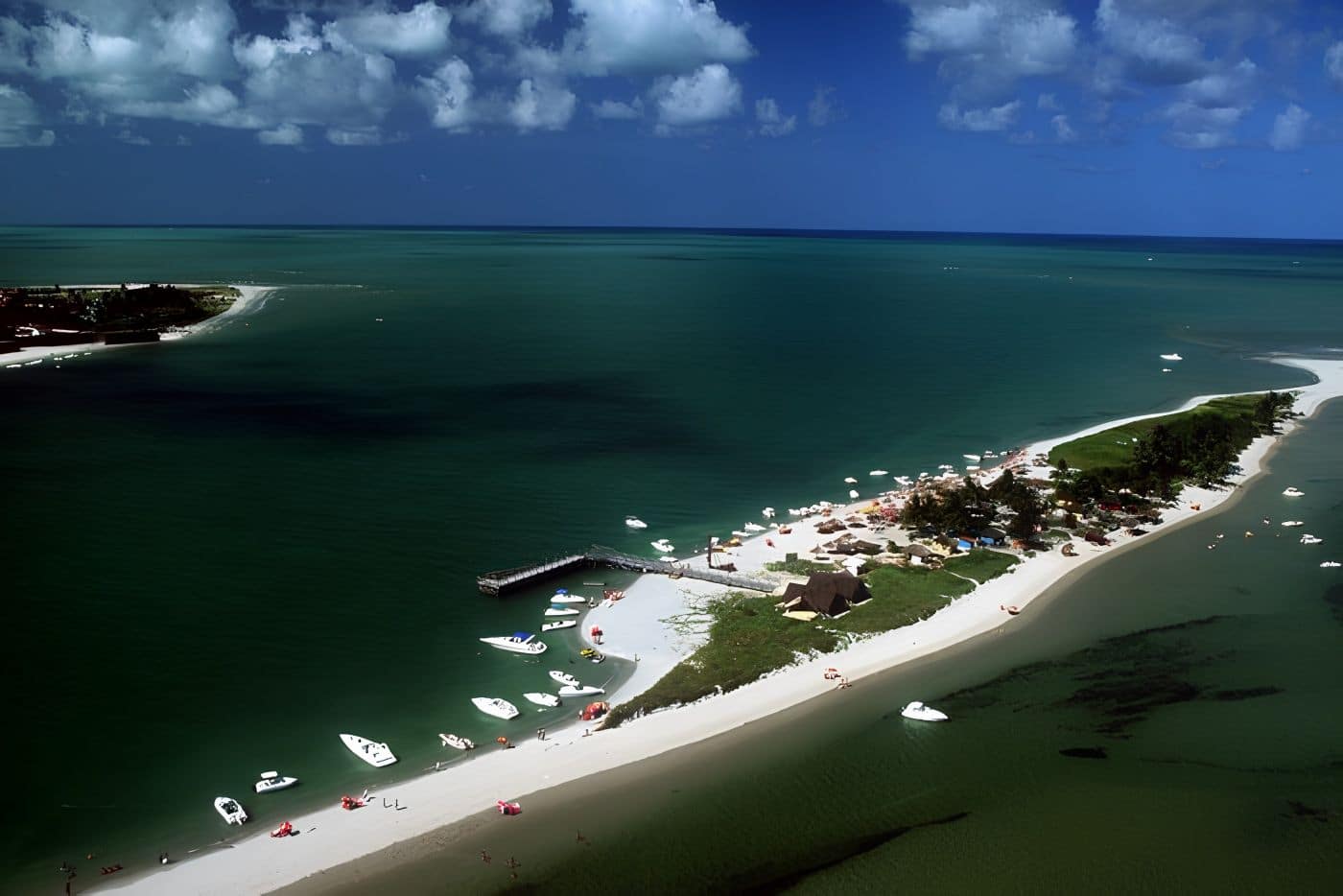
Coroa do Avião is a small sand islet opposite Praia do Forte Orange, on the other side of the channel. It was formed by the force of ocean currents and, in fact, belongs to the municipality of Igarassu. The crossing takes just a few minutes by speedboat or motorized jangada raft.
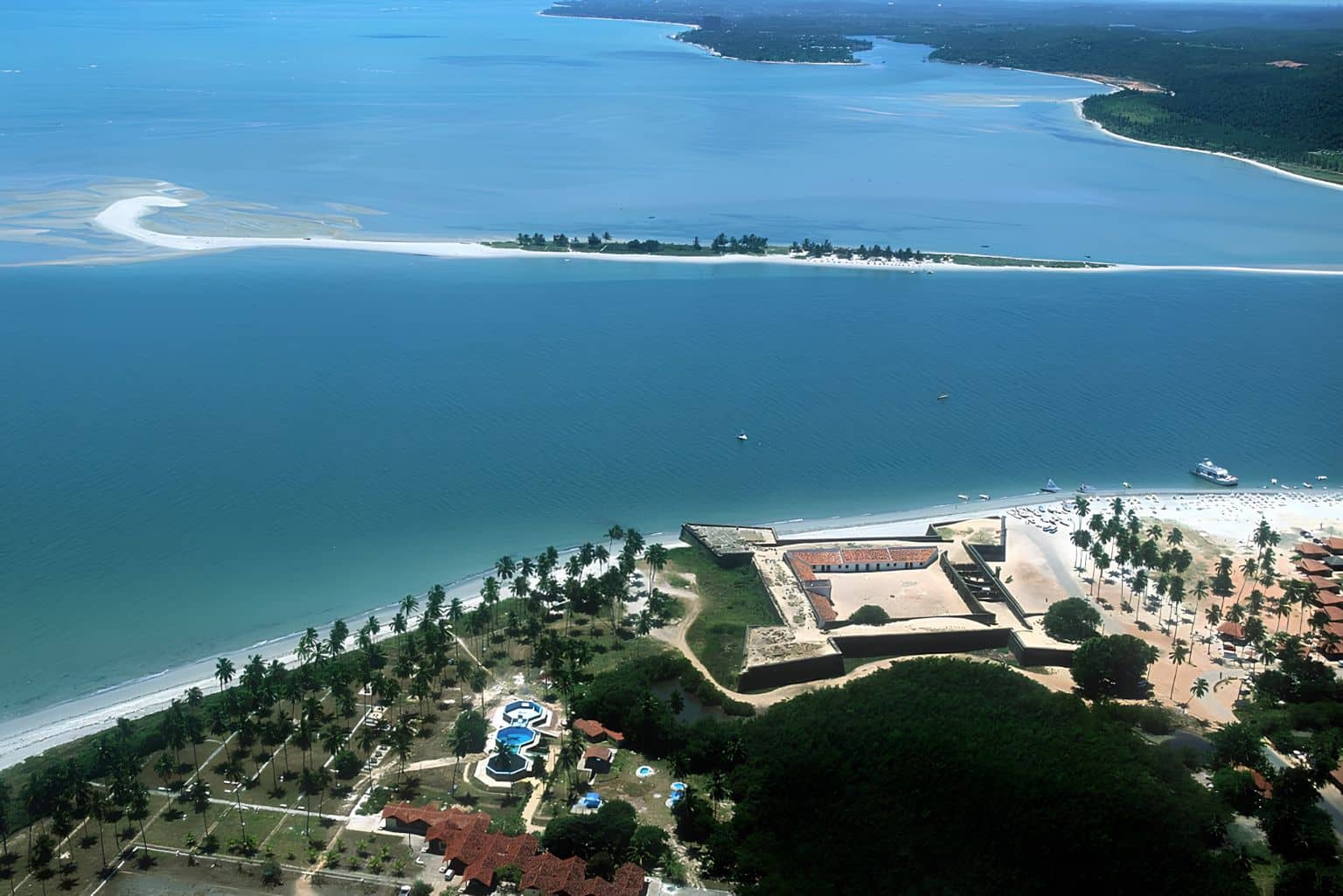
There, you will also find stalls serving regional food and clear waters, good for swimming and kitesurfing. In addition, the islet hosts a station of the Universidade Federal de Pernambuco dedicated to the study of migratory birds.
Vila Velha
Vila Velha was founded in 1534 and was once the seat of the captaincy of Itamaracá. Today, however, it is a small village of simple houses around the old Igreja de Nossa Senhora da Conceição. There are also ruins of what is believed to have been the church of Nossa Senhora dos Pretos.
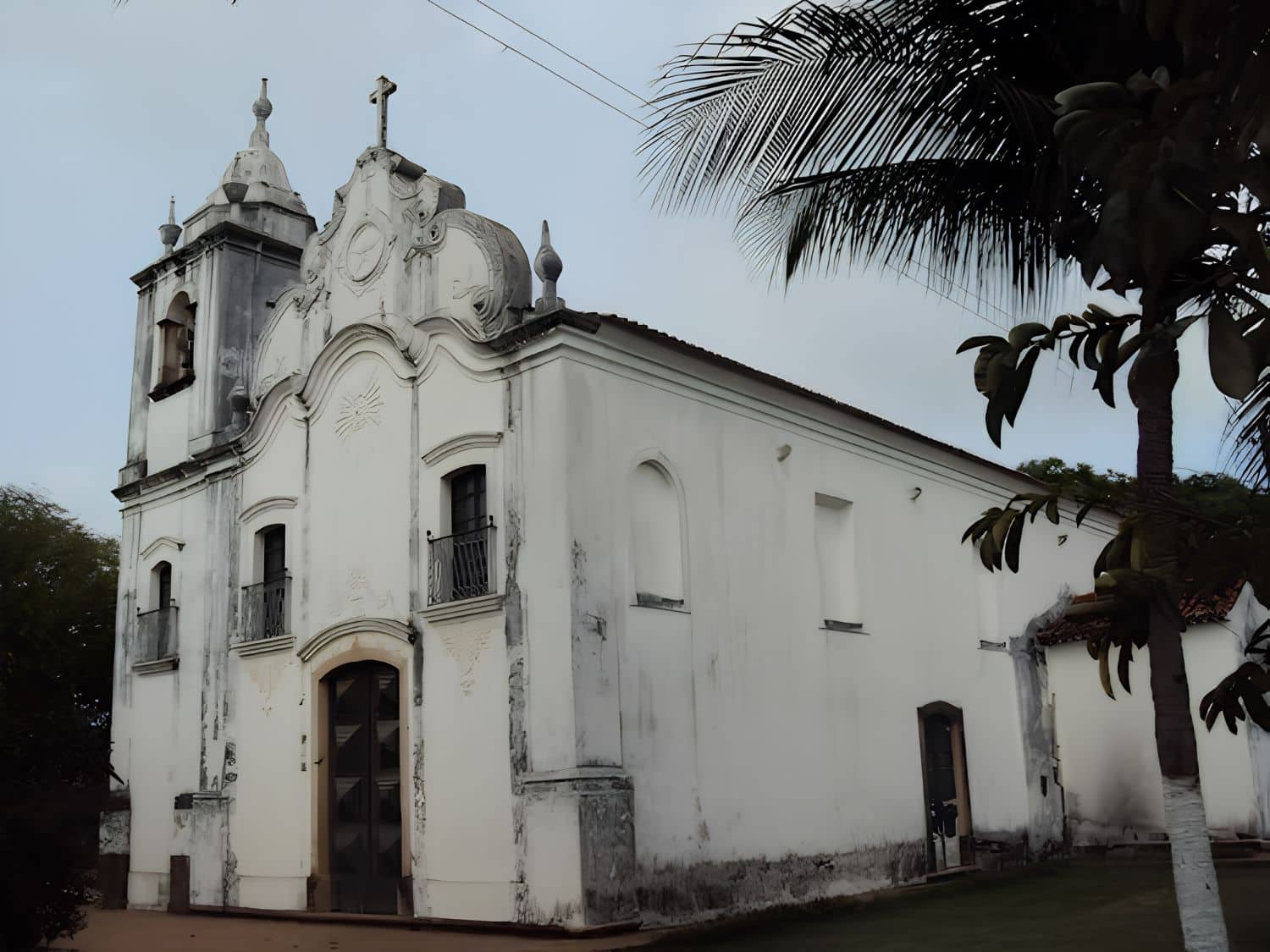
Because the spot sits high up, you can see the sea, the canal de Santa Cruz and Coroa do Avião. That is why it is a great lookout point in the late afternoon.
Projeto Peixe-Boi
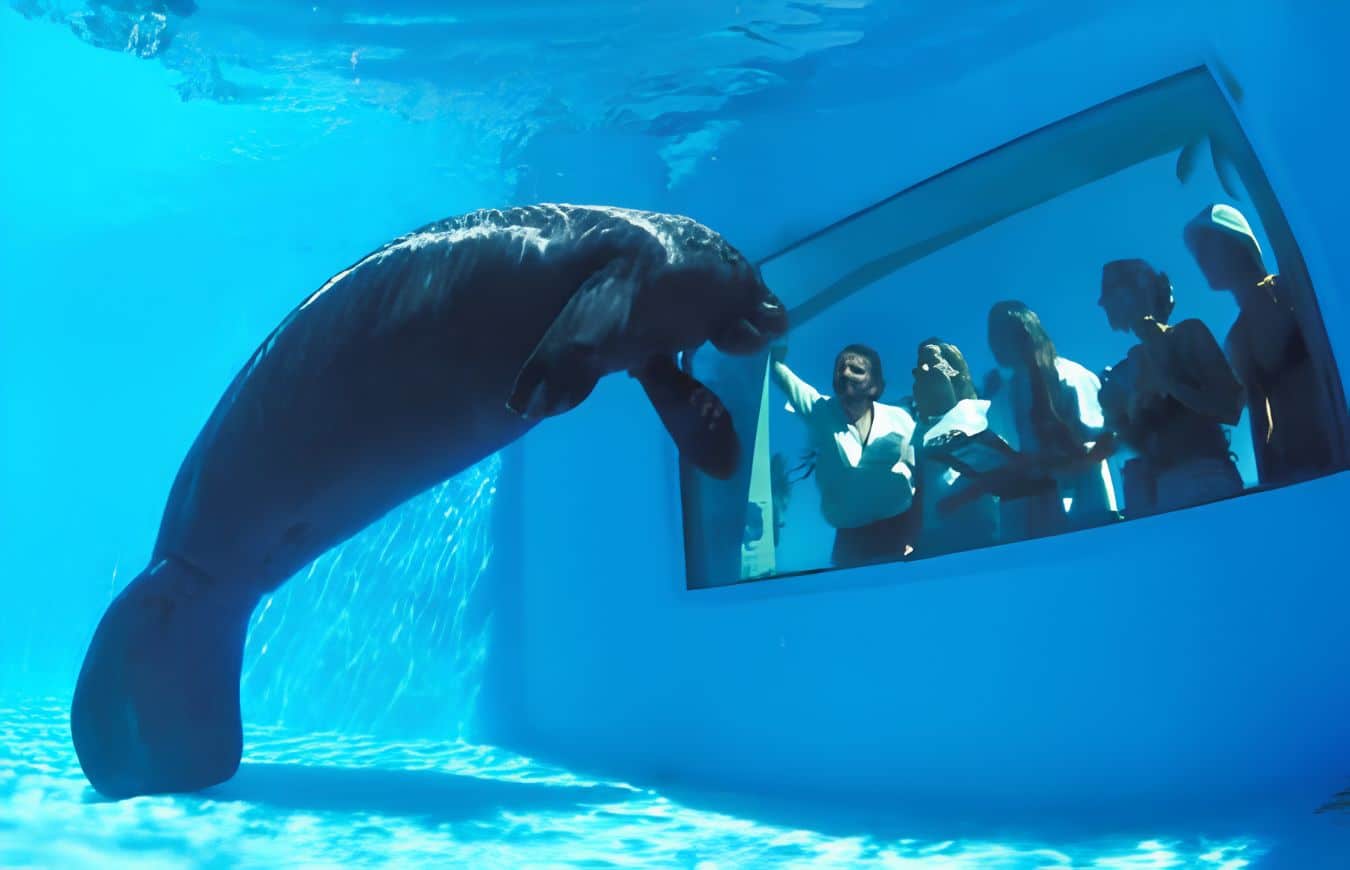
The island is home to a rehabilitation center for the peixe-boi marinho (West Indian manatee), an endangered species. There, visitors also learn about the animal and, sometimes, can see it up close. However, visiting arrangements may change; so confirm before you go.
Trails and ecotourism
Finally, trails through the mangroves and restinga let you explore the island’s rich nature. In addition, boat trips along the canal de Santa Cruz round off the itinerary.
History of Ilha de Itamaracá
According to IBGE, Vila Velha was founded in 1534 by Captain João Gonçalves and became a town in 1540, as the seat of the captaincy of Itamaracá. Incidentally, the island gave its name to one of Brazil’s hereditary captaincies. Tradition also holds that, as early as 1526, a chapel dedicated to Nossa Senhora da Conceição stood there.
Thanks to sugar, the island prospered: in 1630, Vila Velha had about a hundred houses and a Santa Casa de Misericórdia. Shortly afterwards, in 1631, the Dutch invaded the island, built Forte Orange and used it as a granary. Later, however, they were expelled by the Portuguese.
In 1763, according to IBGE, the island was bought for the Portuguese Crown for 4,000 cruzados. Then, in 1866, it became a district of Igarassu. Finally, state law no. 3,338 of December 31, 1958 created the municipality, which was installed on March 17, 1962. Today, the municipal seat is in Pilar.
How to get there and tips
- By car: from Recife, it is about 45 km via the BR-101 and the PE-035, up to the Itapissuma bridge.
- By plane: Recife airport is about 55 km away.
- Best time to go: from September to March, during the dry season.
- Accommodation: options range from simple guesthouses (pousadas) to more comfortable hotels.
- Combine with: Igarassu and the north coast of Pernambuco.
Frequently asked questions about Ilha de Itamaracá
Where is Ilha de Itamaracá?
It lies on the north coast of Pernambuco, about 45 km from Recife.
In addition, it is linked to the mainland by a bridge.
What are the best beaches on the island?
The most popular are Forte Orange, Pilar, Jaguaribe and Sossego.
It is also worth crossing over to Coroa do Avião.
What is Forte Orange?
It is a fortress built by the Dutch in 1631 and later rebuilt by the Portuguese.
Today, it is the island’s main historical attraction.
Is Coroa do Avião in Itamaracá?
Not exactly: the islet lies opposite the island, but it belongs to Igarassu.
Even so, the crossing departs from Praia do Forte Orange.
How do I get to Ilha de Itamaracá from Recife?
By car, via the BR-101 and the PE-035, in about an hour.
Finally, you cross the bridge from Itapissuma.

Publicações Relacionadas

Ricardo Brennand Institute — Castle Museum, Armory, and Art Gallery
Sights in Recife: 5 must-see attractions
The history of the Golden Chapel and the Third Order of Recife
Boa Viagem Beach (Recife) — A Complete Guide for Visitors
The best beaches in Pernambuco — a 5-day itinerary
Praia dos Carneiros voted one of the most beautiful beaches in the Northeast

7-Day Itinerary in Pernambuco with Historical Highlights

Alcatrazes Archipelago: Secrets of Evolution Revealed

Jararaca-ilhoa: Endemic Species of Queimada Grande

History and architecture of the Palácio do Campo das Princesas in Recife

Giant Puppets and Their Role in Olinda Carnival
Graça Church and Olinda Seminary Historical Significance

Monastery of São Bento de Olinda: A Historic Landmark
Olinda Cathedral: A Historical Landmark in Brazil
Franciscan Monastery of Olinda: A Historic Landmark
Igarassu: Discover the historic city of Pernambuco

Sugar mills on the outskirts of Porto de Galinhas PE

The oldest churches in Pernambuco and the first church in Brazil
Gravatá: Your Guide to the Best Attractions
Goiana: A Historical Treasure in Pernambuco
Main historical landmarks of Pernambuco and Recife

Main Tourist Attractions in Recife You Must Visit

Pernambuco's best beaches and their attractions
Vale do Catimbau National Park: Your Guide to Ecotourism
Santo Aleixo Island: A tourist paradise in Pernambuco
Interior of Pernambuco: Nature, Wine, and Tradition
Tracunhaém and Its Rich Clay Handicraft Tradition

Trindade and Martim Vaz: Discovering the Archipelago

Basilica of Our Lady of Penha: A Historical Overview
Church of Santa Teresa D'Ávila da Terceira Ordem do Carmo History
Kahal Zur Israel Synagogue — Jewish Museum and Cultural Centre (Recife)
Church of Nossa Senhora da Boa Viagem History
History of the Basilica of Our Lady of Mount Carmel in Recife
History of the Church of Our Lady of the Rosary of the Black Men
Golden Chapel: A Jewel of Brazilian Baroque
Sacred Recife and Religious Tourism in Recife, Pernambuco
This post is also on:
 Português
  English
  Deutsch
  Español
  Français