Discover the beauty of Ilha Grande: Tropical paradise in Rio de Janeiro
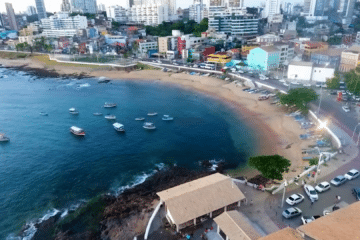
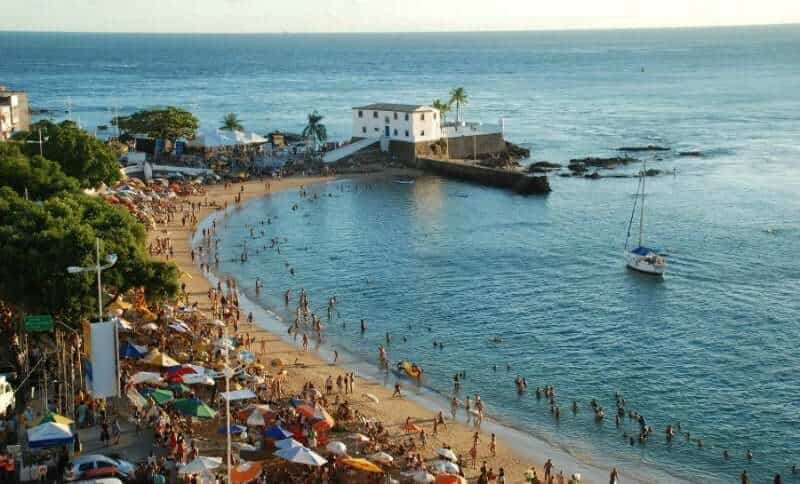
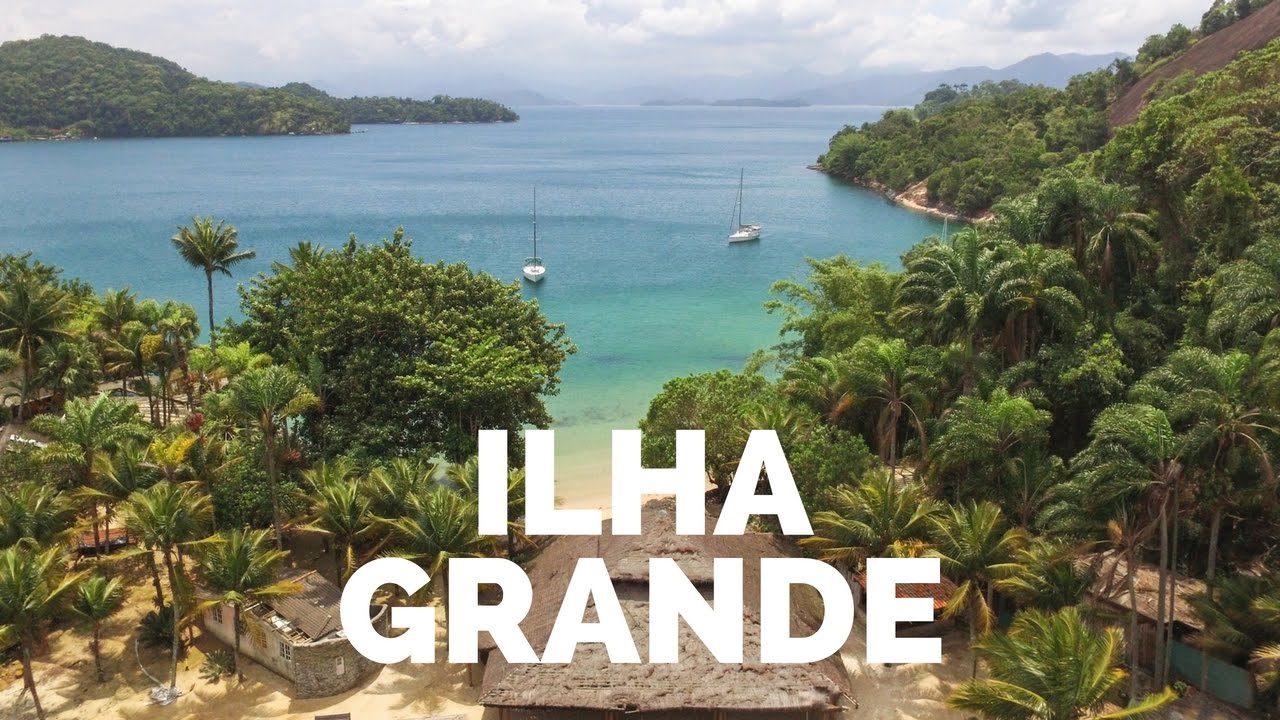
Ilha Grande, located off the coast of the state of Rio de Janeiro, is a true tropical paradise that enchants visitors with its stunning landscapes and rich biodiversity.
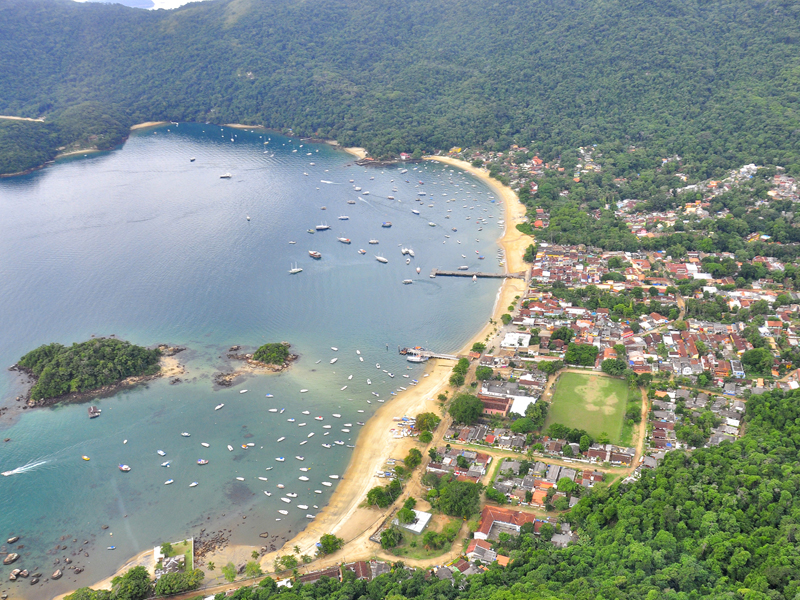
Covering an area of approximately 193 km², the island is part of the Ilha Grande State Park and is home to a variety of ecosystems, including white sandy beaches, tropical forests and mountains covered in lush vegetation.
Known for its hiking trails, such as the famous one that leads to Lopes Mendes Beach, Ilha Grande offers countless opportunities for outdoor activities such as hiking, snorkelling and boat trips.
The island also has a rich history, having been used as a prison and a hideout for pirates, giving it a mysterious charm. With its crystal clear waters and tranquil atmosphere, Ilha Grande has become an unmissable destination for those looking to relax and connect with nature.
Some of the main features of Ilha Grande
1. Geography
- Size and location: Ilha Grande has an area of about 193 km² and is part of the municipality of Angra dos Reis. It is the largest island in the archipelago of the same name.
- Topography: The island is mountainous, with high peaks such as Pico do Papagaio, which reaches an altitude of 982 metres. The coastline is rugged, with more than 100 beaches, coves and lagoons.
- Forests: Much of the island is covered by the Atlantic Rainforest, one of the most biodiverse forests on the planet and home to a rich variety of flora and fauna.
2. Climate.
- Tropical humid: Ilha Grande has a tropical climate, with average annual temperatures between 23°C and 30°C. Rainfall is frequent, especially during the summer (December to March), but the climate is generally pleasant throughout the year.
3. Biological diversity
- Fauna: The island is home to several species of mammals, birds, reptiles and amphibians, including some endangered species. Micos, armadillos, capybaras and a variety of birds are common in the area.
- Marine Life: The waters around the island are rich in marine life, with tropical fish, sea turtles, corals and the occasional dolphin or whale.
4. Environmental protection
- State Park: A large part of the island is protected by the Ilha Grande State Park, created to preserve its ecosystem. In addition, the Praia do Sul State Biological Reserve protects areas of extreme ecological importance.
- Conservation: Due to its status as a protected area, cars and motorbikes are not allowed on the island, which helps preserve the natural environment and provides a more peaceful atmosphere.
5. Culture and History
- History: Ilha Grande has a rich and varied history. In the past it was used as a quarantine for immigrants, the site of a penal colony (Presídio de Dois Rios) and an important strategic point during the slave trade era.
- Local parishes: Vila do Abraão is the main settlement on the island and is home to most of the local population. The local culture is influenced by fishing and tourism, with traces of Portuguese colonisation.
6. Tourism and Activities
- Ecotourism: Ilha Grande is a popular destination for ecotourism, with numerous trails criss-crossing the island, linking different beaches, waterfalls and viewpoints. The trails range from short and easy to long and challenging.
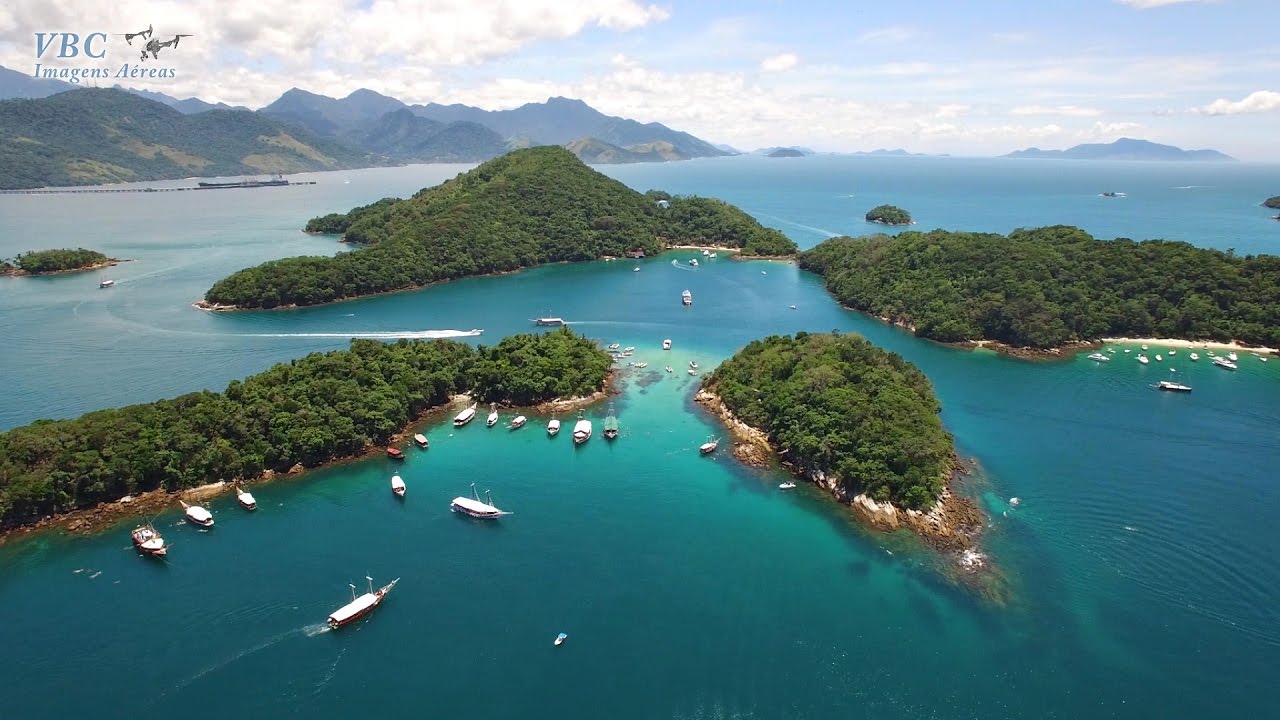
- Diving and Snorkelling: The clear waters and rich marine life make the island one of the best places in Brazil for diving and snorkelling. Popular sites include the Blue Lagoon and Jorge Grego Island.
- Beaches: With more than 100 beaches, Ilha Grande offers everything from secluded, quiet beaches to the busiest, such as Lopes Mendes, often voted one of the most beautiful in the country.
7. Accessibility
- Isolation: Ilha Grande is only accessible by boat, helping to preserve its unspoilt environment and ensuring a more authentic and peaceful experience for visitors.
These characteristics make Ilha Grande a unique destination, combining exuberant nature, rich history and a simpler lifestyle connected to nature.

Videos – Tourist Attractions of Ilha Grande RJ
Ilha Grande Paraiso 106:16
Ilha Grande Paraíso 206:44

Praias de Ilha Grande14:56

Ilha Grande Documentário25:48
Ilha Grande RJ Attractions
1. The beaches
1. VILA DO ABRAÃO

One of the oldest and most important villages of Ilha Grande. Abraão offers an urban infrastructure suitable for those seeking relaxation and harmony with nature.
Quality accommodation (pousadas and campings) and good restaurants, as well as being the only village with regular transport. All this makes Abraão the most popular village on Ilha Grande, attracting thousands of tourists throughout the year.
Visiting the church of São Sebastião, strolling the streets and beaches, buying handicrafts and enjoying the local beauty is an excellent programme.
In July, the Ilha Grande Music and Ecology Festival is held, a major event that has already become part of Angra’s tourist calendar, bringing together new talents and big names from the MPB.
From Abraão, several schooners offer trips to different parts of the island, as well as trails that connect Abraão to other villages or beaches, such as Japariz, Lopes Mendes, Dois Rios, Caxadaço, etc.
2. COVE OF THE STARS

The large number of starfish gave the place its name. At the end of the cove we have Saco do Céu and good beaches with calm waters, ideal for swimming.
They are Praia Grande, Praia de Fora and Praia da Feiticeira, where the famous Feiticeira waterfall is located, with its more than ten metres high, forming an enigmatic veil of water surrounded by the green of the Atlantic Forest.
The beaches in this cove are characterised by being narrow and with little shade.
At Enseada das Estrelas there is an excellent accommodation option, O Sítio do Lobo, with spa options and various leisure activities.
3. SACO DO CÉU

Saco do Céu is located in the cove of the stars. It is characterised by a calm sea that is surrounded by a mountain, as if it were forming a lake.
On starry nights, the stars are reflected in the water, giving the area a magical atmosphere, hence the name.
Much of the coastline is made up of mangroves. In summer, boat traffic is intense: Yachts, speedboats, jet skis.
Saco do Céu is a gastronomic stronghold. Excellent restaurants such as Reis Magos, Flutuante Almirantado, Mar e Massa, among others, attract tourists and personalities from the arts, sports and business world, who usually spend holidays and weekends in Angra.
4. JAPARIZ BEACH

Almost all the sloop trips that take in Lagoa Azul and Freguesia de Santana stop for lunch in Japariz.
The restaurant structure is good, the prices very affordable and the seafood always fresh, as well as other types of dishes.
Due to its proximity to the mainland, Japariz was the site of the terminal that distributed electricity to the other villages on Ilha Grande.
5. TOWN OF FREGUESIA DE SANTANA

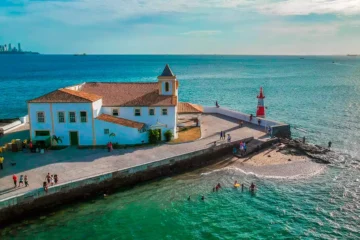
Freguesia de Santana was an important industrial and agricultural centre in the 17th century, with extensive coffee, sugar cane and cereal plantations, as well as brandy mills. The centrepiece is an old church, the most important religious monument on Ilha Grande.
Built in 1843 on the site of an old chapel, it stands in a rectangular cemetery and is supported by retaining walls. Next to it is a huge coconut tree which, together with the two beaches, completes the lush setting.
The upper beach, closer to the church, has a jetty and a good number of trees that provide shade on part of the beach.
The lower beach, with its transparent water and white sand, doesn’t offer as much shade as the upper beach. There are two or three stalls selling snacks, soft drinks and beer.
Due to the calm and quiet sea, this place is very popular with tourists, especially at weekends, as most of the schooner trips that leave from Angra or Abraão include Freguesia de Santana on their itinerary.
6. BLUE LAKE

This is a popular spot for sloops and speedboats to enjoy the lush scenery, where the green contrasts with the blue of the water. In this tranquil setting, tourists have the perfect environment to recharge their batteries in full contact with nature.
A good swim and the distraction of the colourful fish, always in large numbers, coming to the surface in search of food, are the main attractions.
Most of the tours around Ilha Grande Bay include a stop at the Blue Lagoon. They usually stop for about 30 minutes, enough time to admire the beauty of the place, snorkel and take pictures of a paradise.
7. BANANAL COVE

The calm, clean waters make the village of Bananal a very popular spot. It’s an excellent option for an early night and a rest. Tourist attractions include boat trips, snorkelling and nature walks.
The inns offer good services, with sea transport to and from Angra dos Reis.
Bananal, like most of the island, already has electricity supplied by CERJ, making it more comfortable and convenient for holidaymakers.
8. MATARIZ BEACH

Located in the bay of Sítio Forte, near the village of Bananal. An old fish-processing factory still exists, although it is no longer in use, marking one of the island’s most important economic sectors in the 19th century.
Matariz is not frequented by tourists, but for those who want to get to know Ilha Grande, a visit is a must.
9. PASSATERRA BEACH

A small beach with emerald waters. A small town with some modern houses.
In Passaterra, such as Ubatubinha, Maguariquissaba, Tapera and Sítio Forte, fishing colonies predominate.
10. MAGUARIQUESSABA BEACH

Located in the bay of Sítio Forte, it is characterised by its shellfish farms. It has a jetty, restaurants and clear, calm waters, ideal for swimming.
In Maguariquessaba, the town hall has started to implement the Ilha Grande Mussel Farming Project.
Today, other locations are part of the project, which aims to provide an alternative source of income for local people.
11. SÍTIO FORTE COVE

Enseada do Sítio Forte used to be much more populated. Today there are few houses as the land is privately owned. There is a lot of greenery and the beach is medium long.
The beach of Sítio Forte was important during the times of slavery and sugar cane plantations. The higher parts of the coastline have dense vegetation.
Enseada de Sítio Forte also has other beautiful beaches such as Tapera, Maguariquissaba, Passaterra and Ubatubinha.
12. TAPERA BEACH
Tapera is one of the beaches of Enseada do Sítio Forte. It is located in a bay called Saco da Tapera. The outer parts of the bay are excellent for snorkelling.
Semi-deserted, long beach with a narrow strip of sand. The large coconut palms that run along almost its entire length add to the beauty of the place.
13. UBATUBINHA BEACH

This beach belongs to the group of beaches of Enseada do Sítio Forte. Access is easy as there is a jetty. There is also a bar and restaurant.
14. LONGA BEACH

Praia da Longa is located in the bay of Araçatiba. Between it and Araçatiba is Lagoa Verde (Green Lagoon), a popular snorkelling spot for sloops and speedboats plying the bay of Ilha Grande.
Due to its proximity to the village of Araçatiba, it’s common to see people staying in Longa and travelling to Araçatiba, where the excitement is greater, especially during Carnival.
15. ARAÇATIBA BEACH

It is located on the part of Ilha Grande that faces the coast of the parish. The boat ride takes about an hour. It’s an extremely quiet village, mainly made up of local fishermen.
There aren’t many places to eat, but there are plenty of houses to rent. The calm green waters and lush forest make Praia Grande de Araçatiba the perfect place to relax and enjoy nature. During Carnival, the number of people in the village increases considerably.
As well as tourists, hundreds of residents from the city centre come to enjoy the tranquillity of the village’s waters.
From Praia Grande de Araçatiba, you can reach other parts of Ilha Grande via footpaths.
Following the beach in the direction of the telephone post, a path leads to the beach of Araçatiba (Araçatibinha), after which a fork offers two options: Vila de Provetá and Gruta do Acaiá. Following the Acaiá Trail, we’ll pass by places of rare beauty such as Itaguaçu and Praia Vermelha, among others.
This trail takes about 5.30 hours to walk, at a moderate pace. The most strenuous part is just after the red beach, where a steep climb may put you off, but don’t be discouraged as the view from the top is breathtaking.
On the other side of the beach is the path that leads to Vila da Longa, a much shorter route.
Camping is not allowed on the beach, but many locals rent out their land for tourists to pitch their tents.
16. ARAÇATIBA BEACH

Also known as Araçatibinha, this beach is located about 20 minutes from Praia Grande de Araçatiba. It has all the beauty requirements of the other beaches on the island, as well as offering a good area with plenty of shade reserved for camping enthusiasts.
17. RED BEACH

A beautiful beach of medium length, very popular with holidaymakers staying at Praia Grande de Araçatiba. The calm sea and clear, greenish water, together with the beachfront restaurants, are a constant attraction for visitors. It is about 45 minutes walk from Praia Grande de Araçatiba.
18. ACAIA CAVE
Another popular tourist spot, this is a submerged cave that reflects the sunlight through the seawater from the inside out. The passage is narrow but not dangerous.
To get to the cave you have to pass through a private property where there’s a shower, toilet and small bar.
In high season there is a queue to see the cave. Avoid these days as the water becomes very murky and difficult to see. Take the opportunity to swim in the blue waters of Ponta do Acaía, which is also an excellent spearfishing spot.
19. PROVETÁ VILLAGE

A beach with crystal clear green waters, mainly inhabited by the Evangelical Assembly of God community.
For those who have never seen it, it’s quite funny to see the locals bathing in the sea fully clothed, the women in skirts and blouses and the men in trousers and shirts – it’s a local tradition that has continued over the years. There is good trade in the form of bars and grocery shops.
There are no hostels or camping areas, but it is always easy to find places to camp in the grounds of local houses. Although there is no regular transport, there are always fishing boats carrying locals and tourists.
20. MEROS BEACH

Praia dos Meros is a small, secluded beach with crystal-clear waters, but quite rough. The beach has white sand and dunes are common.
In the region of Meros there are geological remains of ancient civilisations dating back some 3,000 years.
These remains are cavities in the rock known as “amolares”, created by the friction and wear of stones used by our ancestors to sharpen their rudimentary tools. Opposite the beach is the island of Meros, a great place for fishing and snorkelling.
Praia dos Meros is located at the tip of Meros, the south-western tip of Ilha Grande.
21. TIP OF THE DRAGONS

On the way to Aventureiro beach from the west, we passed the famous Drago Point, which faces the Praia de Sul bay.
When the sea is rough, the waves collide with such intensity that the foam can be seen from Parnaioca beach, 9.5 kilometres away. Its name comes from a strange rock formation that resembles a lizard, a reptile or a dragon, depending on your imagination.
22. AVENTUREIRO BEACH

A beach with crystal clear, warm water, small waves and a pile of rocks forming a natural pool cut by a lying coconut tree. It looks like a scene from the cinema, but it’s real, and only Praia do Aventureiro can offer such a beautiful image.
From time to time, a phenomenon occurs in the water: the seaweed comes to the beach and is washed by the waves, forming, on moonlit nights, a real sky in the sea, with the reflection of the moonlight on the seaweed, an unforgettable sight.
The beach has small bars and a few fishermen’s houses that serve as guesthouses for tourists, and camping is only allowed on private land.
In recent years, during the summer, the beach has become very busy, with many beautiful people parading on the fine sand of Aventureiro.
23. DEMO’S BEACH

Praia do Demo is a deserted beach with no houses or electricity. Its impressive waves break on the rocky shore known as “Costão do Demo”.
Although many surfers are seen in the area, this beach is not ideal for surfing due to the high risk of accidents; lovers of the sport will find ideal conditions at the neighbouring Praia do Aventureiro.
Navigation in the area is not recommended on days when the sea is rough, especially when crossing the difficult Drago and Meros points. During the summer season, access is controlled by the environmental authorities.
Praia do Demo shares its surroundings with the beaches of Aventureiro and Praia do Sul, forming a setting of unique natural beauty.
24. SOUTH BEACH

We can’t talk about Praia do Sul without mentioning Praia do Demo, which is the only road leading to the beach. It’s called Praia do Demo because of the rocky coastline of the same name, Pedra do Demo.
Legend has it that one moonlit night the daughter of a local fisherman, enchanted by the reflection of the moon on the rocks, went to meet the light by climbing up the cliff when the waves of the wild sea swept her away, leaving the imprint of her feet in the rocks.
of her feet in the rocks. Pedra do Demo is the path that takes us to Praia do Sul and we must be careful when crossing it to avoid accidents, as on days with rough seas the waves tend to “lick” the rocks, making the path very difficult and slippery. At the end of the walk you’ll see a sign indicating the start of the Praia do Sul Biological Reserve and from there you’ll find several kilometres of sand, sun and sea.
The beach is ideal for surfing, as it has well-defined waves with beautiful tubes. Don’t forget two important things: bring your own snacks and a bag to take away the rubbish, as the beach is completely deserted and there are no shops.
25. EAST BEACH

This beach is also part of the Praia do Sul Biological Reserve and has the same characteristics: many kilometres of sand, sun and sea. But its main attraction is Lagoa do Leste.
A Coca-Cola-coloured lagoon that flows into the sea, transforming the border between Praia do Sul and Praia do Leste into a pool of warm, crystal-clear water. We used to be able to walk up the river to the eastern lagoon, but IBAMA no longer allows it without a specialised guide.
This is because there are many snakes that like to sun themselves on the banks of the river, making the journey dangerous.
Locals say that the erosion seen on the east coast was caused by the Indians who inhabited the area many years ago. They used the coast to carve the points for their arrows.
26. PARNAIOCA BEACH

Sparsely populated, with a river that flows into the green waters of the sea and small waves, it’s the ideal setting for those who want to get close to nature.
A hike up the waterfall trail is a must for those who like a cold dip in the river. In summer it’s common to find a stall selling beer and soft drinks, but at other times the beach is virtually deserted.
The beach is practically deserted, a paradise for those who like sun, shade and fresh water.
Most boat trips don’t include Parnaioca in their itineraries, as it’s on the outside of the island. The boat ride from Angra to Parnaioca takes about 3.30 hours, but it’s well worth it.
27. BRAVA DAS PALMAS BEACH

Praia Brava das Palmas (Bay of Palmas) is a place surrounded by nature, with a stunning sea and incredible paths. This small, secluded beach offers a tranquil experience where the spirit of daring, adventure and a thirst for the unknown are paramount.
The sea at Praia Brava das Palmas is mostly calm, allowing for moments of tranquillity. Surrounded by lush Atlantic forest, visitors can enjoy the presence of exotic birds, as well as monkeys and squirrels that visit the area. However, the sunrise on the horizon of the high sea is the main attraction of Enseada de Palmas, offering visitors an unmissable spectacle.
28. VILLAGE OF DOIS RIOS

Vila de Dois rios is the place on Ilha Grande where one of Brazil’s largest prisons, the Candido Mendes Penal Institute, operated until it was imploded on 3 April 1994.
Today, the village is administered by the State University of Rio de Janeiro (UERJ), which in 1995 set up an advanced environmental science centre for biological and oceanographic research.
The best way to get there is to walk along the dirt road that connects Vila do Abraão to Dois Rios. About 12 kilometres, half uphill and half down, there are no bars or restaurants along the way, but the scenery and contact with the Atlantic rainforest is well worth the effort.
At the entrance to the village are giant coconut palms, and further on the chapel of Nossa Senhora do Bom Despacho and around 40 houses with semi-deserted streets, a mysterious setting that describes the living history of Dois Rios.
A 1 kilometre beach, clear waters and the open sea, two rivers that flow into the town and give it its name, and the ruins of the old prison make this a place of legends and stories, always in demand by tourists.
29. CAXADAÇO BEACH

Caxadaço beach is a small sandy area hidden between rocks and forest. It can be reached by boat or via the Abraão x Dois Rios trail. Just before the village of Dois Rios, a path on the left leads to Caxadaço beach.
There is plenty of water to quench your thirst, but no shops in the village.
30. SANTO ANTONIO

Santo Antônio beach is small, discreet and very pleasant. It has similar characteristics to its larger neighbour, Lopes Mendes, with fine white sand and is very popular for surfing.
Santo Antônio is a “very rocky” beach, with several huge boulders competing for space on the strip of sand.
The freshwater stream flowing into the sand and the view of Jorge Grego Island in front of the beach complete the perfect setting. Rough sea with many large rocks.
The path to Santo Antônio beach is easy and short, with little unevenness and sparse vegetation.
31. LOPES MENDES BEACH

Lopes Mendes beach is fantastic. The open sea provides high waves, making it a favourite with surfers. Boat trips don’t usually go there as there is no pier. The boats usually stay in Palmas, from where we set out on a trail that takes about 30 minutes.
On this trail we will have some fantastic views that emphasise the harmony between the sea and the Atlantic forest.
The trail is characterised by a steep climb, which can be slippery if it’s raining, so be careful.
At the end you’ll find fine sand and a flat area where you can hear the sea.
Camping is not allowed on or near the beach and there are no bars or hostels.
32. CASTELHANOS LIGHTHOUSE

The Castelhanos lighthouse, built in the 19th century, is located at the eastern end of Ilha Grande, near the island of Guriri. It is almost hidden by the native forest of the region.
33. MANGROVE BEACH

Praia dos Mangues is one of the most famous beaches on the island, especially as it is the location of the pier where many of the tourists who want to visit Lopes Mendes Beach disembark. Most of these trips are made by schooner from other villages on the island, dropping off tourists for a 20 minute walk to Lopes Mendes.
Praia dos Mangues is a beautiful, quiet, cosy beach of incomparable beauty, perfect for spending the day with friends and relaxing away from the hustle and bustle of Abraão. If you’re looking for a relaxing place full of peace and tranquillity, it might be a good idea to stay here for a while.
34. PALM COVE

Enseada de Palmas is very busy in the summer. It is the arrival point for sloop trips to Lopes Mendes beach. Enseada has Palmas beach, mangroves and a jetty.
According to historians, Palmas Cove was one of the most populated coves on Ilha Grande in the 19th century.
It’s a 30-minute walk from the mangrove beach to Lopes Mendes. There is no electricity or public services.
35. ABRAÃOZINHO BEACH

Camping is forbidden and there are no guesthouses. Abraãozinho is a beach to visit in the morning and return to in the afternoon, ideal for swimming, kayaking and snorkelling along the coastline.

2. TRAILS OR TREKKING
There are trails all over Ilha Grande, linking the beaches. You’ll need plenty of time to get to know them and enjoy the excursions you can take.
Known as one of the most beautiful places in Brazil, Ilha Grande makes adventurers want to explore it from one end to the other. With this in mind, this itinerary aims to present the island in a way that has never been done before: a complete tour of deserted beaches and lots of Atlantic Forest.
An itinerary for lovers of authentic crossings, with walks along deserted beaches with crystal clear waters, trails in the middle of the Atlantic Forest, mangroves, rocky shores and great challenges.
Trails crisscrossing the 193km² of Ilha Grande lead to beaches, waterfalls and secrets – all you need is a spirit of adventure. Maps showing the location of places to visit are easy to find, both on the internet and on the island itself.

Hiking trails
- Abraão Circuit – 1,700 m to 1,900 m – 1 to 1h30 min
- Aqueduct / Saco do Céu – 5,800 m to 6,000 m – 3h to 3h30 min
- Saco do Céu / Freguesia de Santana – 3,800 m to 4,000 m – 2h to 2h30 min
- Freguesia de Santana / Bananal – 2,700 m to 3,000 m – 1h to 1h30 min
- Bananal / Sitio Forte – 4,900 m to 5,000 m – 2h30 min to 3h
- Sitio Forte / Praia Grande de Araçatiba – 6.000 m to 6.200 m – 3h to 3h30 min
- Praia Grande de Araçatiba / Gruta do Acaiá – 5,200 to 5,400 m – 3h to 3h30 min
- Praia Grande de Araçatiba / Provetá – 4,500 m to 4,700 m – 2h30 min to 3h
- Provetá/Aventureiro – 3,500 m to 3,700 m – 2h 30 min to 3h
- Abraão/Mangues/Pouso – 5,800 m to 6,000 m – 2h30 min to 3h
- Mangues/Pouso/Lopes Mendes – 1,000 m to 1,200 m – 30 min to 1h
- Mangues/Pouso – Farol dos Castelhanos – 5,800 m to 6,000 m – 3h to 3h30 min
- Abraão / Pico do Papagaio – 5,700 m to 5,900 m – 3h 3h30 min
- Abraão / Dois Rios – 6,800 m to 7,000 m – 2h30 min – 3h
- Dois Rios / Caxadaço – 4,100 m to 4,300 m – 2h 2h30 min
- Dois Rios / Parnaioca – 7,600 m to 7,800 m – 3h to 3h 30 min
The following trails are not shown on the Ilha Grande signposts, but they serve as a warning to trekkers:
- Saco do Céu x Bananal – 3,000 m to 3,200 m – 1h30 min (difficult access. Requires experience)
- Longa x Lagoa do Sul – (Impossible to complete and completely closed by forest)
- Provetá x Praia do Meros – 6,800 m to 7,000 m – 2h30 min – 3h (trail closed by forest)
- Parnaioca x Praia do Leste – 1,500 m to 1,700 m – 0:40 to 1h (requires IBAMA permit)
- Caxadaço x Stº Antonio – 3,000 m to 3,200 m – 1h30 min (difficult access. Experience required)
3. Dois Rios Prison and Lazareto Foundation
Ilha Grande is known for its rich history and an important part of that history is the prisons that once existed on the island. The most famous of these is the Dois Rios Prison, which was one of the most notorious and feared prisons in Brazil. Here’s an overview of the prisons on Ilha Grande:
1. Dois Rios Penal Colony
- Origin and purpose: Dois Rios Prison, originally called Cândido Mendes Penal Colony, was inaugurated in 1903. It was built on the site of the former Fazenda Dois Rios, which had previously housed a penal colony.
- Function: Initially, the penal colony was created to house ordinary prisoners who worked in agriculture, cultivating the land and helping to maintain the island’s infrastructure. Over time, its function changed and it began to house political prisoners during the New State under Getúlio Vargas and later during the military dictatorship.
- Famous prisoners: Among the most famous prisoners to have passed through Dois Rios are the writer Graciliano Ramos, who recounted his experiences in the book “Memórias do Cárcere”, and other political prisoners, especially during the military dictatorship (1964-1985).
- Closure: The prison was closed in 1994 after complaints of overcrowding and poor living conditions. The ruins of the prison are now a tourist attraction, and part of the site has been converted into the Prison Museum, which preserves the memory of the prison’s history.
2. Ilha Grande Prison

- Prehistory: Before the construction of Dois Rios Prison, there was already a prison on Ilha Grande in the 19th century. In 1884, the Lazareto was built, a quarantine hospital for immigrants, which was later converted into a prison. This first prison was closed at the beginning of the 20th century, giving way to the Dois Rios penal colony.
3. Prison Museum
- Location and purpose: The Cárcere Museum is located in the ruins of the former Dois Rios Prison. It was created to preserve the history of the prison and to educate the public about the periods when the island served as a place of detention for common criminals and political prisoners.
- Exhibitions: The museum displays documents, photographs and objects related to the history of the prison and the lives of the inmates. There is also information on the history of the island and its transformation over the years.
4. Impact on the island
- Native population: The presence of the prisons has influenced the island’s demography and economy. Many families living on Ilha Grande today are descendants of former guards, prison staff or former inmates.
- Tourism: The ruins of the prisons and the Prison Museum are now tourist attractions, attracting visitors interested in the island’s history and complementing the natural beauty that makes Ilha Grande a popular destination.
The history of the prisons on Ilha Grande reflects an important part of Brazil’s penal and political history, making the island not only an ecotourism destination, but also a place of great historical interest.
How to get to Ilha Grande
Getting to Ilha Grande, located on the southern coast of the state of Rio de Janeiro, involves a combination of land and sea transport. Here are the main options:
1. Land transport to the port
To get to Ilha Grande, you must first travel to one of the ports from which boats depart for the island. The main ports are
- Conceição de Jacareí: This is the closest and most popular departure point, especially for those coming from Rio de Janeiro.
- Angra dos Reis: Another popular option, with several daily boat departures.
- Mangaratiba: Also provides transport to Ilha Grande, but with fewer timetables.
By car
- From Rio de Janeiro: The journey to Conceição de Jacareí takes about 2.5 hours on the BR-101 (Rio-Santos).
- From São Paulo: It takes about 6 hours to get to Angra dos Reis via the Rodovia dos Imigrantes and the BR-101.
You can leave your car in the car parks near the ports, as vehicles are not allowed on the island.
By bus
- Rio de Janeiro to Conceição de Jacareí or Angra dos Reis: There are regular buses from the Novo Rio bus station, operated by companies such as Costa Verde. The journey takes about 2 to 3 hours.
- São Paulo to Angra dos Reis: Companies such as Reunidas Paulista operate this route, which takes about 6 hours.
2. Sea crossing to Ilha Grande
Once in the ports, you will need to take a boat to cross to the island. Options include
Boats and speedboats
- From Conceição de Jacareí: Speedboats are the quickest way, taking about 20 minutes to Vila do Abraão, the main town on Ilha Grande.
- From Angra dos Reis: There are speedboats (30 to 40 minutes) and conventional boats (1h30 to 2 hours).
- From Mangaratiba: The journey to Abraão takes about 1.5 hours by conventional boat.
Timetables and prices
- Speedboats: These are more frequent and slightly more expensive, with departures usually every hour.
- Conventional boats: Cheaper, but less frequent and slower.
Getting to Ilha Grande
Most boats arrive at Vila do Abraão, which is the main town on the island and the starting point for exploring the various attractions. From there, you can continue on foot, by boat or by taxi boat to other beaches and trails on the island.
Important tips
- Check timetables: Boat timetables can vary depending on the time of year and weather conditions.
- Buy tickets: This can be done in advance, especially in high season, to guarantee your place.
- Cash: Although there are some ATMs on the island, they don’t always work well and many places don’t accept cards.
Following these steps will get you to Ilha Grande and allow you to enjoy its natural wonders.
You can also visit Brazil’s mainland islands, Ilhabela, Ilha Grande and Ilha de Santa Catarina, and oceanic islands such as Fernando de Noronha, Atol das Rocas, Archipelago of São Pedro e São Paulo and, Trindade e Martim Vaz.
Tourist guide to Ilha Grande in Angra dos Reis

Publicações Relacionadas
Jararaca-ilhoa: Endemic Species of Queimada Grande
Florianópolis: A Blend of Urban and Natural Beauty
Ponta do Boi Lighthouse: History and Significance
Ilhabela: A Tropical Paradise Awaiting You
Anchieta Island: History, Beaches, and Nature
Alcatrazes Archipelago: Secrets of Evolution Revealed
History and Heritage of Itaparica Island — Bay of Todos os Santos
Atol das Rocas - Origin, biology, climate and shipwrecks
São Pedro e São Paulo Archipelago: An Overview
What is the largest island in Brazil? Marajó and the Brazilian islands
Trindade and Martim Vaz: Discovering the Archipelago
Itamaracá Island: Best Attractions and Activities
Marajó Archipelago: A Unique Ecological Paradise
This post is also on:
 Português
  English
  Deutsch
  Español
  Français