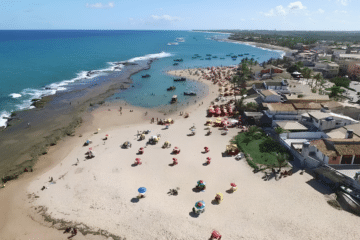
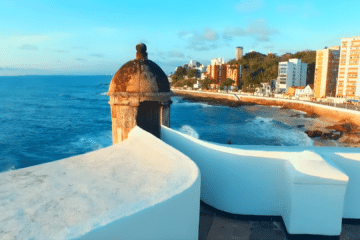
Discover the north coast of Pernambuco.
The North Coast of Pernambuco is home to one of the region’s most important historical sites.
The northern coast of Pernambuco is more densely populated than the southern coast, with urbanisation extending from the Recife Metropolitan Area to the border with Paraíba.

The North Coast of Pernambuco has some of the most important historic sites in the Northeast region. Municipalities such as Olinda, Itamaracá and Goiana began to be populated in 1535.
Tourists visiting the region are very fond of buildings from colonial Brazil, such as Fort Orange.
In addition to its beaches, the northern coast of Pernambuco is also home to the Veneza Water Park, one of the largest in Brazil. It is located on Marinha Farinha Beach in the Paulista neighbourhood of the Recife metropolitan area.
The main beaches on the northern coast of Pernambuco are located in the following municipalities: Paulista (Maria Farinha, Conceição, Pau Amarelo and Janga beaches), Goiana (Gavião and Itamaracá beaches), Olinda (Rio Doce and Casa Caiada beaches). Pontas de Pedra, Carne de Vaca, Catuama, Barra de Catuama and Atapuz; Itamaracá (Itamaracá and Gavoa); and Olinda (Rio Doce and Casa Caiada).

Videos: Historic Cities of Pernambuco

História e Guia de Turismo de Igarassu13:01

Guia de Turismo da Ilha de Itamaraca03:05

Drone - Olinda em Pernambuco01:00
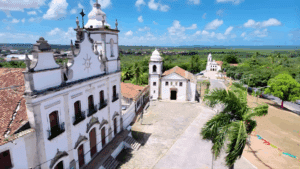
IGARASSU - UM LUGAR BARATO E DESCONHECIDO15:17
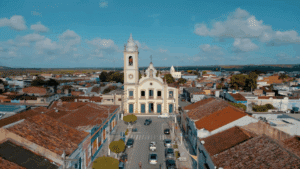
Cidade histórica de Goiana PE
Forte Orange na Ilha de Itamaracá07:05
Tourist and historical attractions on the northern coast of Pernambuco
- Igarassu
- goian
- Itamaracá Island
- Olinda
1. Igarassu
The small town of Igarassu, on the northern coast of Pernambuco and listed as a historical heritage site, was founded in 1535 by Duarte Coelho’s troops.
Situated approximately 30 kilometres north of Recife on the BR-101 motorway, the city boasts well-preserved 18th- and 19th-century houses. Highlights include the art gallery in the 18th-century Franciscan convent of Santo Antônio de Igarassu.
Although the building needs repairing, it contains a collection of items of artistic and historical value, including 24 oil paintings on wood from the 17th and 18th centuries. These depict sacred figures and historical events, such as the ravages of the yellow fever epidemic that hit the region in 1685.
According to tradition, Igarassu survived the outbreak unscathed thanks to the protection of São Cosme and São Damião, in whose honour Duarte Coelho had a church built in 1535 (Rua Barbosa Lima, s/n).
Built of rammed earth, the Church of São Cosme and São Damião was vandalised by the Dutch in 1634, rebuilt in 1654, and underwent changes in the 18th century that gave it a Baroque appearance.
The paintings on the walls are almost fading away. From one side, you can see the roofs of the little houses in Igarassu (Rua Frei Caneca, s/n, Centro).
The Church of Saint Anthony, located within the Franciscan convent, is the best-preserved church in the city.
It was built with stone in 1588 and underwent renovations the following century after being looted during disputes between the Dutch and the Portuguese.
The high altar, which is made of cedar, features golden paintings from the Baroque era’s Joanine period. Tile panels on the sides depict miracles and visions of the saint. The sacristy contains a solid 18^(th)-century wooden chest of drawers and a stone washbasin.


1.1 The Emperor’s Townhouse
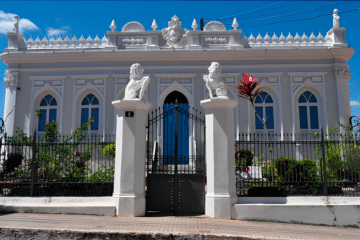
Built between the 17th and 18th centuries, the Sobrado is one of the most notable buildings in the historic centre of the city. It was constructed using funds raised from meat taxes in the village of Igarassu at the time.

Initially, the buildings had a variety of uses, but they eventually became home to official institutions such as a retirement home, a prison and a town hall. In 1972, the Igarassu Architectural and Landscape Complex was entered into the Institute’s Register of Archaeological, Ethnographic and Landscape Sites.
The building underwent extensive renovations in the 19th century.
The building was adorned with neoclassical ornamentation, a stylistic trend that arrived in Brazil through the influence of the French Mission in 1816 and remained dominant throughout the rest of the century.
Despite the alterations, the essence of the 17^(th)-century architecture was preserved.
These features are evident in spaces characterised by patterns of empty and occupied areas, and in the arrangement of stonework elements, consisting of blocks of rough rock carved into geometric shapes.
The name ‘Sobrado do Imperador’ refers to the visit of Dom Pedro II, who was in the building on 5 December 1859 while travelling through the Northeast region.
The event perpetuated the misconception that the building was constructed in the 19th century.
That year, the property was prepared solely to welcome the monarch.
1.2 History of Igarassu
Some scholars consider Igarassu to be the first settlement in the country. It is more widely accepted that it was the second village to be established in Brazil, after São Vicente, in the current state of São Paulo.
The city was founded on 27 September 1535, after the Portuguese defeated the Caeté Indians.
At that time, Captain Afonso Gonçalves ordered the construction of a chapel dedicated to Saints Cosmas and Damian on the site, which is now the oldest in Brazil.
A model of Portuguese colonial administrative and religious power began to emerge at the top of the hill.
The initial settlement structure consisted of a square and a plaza bordered by a church, town hall, jail and other prominent buildings, and this would be repeated in Olinda and other Brazilian cities.
There are two explanations for the origin of the name, both of which come from indigenous tradition. According to the first, it comes from the Tupi terms ‘Igara’ and ‘Assu’, meaning ‘canoe’ and ‘big’, respectively. Historians believe that the name originated from the indigenous people’s exclamation of surprise when they saw the huge Portuguese caravels.
Another possibility is that it refers to three indigenous words: Ig = water or river; Guara = water bird; and Açu = large. Therefore, ‘Igarassu’ would mean ‘River of the Great Birds’, also alluding to the ships that appeared on the coast during the early years of colonisation.
2. Goiana
The city of Goiana, located on the northern coast of Pernambuco, thrives on the sugar cane cycle. It is a medium-sized city situated about 60 kilometres from Recife on the edge of the BR-101 highway in the Zona da Mata region of Pernambuco.
Founded in the mid-16th century, the city was captured by the Dutch and served as the headquarters of the Itamaracá captaincy. It was also the setting for the Epic of the Heroines of Tejucupapo, in which women took up arms to defend themselves against Flemish invaders.
It is also remembered as the first place where slavery was abolished, even before the Golden Law. Many of the historical landmarks and churches are in need of repair and operate on irregular schedules.
The Church of Our Lady of the Rosary of Black Men is the most important, as it houses the Museum of Sacred Art, which has a rich collection of 17th- and 18th-century imagery.
Originally built in the mid-16th century, the building acquired Baroque features in the 17th century. Of particular note are the images of Our Lady of Amparo and Our Lady of Milk, which were long rejected by the Church for depicting breast feeding (Rua do Rosário, s/n, Centre).


3. Itamaracá Island
The island of Itamaracá, located on the northern coast of Pernambuco, offers a variety of attractions and is the perfect addition to a trip to the nearby town of Igarassu.
Itamaracá Island is located approximately 50 kilometres from Recife, via the BR-101 motorway towards Paraíba, then the PE-35 motorway.

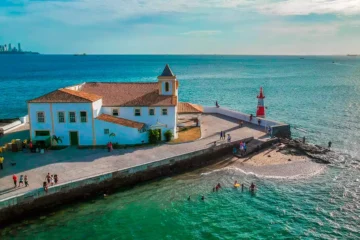
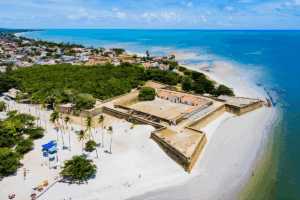
The island is home to the restored Fort Orange, a four-pointed fortress built by the Dutch in 1631. Two of its points face the sea and two face the island.
There are signs stuck in the sand explaining what each corner represents, such as the location of a well that was built by the Dutch. The fort also has a 16^(th)-century chapel and a small museum containing weapons, cannonballs and porcelain (site: Orange, s/n, Forte Orange).
At Ecoparque Peixe-Boi & Cia, there is an oceanarium with nine manatees (Trichechus manatus), open to visitors, and a rehabilitation unit of the Manatee Project of Ibama, closed to the public, which cares for calves rescued from strandings and returns them to the wild.
Students of biology or oceanography are on hand to provide information about the animals. There is also a screening room showing documentaries, as well as a souvenir shop and a snack bar (Estrada do Forte Orange, s/n, Forte Orange).

It is worth taking a short boat trip to Coroa do Avião, a tiny island with several bars, just to see Fort Orange from the sea – the same view that explorers had in the 16^(th) century (Fort Orange Beach).
The island of Itamaracá is also home to the Estrela de Lia cultural centre, which was created by the cirandeira Lia de Itamaracá.
She hosts nightly performances of ciranda on a stage built in an open hall facing the sea on Jaguaribe beach, as well as guests such as Selma do Coco and Mestre Salustiano. There is also a bar where you can enjoy delicious lemon and lemongrass juice.
In Vila Velha, a settlement that emerged in the 16th century and was the administrative headquarters of the Itamaracá captaincy, there is a cluster of simple masonry houses built near the old Nossa Senhora da Conceição church (Rua João Paulo II, s/n), as well as the ruins of the former Nossa Senhora dos Pretos church. As the site is elevated, visitors can enjoy views of the sea, the Santa Cruz canal and the Coroa do Avião.

In colonial times, this location also offered a strategic view of the area, providing protection against enemy attacks. The village was invaded by Flemish troops in 1631, who named it Cidade Schoppe (between km 9 and 10 of the Recife-Itamaracá road).
4. Olinda
The historic centre of Olinda, near the city of Recife (the capital of the state of Pernambuco), dates back to the beginning of Portuguese colonisation of Brazil in the 16^(th) century. During the golden age of the sugar cane economy, it became the seat of the Captaincy of Pernambuco. The architectural, urban and landscape ensemble was listed by IPHAN in 1968.

The city was recognised as a World Cultural Heritage Site by UNESCO in 1982 and covers an area of 1.2 km². It features 19th-century and neoclassical and eclectic works from the early 20th century.
The lush vegetation on the streets, in the gardens and alleys, and around the convents — consisting of leafy fruit trees such as mango, breadfruit, jackfruit, sapodilla and coconut — gives the site its defining feature: an urban centre surrounded by greenery under tropical light, with the beach and ocean at its feet.
The city’s relationship with the local landscape and the sea is reflected in its vernacular architecture. This cultural manifestation was inherited from Portugal and adapted to the environment, to the extent that it acquired its own personality, which has been maintained over time.

Publicações Relacionadas
Goiana: A Historical Treasure in Pernambuco
Cais do Sertão Museum: Discover Sertanejo Culture
Church of Santa Teresa D'Ávila da Terceira Ordem do Carmo History
Ricardo Brennand Institute — Castle Museum, Armory, and Art Gallery
Giant Puppets and Their Role in Olinda Carnival
Church of Nossa Senhora da Boa Viagem History
Tracunhaém and Its Rich Clay Handicraft Tradition
Porto de Galinhas: Your Guide to Perfect Beaches
Igarassu: Discover the historic city of Pernambuco
Main tourist towns in Pernambuco's Zona da Mata
Olinda: A Journey Through Colonial Architecture
History of the Basilica of Our Lady of Mount Carmel in Recife
Olinda Cathedral: A Historical Landmark in Brazil
Golden Chapel: A Jewel of Brazilian Baroque
Cabo de Santo Agostinho: A Complete Tourist Guide
Dutch Recife and the Dutch Invasion of Brazil
Interior of Pernambuco: Nature, Wine, and Tradition
7-Day Itinerary in Pernambuco with Historical Highlights
Serra Talhada: A Journey Through Pernambuco's Culture
History and architecture of the Palácio do Campo das Princesas in Recife
Pernambuco: History and must-see attractions
Tourist Attractions in Agreste de Pernambuco
Sugar mills on the outskirts of Porto de Galinhas PE
Graça Church and Olinda Seminary Historical Significance
Pernambuco's Rural Tourism Route: A Traveler's Guide
Pernambuco's best beaches and their attractions
Vale do Catimbau National Park: Your Guide to Ecotourism
The oldest churches in Pernambuco and the first church in Brazil
Petrolina: Exploring Its Wine and Tourism
Recife: The Brazilian Venice and its Cultural Heritage
Mata Sul Region of Pernambuco: Waterfalls to Explore
Sights in Recife: 5 must-see attractions
Kahal Zur Israel Synagogue — Jewish Museum and Cultural Centre (Recife)
Main Tourist Attractions in Recife You Must Visit
Beaches on the South Coast of Pernambuco: A Complete Guide
Sacred Recife and Religious Tourism in Recife, Pernambuco
This post is also on:
 Português
  English
  Deutsch
  Español
  Français