When the first Spanish colonists arrived in the Americas, cacao was already being cultivated by the Indians, especially the Aztecs in Mexico and the Mayans in Central America.
According to historians, the cacao tree, called cacahualt, was considered sacred.

In Mexico, the Aztecs believed it to be of divine origin and that the prophet Quetzalcóatl himself had taught the people to cultivate it, both for food and to decorate the gardens of the city of Tetzapotlapan. Its cultivation was accompanied by solemn religious ceremonies.
This religious significance probably influenced the Swedish botanist Carolus Linnaeus (1707-1778), who named the plant Theobroma cacao and called it the food of the gods.
The Indians considered the cocoa bean so valuable that they used it as a currency. Four hundred seeds were worth one countle, and 8,000 seeds were worth one xiquipil.

Emperor Montezuma used to receive 200 xiquipils (1.6 million seeds) a year as tribute from the city of Tabasco, which would be about 30 60-kilo bags today.
It is said that even a good slave could be exchanged for 100 seeds.
Still on the use of cacao as currency, Peter Martyr d’Anghiera wrote in 1530 in his book De Orbe Novo Petri Martyres ab Algeria:
“Blessed money, which is a sweet drink and a benefit to mankind, and protects its possessors from the infernal plague of greed, for it cannot be hoarded for long, nor hidden underground.”
Video on the history of cocoa

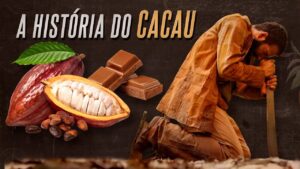
A História da origem do cacau e do chocolate

Como o chocolate é feito - Processo Industrial

Fabrica de Chocolate05:55
History of cocoa: Origins, expansion and economic impact
1. The cacao tree: The tree of golden fruits
The cocoatree, Theobroma cacao, is the plant that produces cocoa, a fruit of great economic importance. It belongs to the Malvaceae family and the Theobroma genus. The cacao tree is found mainly in Brazil in the North (Acre, Amazonas, Amapá, Pará and Rondônia), Northeast (Bahia, Maranhão and Sergipe) and Southeast (Espírito Santo) regions.
Cacao is the fruit of the cacao tree(Theobroma cacao), a plant native to the American tropical rainforest. In Brazil it is mainly found in the forests of the Atlantic Rainforest, especially in the states of Bahia and Espírito Santo.
This plant has enormous commercial value and is widely exploited economically as its seeds, once dried and processed, are used to make chocolate.
The cacao tree originated in the rainforest regions of tropical America, where it still grows wild today, from Peru to Mexico. It is classified in the genus Theobroma, which belongs to the family Sterculiaceae.
It was first mentioned in botanical literature by Charles de l’Ecluse, who described it under the name Cacao fructus. In 1937 it was described as Theobroma fructus by Linneu, who in 1753 proposed the name Theobroma cacao, which has remained to this day.
Botanists believe that cocoa originated in the headwaters of the Amazon River and spread in two main directions, giving rise to two major groups: Criollo and Forastero.
The Criollo, which has spread northwards to the Orinoco River and into Central America and southern Mexico, produces large fruits with a wrinkled surface. Its seeds are large, with a white or pale purple interior. It was the type of cacao grown by the Aztec and Mayan Indians.
The Forastero spread throughout the Amazon Basin and towards the Guianas. It is considered to be the true Brazilian cocoa and is characterised by ovoid fruits with a smooth, imperceptibly furrowed or wrinkled surface. The inside of the seeds is dark purple or sometimes almost black.
To grow best, the cacao tree needs deep, rich soils and a warm, humid climate with an average temperature of around 25°C and annual rainfall of between 1,500 and 2,000 millimetres without long dry spells.
2. Cocoa’s long journey
As cocoa gained economic importance with the expansion of chocolate consumption, several attempts were made to plant cocoa in other regions with climate and soil conditions similar to those of its natural habitat.
As a result, its seeds gradually spread around the world. By the middle of the 18th century, cocoa had reached the south of Bahia, and in the second half of the 19th century it was taken to Africa.
The first African plantations were established around 1855 on the Islands of São Tomé and Príncipe, Portuguese colonies off the west coast of Africa.
Officially, cacao cultivation began in Brazil in 1679, with a Royal Charter authorising the colonists to plant it on their lands.
Several attempts in Pará failed, mainly due to the region’s poor soils. Nevertheless, by 1780, Pará was producing more than 100 arrobas of cocoa.
Cultivation was not consolidated at that time, however, and remained an extractive activity until recent years.
3. Cocoa: A wealth-generating foreign currency
In 1746, Antônio Dias Ribeiro, from Bahia, received some seeds of the Amelonado – Forastero group from a French colonist, Luiz Frederico Warneau, from Pará, and introduced the crop to Bahia.
The first planting in the state was at Fazenda Cubículo, on the banks of the Rio Pardo, in the modern municipality of Canavieiras. In 1752, plantations were established in the municipality of Ilhéus.
Cocoa has adapted well to the climate and soil of Southern Bahia, a region that today produces 95 per cent of Brazil’s cocoa, with Espírito Santo accounting for 3.5 per cent and the Amazon for 1.5 per cent.
Brazil is the 5th largest cocoa producer in the world, along with Ivory Coast, Ghana, Nigeria and Cameroon. In 1979/80, Brazilian cocoa production exceeded 310,000 tonnes.
About 90 per cent of all Brazilian cocoa is exported, generating foreign exchange for the country. In the period 1975-1980, cocoa generated 3 billion 618 million dollars.
4. Cocoa and chocolate
The civilised world only became aware of the existence of cocoa and chocolate after Christopher Columbus discovered America.
Until then, it was the privilege of the Indians who lived in Southern Mexico, Central America and the Amazon Basin, where cocoa grew naturally in the middle of the forest.
Today, almost 5 centuries later, cocoa derivatives are consumed in many forms, in almost every country, and are part of the life of modern man.
They are everywhere:
- In soldiers’ rucksacks and students’ bags, in highly nutritious chocolate bars;
- In beauty parlours, in various forms of cosmetics;
- In social gatherings, in wines and liqueurs.
Its residues are used as fertiliser and animal feed.
Cocoa has come a long way from the Amazon rainforest to conquer the world. Its history, surrounded by legends, is full of strange episodes:
- It was used by the Aztecs as a currency;
- It provoked religious discussions about its use in monasteries because of its supposed aphrodisiac properties;
- For a long time it was the exclusive drink of the richest courts in Europe.
Its seeds, taken to other regions and continents, formed large plantations which today are an important source of work and income for millions of people.
4.1 The energy value of chocolate
Chocolate is one of the most balanced foods available, containing a balanced combination of cocoa, milk and sugar.
Due to its high carbohydrate and fat content, chocolate contains a significant amount of protein.
A 100g bar is equivalent to
- 6 eggs;
- 3 glasses of milk;
- 220 grams of white bread;
- 750 grams of fish;
- 450 grams of beef.
4.2. MULTIPLE USE OF COCOA
- Beyond chocolate
Cocoa reminds us of chocolate. It’s always been that way, ever since the Aztecs incorporated chocolate into their religious ceremonies. Today, the fruit of the cocoa tree is also used to make cocoa juice by extracting its pulp.
The cocoa liquor can also be used to make jams, liquors, fermented products – such as wine and vinegar – and syrups for confectionery, as well as nectars, ice cream, sweets and yogurt. There is a large and immediate market, especially for cocoa juice, both at home and abroad.
- Research pays off
Research carried out by MA/CEPLAC has recently begun to produce technologies that can optimise cocoa production by making full use of by-products and post-harvest residues.
As well as helping to diversify rural incomes, this programme can significantly increase the net income of cocoa producers, making them less dependent on fluctuations in the foreign market, which regulates the price of the product.
- Cocoa beans are worth gold
The cocoa tree has always been grown to produce only the seeds of its fruit, which are the raw material for the chocolate industry. The dried seeds make up no more than 10 per cent of the weight of the cacao fruit.
It is only recently that the remaining 90 per cent has begun to attract the interest of producers, following studies carried out by MA/CEPLAC technicians. One tonne of dried cocoa, for example, corresponds to 400 to 425 kg of whole nibs.
- Cocoa shells can also be used
The husk of thecocoa fruit can also be used economically, according to research by MA/CEPLAC technicians.
It can be used to feed cattle, both fresh and in the form of dried husk meal or silage, as well as pigs, poultry and even fish.
The cacao fruit shell can also be used to produce biogas and biofertiliser, in the composting or vermicomposting process, to obtain microbial or unicellular protein, to produce alcohol and to extract pectin. One tonne of dried cocoa produces 8 tonnes of fresh shells.
- The exotic flavour of cocoa
Cocoa juice has a very distinctive flavour, considered exotic and very pleasant to the palate, similar to the juice of other tropical fruits such as bacuri, cupuaçu, graviola, acerola and taperebá.
It is fibrous and rich in sugars (glucose, fructose and sucrose) and pectin. In terms of protein and some vitamins, it is equivalent to acerola, guava and umbu juices. Some of the substances in cocoa juice give it a high viscosity and pasty appearance.
- Hand in hand
Stimulating the production of cocoa juice and opening up markets for producers by pooling efforts and diluting costs.
These, in a nutshell, are the aims of the cocoa producers who have set up their Association of Cocoa Fruit and Pulp Producers of the Rio das Contas Valley.
CEPLAC supports this initiative and even co-sponsored a workshop in Bahia’s cocoa region on“The Recovery of the Agroindustrial Pole of the Rio de Contas Valley“.
Aprosuco has its headquarters (currently under construction) in the cocoa region itself, in the city of Ipiaú.
Cocoa by-products based on an annual productivity of 750 kg of dry product per hectare:
| By-products | Cocoa Yields |
|---|---|
| Dried cocoa | 750 kg |
| Dried seeds | 100 kg |
| Cocoa Honey | 200 Litres |
| Jelly | 150 kg |
| White vinegar | 180 litres |
| Distillate | 25 litres |
| Chemical pulp | 300 to 400 litres |
| Frozen juice | 300 to 400 litres |
| Nectar | 600 to 800 litres |
| Jellied | 200 to 300 litres |
Bahia.ws is the largest tourist guide to Bahia and Salvador.

Publicações Relacionadas
Arembepe: beaches (Piruí, Praia do Canto), Hippie Village and the Tamar Project

Paranaguá Palace — History, architecture and visiting information | Ilhéus (BA)

São Jorge Parish Church in Ilhéus — history, architecture and religious art

History of the Convent and Church of Nossa Senhora da Piedade in Ilhéus

São Sebastião Cathedral (Ilhéus) — History, architecture and tourism
The 15 Most Visited and Well-Known Beaches in Bahia

The 3 most paradisiacal beaches in Bahia

Skydiving, Paragliding and Ballooning in Bahia

Historic Towns in Bahia: A Journey Through Time
Places to visit on the south coast of Bahia

História da Arte - Caracteristicas, Aspectos e Periodos
Tourist Attractions in Bahia: main attractions, beaches and cities

Subaúma, Bahia: where it is, things to do and where to stay
Massarandupió Naturist Beach, Bahia: Rules and Access
Beaches on the South Coast of Bahia: 10 Best and Tips
Towns and the Abrolhos Archipelago — The southernmost tip of Bahia

Baixio: Between lagoons, dunes and the charm of a village surrounded by nature
Best Beaches in Bahia: Your Guide to Paradise
Salinas da Margarida (BA) — Beaches, Attractions and a Complete Guide

Guarajuba Beach, Bahia: Natural Pools and Tips

Barra do Cahy: Brazil's first beach - history and nature

Garcez Beach: Discover Paradise in Jaguaripe

Barreiras: An Ecological Paradise in Bahia
Catabrigas Waterfall — A natural haven in Ibirajá, Itanhém (BA)

Serra Grande: Your Guide to Bahia's Paradise
Corumbau, Bahia: Ponta de Corumbau, beaches, map, how to go

Taipu de Fora: Discovering Natural Pools

Iguaí: A Guide to Waterfalls and Relaxation
Morro de São Paulo: Map, Beaches & How to Get There (2026)
Tourism in São Francisco do Conde (BA) — Tips and Attractions
Todos-os-Santos Bay (Bahia) — History, geography and conservation
Todos os Santos Bay — Nature, History and Water-based Tourism
Bay of Todos os Santos: nature, history and cultur

Rafting in Taboquinhas: The Ultimate Adventure Guide

Abseiling Sites in Bahia: Top Locations to Explore

Diving Spots in Bahia: Discover Underwater Treasures
This post is also on:
 Português
  English
  Deutsch
  Español
  Français