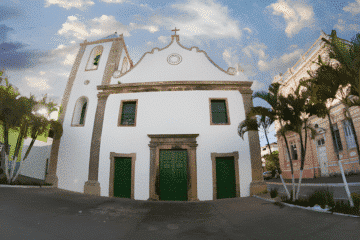
The Bonfim Church, officially the Basílica do Senhor do Bonfim, is the most famous church in Salvador. It stands on the Colina Sagrada (Sacred Hill), in the Cidade Baixa, and is known for the Lavagem do Bonfim and for the ribbons tied to its railings. In this guide, therefore, you […]
Tag: Salvador
Musical Style and History of Samba de Roda
Discover the cultural richness of the samba de roda: Origins, Instruments and Intangible Heritage Samba de Roda is a more primitive musical variant of the samba, which originated in the Brazilian state of Bahia in the 17th century, probably in the 19th century. This traditional Afro-Brazilian musical style is associated […]
Olodum pays tribute to Michael Jackson in Pelourinho, Salvador
On June 26, 2009, the band Olodum held a tribute to Michael Jackson at Largo do Pelourinho in Salvador—the location where the artist filmed scenes for the music video “They Don’t Care About Us” in February 1996. Thirty musicians performed for the passersby. Memories and emotion Ubiraci Carvalho, known as […]
Novos Baianos: A Journey Through Brazilian Music
The New Bahians: The musical revolution of Bahia in the 1960s and 1970s The Novos Baianos were formed in Bahia in the 1960s by Paulinho Boca de Cantor, Pepeu Gomes, Moraes Moreira, Dadi, Galvão, Jorginho, Baixinho, Bolacha and Baby. The group made their debut with the show “Desembarque dos Bichos […]
The evolution of carnival: traditions and stories
The fascinating history and evolution of carnival: from ancient times to today The origin of Carnival is a controversial subject. Some historians associate the beginning of Carnival celebrations with ancient rituals performed to praise good harvests, ten thousand years before Christ. Historical influences Others say it began later, in Egypt, […]
Biography of Raul Seixas: Life and Musical Career
Biography of Raul Seixas: The journey of a Brazilian rock legend Childhood and influences Raul Seixas (Raul dos Santos Seixas) was born in Salvador, Bahia, on 28 June 1945, the son of Raul Varella Seixas and Maria Eugênia Seixas. He comes from the same region and generation as Gilberto Gil, […]
Tourist Areas in Bahia – Tourist Guide
Tourism in Bahia is characterised by the fact that the state is one of the most important tourist centres in Brazil. Bahia has an immense variety of landscapes, cultural traditions and attractions, allowing it to be divided into tourist areas, each with a name characteristic of its main physical and […]
Origin of capoeira: Brazilian or African? History
The origin of capoeira lies with the enslaved Africans brought to Brazil and their descendants. They blended fighting styles, dances, songs and rhythms from many parts of Africa, especially the Bantu region, and thus created on Brazilian soil an art that is at once a fight, a dance, music and […]
Candomblé: Origins, History and Traditions
Candomblé: An Afro-Brazilian religion Candomblé is an Afro-Brazilian religion that developed in the 19th century, particularly in Brazil, from a mixture of African religious traditions brought by slaves, mainly from the region of modern-day Benin and Nigeria, with elements of Catholicism and indigenous traditions. Origins and cultural resistance Its origins […]
Discover the History of Capoeira in Salvador
Capoeira in Salvador: An authentic martial art Salvador, in Bahia, is one of the birthplaces of capoeira and offers numerous opportunities to see this martial art in its most authentic setting. The city is home to many renowned capoeira groups and historical sites where capoeira is practised regularly. The history […]
Iemanjá Festival: Meaning and Celebrations
Iemanjá, thousands of Bahians and tourists flock to the beaches of Rio Vermelho in Salvador every year on 2 February. The goddess Iemanjá Iyemanjá, Yemanjá, Yemaya, Iemoja or Yemoja is an African orisha whose name derives from the Yoruba expression “Yèyé omo ejá” (“Mother whose children are fish”). Identified in […]
The Baiana costume in Salvador, Bahia: Origin and Significance
The Baiana costume in Salvador, Bahia: a cultural expression The Baiana costume is one of the most recognisable symbols of Salvador and the whole of Bahia. Combining African, Portuguese and Islamic influences, it reflects the strength of African culture in Brazil and complements the rebolado and ginga of the Baianas as they move through the city’s streets, hills and festivals. In […]
The Origins and History of Acarajé: Discover the Afro-Brazilian Tradition
Acarajé: An Expression of Afro-Brazilian Tradition Acarajé is much more than just a dish from Bahian cuisine; it is a true expression of the rich Afro-Brazilian tradition. With roots stretching back to Africa, this delicacy symbolises the fusion of cultures and the resilience of Afro-descendant communities over the centuries. Street Trading in Salvador Sold on the streets […]
Afro-Brazilian Religions: History of Candomblé and Umbanda
The history of Afro-Brazilian religions begins with the forced encounter between the African peoples brought over by slavery and the Indigenous and European cultures of Brazil. Out of this coexistence, distinct traditions were born, such as candomblé and umbanda, which are linked by common roots and by a long path […]
The origins of Afro hairstyles in Salvador, Bahia
Afro hairstyles in Salvador have deep roots in African culture brought by enslaved peoples during the colonial period. These hairstyles are an essential part of the identity and resilience of African peoples and Afro-descendants in Bahia and Brazil as a whole. Video about Afro hair styles in Salvador Afro Hairstyles […]