Map of Mexico and Central America, 1671 – Historical Map

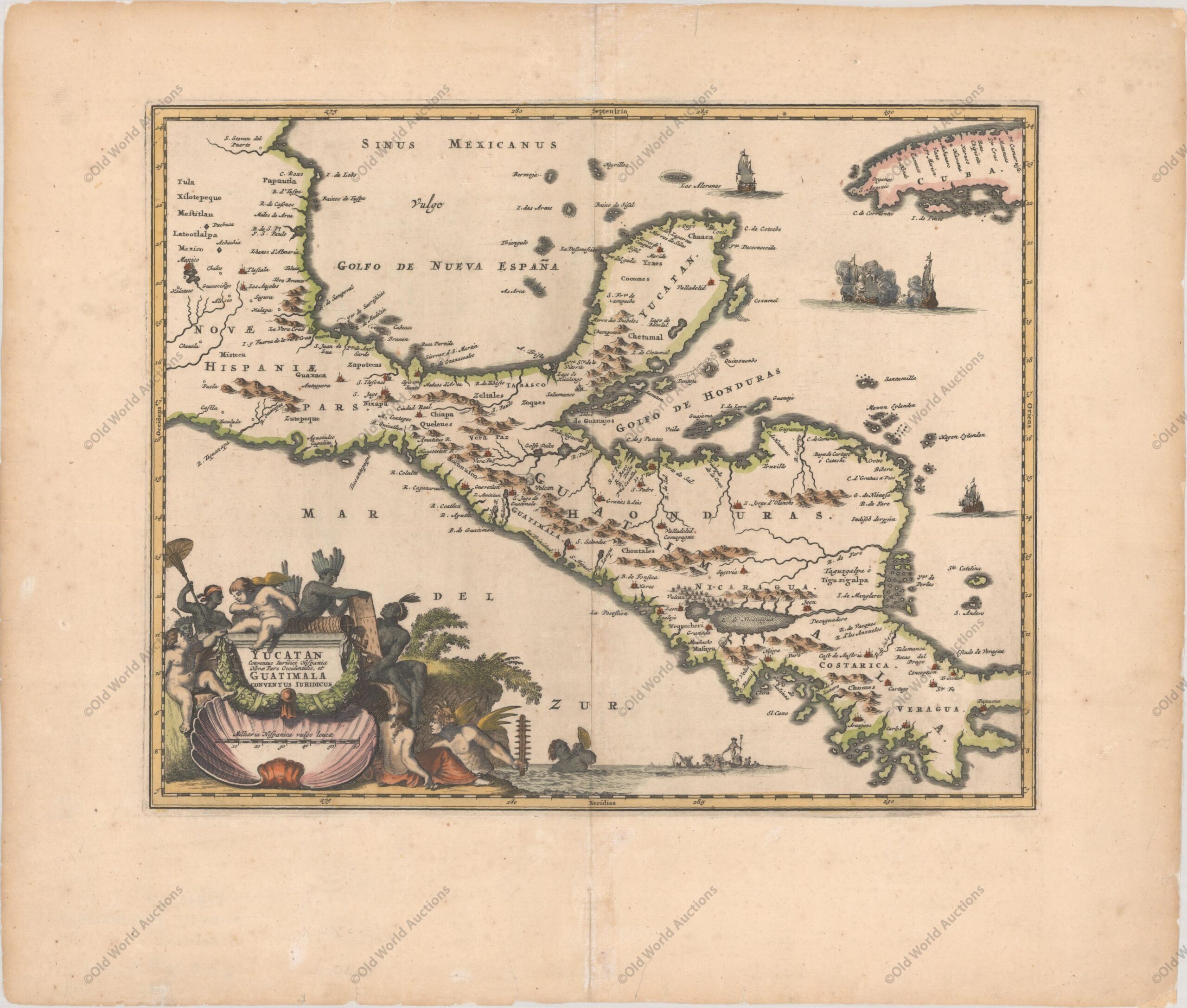
Map of Mexico and Central America from 1671"Yucatan Conventus Iuridici Hispaniae Novae Pars Occidentalis, et Guatimala Conventus Iuridicus", Montanus/Ogilby Montanus' work was perhaps the greatest illustrated book on the New World produced in the seventeenth century. It contained over one hundred beautifully engraved plates, views, and maps of North and South America. The plates vividly depict forts, festivals, occupations, Dutch fleets, battles, religious rites, and customs of the native inhabitants. This important work was translated into German by Olivier Dapper, and into English by John Ogilby. Several of the plates were later acquired by Pierre Vander Aa. This decorative map covers the region from Mexico City to Panama City and extends to include part of Cuba, and is based on Blaeu's map of the Yucatan peninsula. Cozumel is named, and Lake Nicaragua is presented on an east-west orientation. This map is richly adorned with ships engaged in battle, Neptune and his entourage, and an elaborate title cartouche with Natives, putti, and a large shell. Map of Mexico and Central America from 1671 - Historical Map
Map of Mexico and Central America, 1671 “Yucatan Conventus Iuridici Hispaniae Novae Pars Occidentalis, et Guatimala Conventus Iuridicus”, Montanus/Ogilby Montanus’s work was perhaps the greatest illustrated book of the New World produced in the seventeenth century. It contained over one hundred beautifully engraved plates, views and maps of North and South America. The plates vividly depicted forts, festivals, occupations, Dutch fleets, battles, religious rites and native customs. This important work was translated into German by Olivier Dapper and into English by John Ogilby. Some of the plates were later acquired by Pierre Vander Aa. This decorative map covers the region from Mexico City to Panama City, including part of Cuba, and is based on Blaeu’s map of the Yucatan Peninsula. Cozumel is named and Lake Nicaragua is shown in an east-west orientation. This map is richly decorated with ships in battle, Neptune and his entourage, and an elaborate title cartouche with natives, putti, and a large shell. Map of Mexico and Central America of 1671 – Historical Map

Map of Mexico and Central America, 1671

“Yucatan Conventus Iuridici Hispaniae Novae Pars Occidentalis, et Guatimala Conventus Iuridicus”, Montanus/Ogilby

Montanus’ work was perhaps the greatest illustrated book on the New World produced in the seventeenth century.

It contained over one hundred beautifully engraved plates, views and maps of North and South America.

The plates vividly depicted forts, festivals, occupations, Dutch fleets, battles, religious rites and native customs.

This important work was translated into German by Olivier Dapper and into English by John Ogilby. Some of the plates were later acquired by Pierre Vander Aa.

This decorative map covers the region from Mexico City to Panama City, including part of Cuba, and is based on Blaeu’s map of the Yucatan Peninsula.

Cozumel is named and Lake Nicaragua is shown in an east-west orientation.

This map is richly decorated with ships in battle, Neptune and his entourage, and an elaborate title cartouche with natives, putti, and a large shell.

Map of Mexico and Central America 1671 – Historical Map
Publicações Relacionadas

Map of the Captaincy of Paraíba and Rio Grande, 1720

Map of Rio de Janeiro, 1840 - Historical Map

Map of Africa 1593 - Historical Map

Gravura da Baia de Todos os Santos de 1690

1579 Map of the Western Hemisphere - Historical Map

Map of Rio de Janeiro from 1682 - Historical Map

Map of Rio de Janeiro, 1775 - Historical Map

1587 Map of the Western Hemisphere - Historical Map

All Saints Bay Map of 1644 - Historical Map

View of Rio de Janeiro in 1840: Beauty Captured

Map of Europe from 1644: A Classic Antique

1730 Map of the Western Hemisphere - Historical Map

Map of Brazil 1698 - Historical Maps of Brazil

Engraving of Todos os Santos Bay from 1671 Explained

1638 Map of South America - Historical Map

Map of Brazil from 1630: Cartography's Legacy

1659 Map of the Western Hemisphere - Historical Map

1727 Map of the Western Hemisphere - Historical Map

Map of South America from 1750 - Historical Maps of Brazil

1666 Map of the Gulf of Mexico and the Caribbean - Historical Map

Map of Brazil from 1695: A Historical Overview

Map of South America, 1840

1823 Map of Brazil - Historical Map

Map of the Captaincy of Espírito Santo and Porto Seguro from 1698

1677 Map of the Western Hemisphere - Historical Map

Map of Rio de Janeiro of 1810 - Historical Map

Engraving of the Fort of the Three Kings in Natal, 1671

1679 Map of Recife - Historical Map

1581 Map of the Western Hemisphere - Historical Map

Map of Madeira and the Canary Islands from 1692

Painting of the Three Kings Fort in Natal from 1647

1620 Map of Portugal and Spain - Historical Map

Map of Brazil 1747 - Historical Map of Brazil

Map of Brazil 1554 - Historical Maps of Brazil

Map of the Cape Verde Islands, 1697

Map of West Africa and the Cape Verde Islands from 1699

This post is also on: English