Explore Brazil’s islands: Oceanic and continental diversity
The thermilogical distinction between the two types of island, oceanic and continental, is related to the distance from the continent.
If the island is close to the coast of the mainland, it is called continental, and if it is far away, lost in the middle of the oceans, it is called oceanic.
1. Oceanic islands
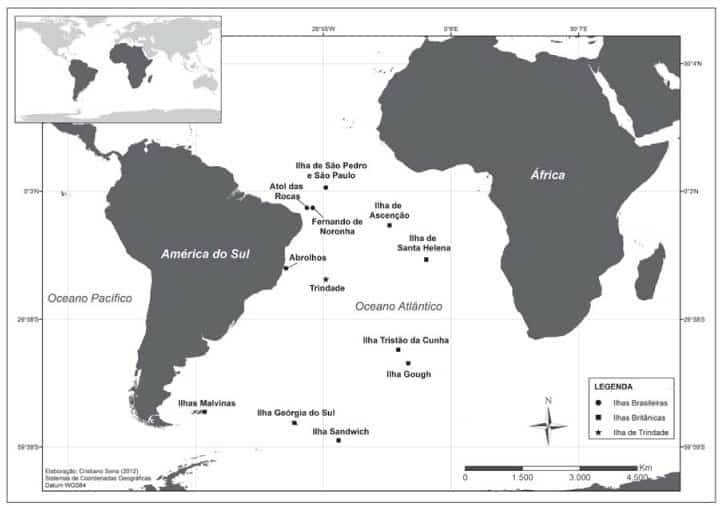
Brazil’s oceanic islands are
- Fernando de Noronha Archipelago
- Trindade and Martim Vaz Islands
- Penedos de São Pedro e São Paulo
- Rocas Atoll
Located more than 150 kilometres off the Brazilian coast, in the middle of the Atlantic Ocean.
1.1 Fernando de Noronha Archipelago.
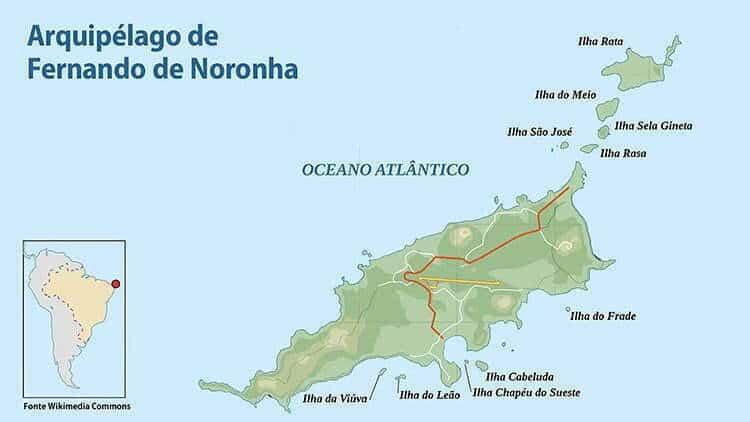
Located 360 kilometres off the coast of Rio Grande do Norte, it is made up of several volcanic islands. It was incorporated into the state of Pernambuco in 1998. It is the only Brazilian oceanic archipelago inhabited by a permanent population.
The archipelago has a semi-arid tropical climate, sparse vegetation and volcanic mountainous terrain.

Tubarões no Arquipelago de Fernando de Noronha
1.2 Trindade and Martim Vaz Islands.
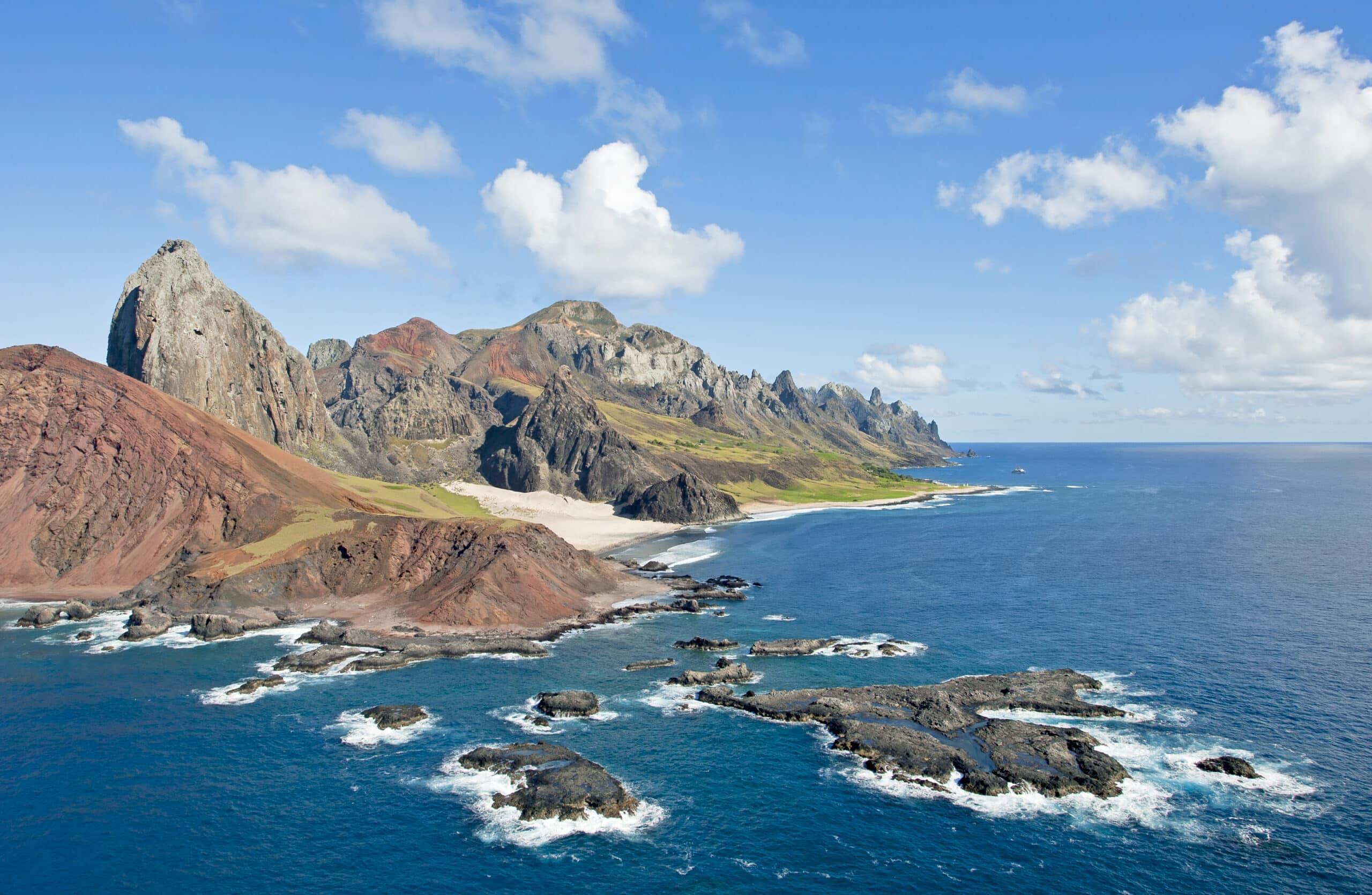
These islands of volcanic origin are located 1,200 kilometres from Espírito Santo. They are uninhabited, but the Brazilian Navy has a base on Trindade Island.
1.3 Penedos de São Pedro e São Paulo.
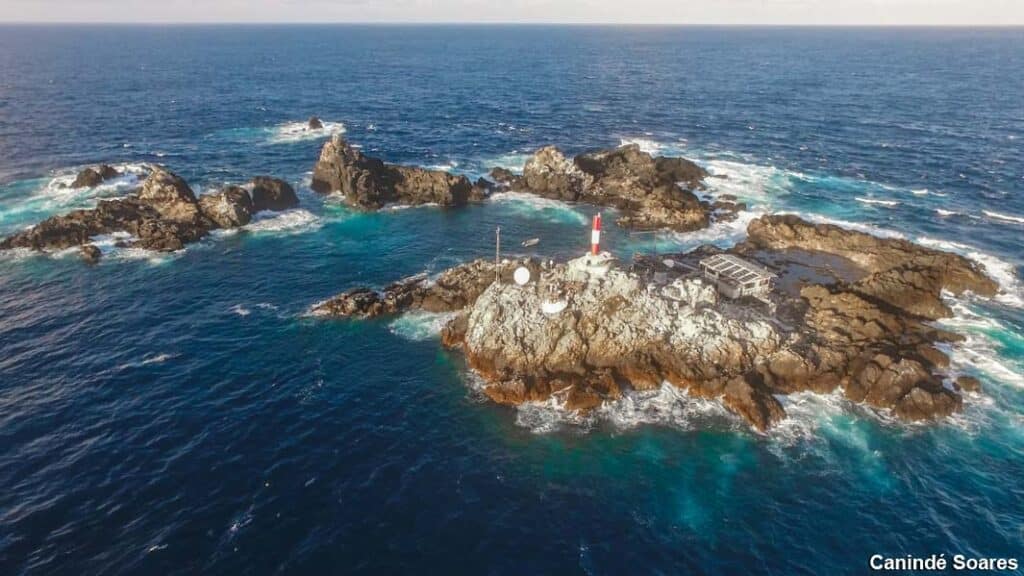
It is made up of a group of small islands of volcanic origin, no more than 600 metres high and no more than 20 metres above the sea. They have no vegetation and are used as landing sites by sea birds.
1.4. Rocas Atoll.
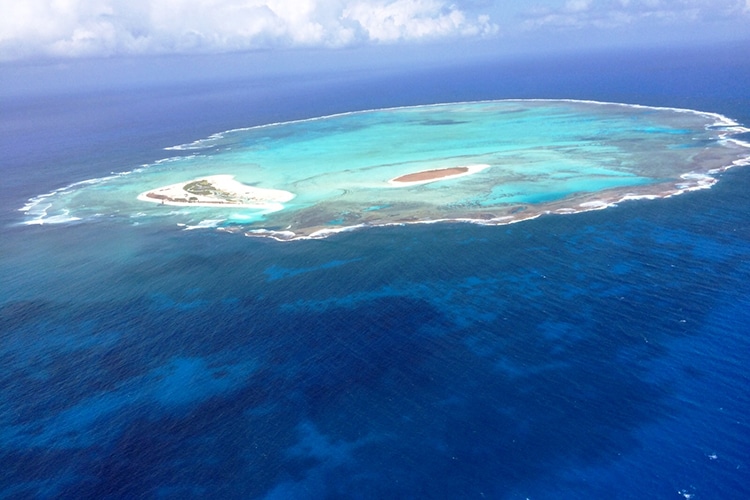
Located between Fernando de Noronha and the coast of Rio Grande do Norte. It is surrounded by reefs, corals and inhabited by a wide variety of plant and animal species.
Since 1979 it has been a biological reserve for conservation, study and research. Access to the area is restricted, and only small groups accompanied by Ibama rangers can visit for research purposes.
2. Continental islands
Continental islands are those that form as an extension of the continent and are also called remnant islands.
They are almost always formed by the erosion of continental areas, which causes part of the land to be invaded by the sea, isolating some points.
In some cases, they are classified as fluvial-marine, with the sea on one side and the river on the other, such as Marajó Island.
2.1 Santa Catarina Island (SC).
The island is the largest of an archipelago of more than 30 islands, most of which belong to the municipality of Florianópolis. The archipelago also includes islands in neighbouring municipalities, such as Anhatomirim Island, Cabras Island, Arvoredo Island, Deserta Island and Galés Island, among others.
The island of Santa Catarina is connected to the mainland by three bridges: the Hercílio Luz Bridge, the Colombo Salles Bridge and the Pedro Ivo Campos Bridge. These bridges span a channel that is about 500 metres wide and up to 28 metres deep. The resulting strait gives its name to one of the city’s mainland neighbourhoods and separates the southern and northern bays.
2.2 Marajó Island (PA)
With an area of 40,100 km², it is the largest coastal island in Brazil and the largest fluvial-marine island in the world (bathed by both river and ocean waters), surrounded by the Amazon River to the west and northwest, the Atlantic Ocean to the north and northeast, the Bay of Marajó to the east and southeast, and the complex of distributaries of the Tocantins and Pará Rivers to the south.
2.3 São Luis Island (MA).
São Luís (often called São Luís do Maranhão) is a Brazilian municipality and the capital of the state of Maranhão.
2.4 Ilhabela (SP)
Ilhabela is one of Brazil’s only marine archipelago municipalities, located on the north coast of the state of São Paulo.
2.5 Ilha do Mel (PR)
Ilha do Mel is a Brazilian island located at the mouth of Paranaguá Bay, in the state of Paraná.
2.6 Itamaracá Island (PE)
Itamaracá Island is a Brazilian municipality in the state of Pernambuco, in the metropolitan region of Recife. The area of the municipality corresponds to the whole of the island of the same name, located on the north coast of Pernambuco and separated from the mainland by the Santa Cruz Channel, which for some scholars gave rise to the name “Pernambuco”.
2.7 Itaparica Island (BA)
Itaparica is the largest island in Brazil. Located in the Bay of All Saints, in the state of Bahia, its 239 square kilometres are divided between the municipalities of Itaparica and Vera Cruz. It is over 36 kilometres long.
Brazil has oceanic and continental islands
Publicações Relacionadas
Itamaracá Island: Best Attractions and Activities
Alcatrazes Archipelago: Secrets of Evolution Revealed
Jararaca-ilhoa: Endemic Species of Queimada Grande
Marajó Archipelago: A Unique Ecological Paradise
Atol das Rocas - Origin, biology, climate and shipwrecks
Ponta do Boi Lighthouse: History and Significance
São Pedro e São Paulo Archipelago: An Overview
History and Heritage of Itaparica Island — Bay of Todos os Santos
Ilhabela: A Tropical Paradise Awaiting You
Florianópolis: A Blend of Urban and Natural Beauty
Trindade and Martim Vaz: Discovering the Archipelago
Ilha Grande: The Ultimate Tropical Paradise
Anchieta Island: History, Beaches, and Nature
This post is also on:
 Português
  English
  Deutsch
  Español
  Français