In this travel guide, you’ll find out how to visit the Parque dos Falcões and the Serra de Itabaiana, two very popular ecotourism destinations in Sergipe. Both are located in the municipality of Itabaiana, less than an hour from Aracaju, and can be visited on the same day.
Parque dos Falcões in Itabaiana, Sergipe

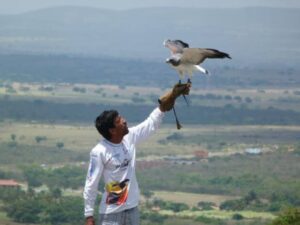
The Parque dos Falcões is a centre for the conservation, breeding and rehabilitation of birds of prey. It is situated in the village of Gandu II, in Itabaiana, at the foot of the Serra de Itabaiana, and is known for its work with falcons, owls, hawks, caracaras and other birds.

Things to Do at Parque dos Falcões
Birds of Prey Exhibition
The park is home to around 300 birds, including sparrowhawks, falcons, owls, caracaras and other species. Visitors can observe the animals up close and learn about each one’s behaviour.
Flight Demonstrations
The flight displays are one of the highlights. The trainers demonstrate the birds’ abilities by simulating attacks on imaginary prey and flying low over the visitors.
Environmental Education
The park offers educational sessions on the importance of protecting birds of prey and the environment.
Bird Rehabilitation
The park takes in rescued and abused animals and works to return them to the wild wherever possible. Visitors learn about their rescue and rehabilitation stories.

Tips for Visiting Parque dos Falcões
Opening Hours and Appointments
The park is open every day, but visits must be booked in advance. Visits usually take place in the morning and in the afternoon. Please check the dates, times and prices on the official Parque dos Falcões website before you go.
Entrance
There is an admission charge. The most recent prices we found were R$ 25 for adults and R$ 15 for children aged 8 to 12, with free entry for children under 7. As prices are subject to change, please check before your visit.
How to get there
The park is situated about 45 km from Aracaju, on the BR-235. It can be reached by car: after Areia Branca, follow the sign and turn onto the dirt track. There are signs along the way.
History of Parque dos Falcões
Parque dos Falcões was born out of the work of two dreamers, José Percílio Costa and Alexandre Correia. Alexandre became Percílio’s partner in 1999, but the story began back in the founder’s childhood. At the age of 7, Percílio was given a caracara egg (Caracara plancus). After 28 days of being incubated by a hen, Tito was born – his first great friend.
Building on this history, the project has grown and now looks after around 300 birds, including sparrowhawks, falcons, owls and other species. The park is well known to tourists, students, biologists and researchers from Brazil and abroad.
He has authorisation from IBAMA to keep these birds in captivity and is a leading expert in the management, breeding and rehabilitation of birds of prey.
Itabaiana Mountain Range: National Park

The Serra de Itabaiana is one of Sergipe’s main natural tourist attractions. Since 2005, it has been home to the Serra de Itabaiana National Park, a federal conservation area managed by the ICMBio (Chico Mendes Institute for Biodiversity Conservation).
The park was established by a decree dated 15 June 2005 and protects an area of approximately 7,966 hectares, which spans six municipalities in Sergipe: Itabaiana, Areia Branca, Campo do Brito, Itaporanga d’Ajuda, Laranjeiras and Malhador.
The highest point of the mountain range is around 660 metres above sea level, the second highest in Sergipe. The vegetation comprises areas of Atlantic Forest and caatinga, and the mountain range is an important water reserve, with waterfalls and wells that encourage ecotourism. The fauna includes reptiles, amphibians, mammals and over 120 species of birds.
Parque dos Falcões is situated next to the national park, at the foot of the mountains, but it is a separate private initiative. Among the region’s main attractions are the Poço das Moças, the Via Sacra, the Gruta da Serra and the Caldeirão.
Things to Do in the Itabaiana Mountains
Trails and Walks
The mountain range has a number of trails, such as the Via Sacra, the Caldeirão Trail, the Paredão Trail and the Gruta da Serra Trail. Some are easier, whilst others require a good level of fitness. The Caldeirão Trail and the Via Sacra usually take a few hours to complete and can be combined.
Waterfalls and Wells
The region boasts waterfalls and pools of crystal-clear water, such as the Caldeirão waterfalls, the Poço das Moças, the Poço Azul and the Poço Preto. They’re perfect for a refreshing dip after a walk.
Viewpoints and Scenery
High up in the mountains, the Cruzeiro offers panoramic views of the region.
Birdwatching and Wildlife Spotting
The mountains are a great place to spot birds and small animals, set amidst the Atlantic Forest and the Caatinga.
Tips for Visiting the Itabaiana Mountains
Best Time to Visit
During the rainy season, the waterfalls and pools are fuller, but the trails become more slippery. In the drier season, the path is firmer, but there is less water and it is hotter. Choose according to what you’re looking for and avoid the early afternoon on very hot days.
Local Guides
The region has few road signs and little support infrastructure, so it is highly recommended that you hire a local driver. Experienced guides make the trip safer and help you discover the best spots.
What to Pack
Wear suitable walking shoes, light clothing, a hat, sun cream and insect repellent. Take plenty of water, light snacks and a bag to carry your rubbish back in. Do not leave valuables unattended in busy areas, such as Poço das Moças.
How to get there
The mountain range lies between 40 and 60 km from Aracaju, via the BR-235, depending on the access point. The main entrance is just past Areia Branca and is clearly signposted. You can get there by car or on organised tours. Entry to the national park is free.
How to Combine a Visit to Parque dos Falcões and the Serra de Itabaiana
The two destinations are close to one another and complement each other perfectly. Start the morning at Parque dos Falcões, with flight demonstrations and information about the birds, and then head into the mountains to explore footpaths, natural wells and waterfalls. This combination brings together learning, adventure and contact with nature in a single day, starting from Aracaju.
Practical Information and Useful Links
- Aracaju: use the Aracaju guide as a basis for finding accommodation and other things to do.
- Full itinerary: The 7-day itinerary through Sergipe includes a day in the Serra de Itabaiana.
- Another excursion: visit Croa do Goré Island, a sandbank on the River Vaza-Barris.
- History: visit São Cristóvão, the fourth oldest city in Brazil.
- General guide: see the Sergipe Tourist Guide.
Frequently Asked Questions
Where is Parque dos Falcões?
In the village of Gandu II, in Itabaiana (SE), at the foot of the Serra de Itabaiana, some 45 km from Aracaju, on the BR-235.
Do I need to book a visit to Parque dos Falcões?
Yes. You need to book your visit in advance. Please check the dates, times and prices on the park’s official website.
How much does it cost to get into Parque dos Falcões?
The most recent prices we found were R$ 25 for adults and R$ 15 for children aged 8 to 12, with free entry for children under 7. Prices are subject to change, so please check before you go.
What is there to see at Parque dos Falcões?
Around 300 birds of prey, including sparrowhawks, falcons, owls and caracaras, as well as flight demonstrations and talks on conservation and rehabilitation.
Is Parque dos Falcões located within the Serra de Itabaiana National Park?
No. It’s next to the national park, at the foot of the mountains, but it’s a separate initiative, with its own visiting arrangements and admission fees.
Is there an entry fee for the Serra de Itabaiana National Park?
Entry to the national park is free. The main costs are usually for transport and the local guide, who is highly recommended.
Do I need a guide to go hiking in the Serra de Itabaiana?
It comes highly recommended. The area has few signposts and little infrastructure, and some sections require a good level of fitness.
When is the best time to visit the Serra de Itabaiana?
During the rainy season, the waterfalls and pools are fuller, but the trails become more slippery. In the dry season, the path is firmer, with less water.
Is it possible to visit Parque dos Falcões and the Serra de Itabaiana on the same day?
Yes. They’re both nearby. Ideally, you should visit the park in the morning and then head off to the trails and springs in the mountains afterwards.

Publicações Relacionadas
Sergipe: A Comprehensive Travel Guide to Brazil’s Smallest State
Discover São Cristóvão: A Complete Tourist Guide to a Historical Treasure in Sergipe
Ponta dos Mangues Beach and the Santa Isabel Biological Reserve: Tourist Guide
7-day itinerary around Sergipe: Aracaju, Xingó and the beaches
Laranjeiras: A Guide to Tourism and Cultural Heritage in the Heart of Sergipe
Croa do Goré Island, Aracaju (SE): A Comprehensive Travel Guide
Discover Santa Luzia Island: A Comprehensive Travel Guide to Sergipe
Xingó Canyon — Tours, How to Get There and Accommodation
The South Coast of Sergipe: A Travel Guide and Things to Do
Discover Aracaju: The Complete Travel Guide to the Capital of Sergipe
Discover Pirambu: A Comprehensive Travel Guide to the North Coast of Sergipe
Pacatuba SE and the Sergipe Pantanal: Tourist Guide
Praia do Saco (Estância, SE) — Guide: how to get there, what to do and tip
Discover Canindé de São Francisco: A Comprehensive Travel Guide to a Paradise of Culture and Nature
This post is also on:
 Português
  English
  Deutsch
  Español
  Français