The ruby is one of the world’s most valuable gemstones. The name comes from the Latin ruber, which means ‘red’. In this guide, you’ll learn about the significance of the ruby, its characteristics (colour, hardness, lustre and treatments), where it comes from and how it is used in jewellery.
A ruby is the red variety of a mineral called corundum (aluminium oxide). The colour comes from small amounts of chromium in the crystal structure. Corundum in any other colour is called sapphire, and the name ‘ruby’ is reserved for the red variety.

What is a ruby?
The ruby is one of the so-called traditional gemstones, alongside the diamond, the sapphire and the emerald. The amethyst was once counted amongst the ‘cardinal’ gemstones of jewellery. To find out how to tell one gemstone from another, see how to identify a gemstone.
Not every piece of quartz becomes a gemstone. To be considered a gemstone, the crystal must have the right transparency and colour.
The distinction between ruby and pink sapphire depends on the intensity of the red colour, rather than on the mineral’s composition. For centuries, ruby was confused with red spinel and garnet, stones that are very different in composition. The most prized colour is a pure red, vivid in intensity and with a slight bluish (slightly purplish) tinge, known as pigeon’s blood. Lighter or darker specimens lack this characteristic brilliance.

The meaning of the ruby
The red colour of the ruby has led many cultures to associate it with love, passion, courage and vitality. In jewellery, it is seen as a symbol of strength and enduring affection. The ruby is the birthstone for July.
In wedding anniversary lists, it features as the ruby anniversary, though the age varies according to tradition: the 40th anniversary in international lists and the 45th in some Brazilian lists. These meanings form part of tradition and of popular and esoteric beliefs. There is no scientific evidence of the stone having any effect on health or emotions.
Where rubies are found
The Mogok Valley in Myanmar (formerly Burma) is the historic source of the most famous rubies, and the ‘Burmese’ colour remains the benchmark to this day. Other important sources include Thailand, Sri Lanka, Madagascar, Tanzania, Vietnam and, in recent years, Mozambique.
The Montepuez mine, discovered in 2009, produced around 10 million carats in 2022, according to Wikipedia. In the United States, deposits are found in Montana and the Carolinas. In Brazil, corundum is scarce. The gemmological map of Santa Catarina, produced by the Geological Survey of Brazil mentions occurrences of ruby in Barra Velha and São João do Itaperiú, in Santa Catarina, but these are of no gemmological significance comparable to that of Asian and African sources.

Pedra Rubi - Caracteristicas, Cores e Lapidação
Rubies in jewellery: uses and value
Rubies are mainly used as gemstones in jewellery. As they are very hard, they are suitable for rings, earrings, pendants, necklaces and bracelets for everyday wear, including engagement rings. The most common cuts are cabochon, mixed cut and oval faceted.
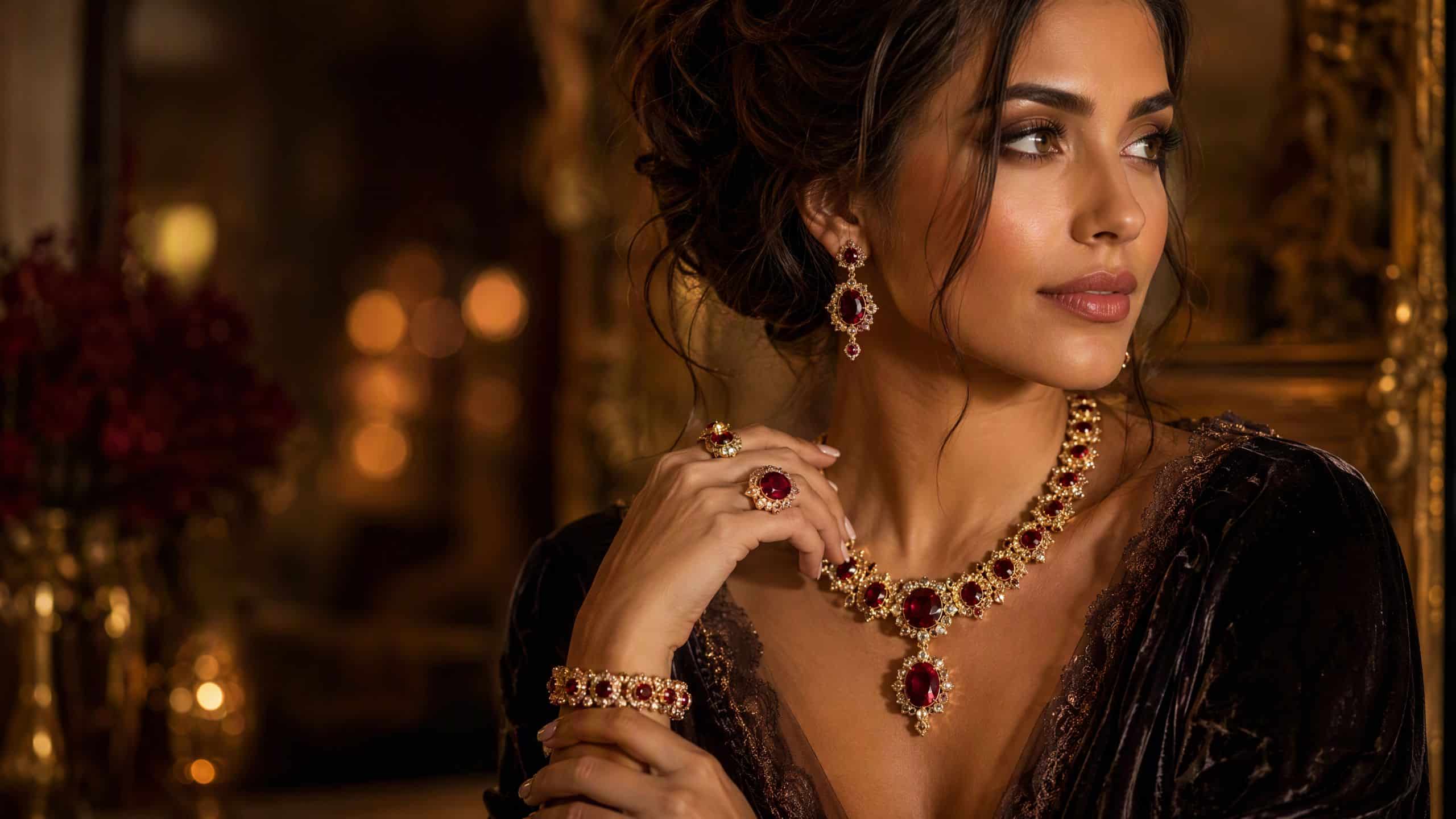
The value of a ruby depends primarily on its colour, followed by its origin, any treatments (which must be stated in a laboratory report) and its size. Transparency is assessed according to criteria specific to rubies, rather than those used for diamonds. High-quality, unheated rubies are worth considerably more.
One example is the 25.59-carat Sunrise Ruby, a Burmese ruby that has not undergone heat treatment, which was sold in 2015 for over US$30 million, according to Skyjems. In 2022, the rough ruby that became the ‘Estrela de Fura’ gem – weighing 55.22 carats after cutting – was discovered in Montepuez, Mozambique.
In 2023, it was described as the largest gem-quality ruby ever to go under the hammer, according to Gulf News. When the crystal contains microscopic rutile needles, the ruby can be cut into a cabochon and display asterism – a three- or six-pointed star – or the cat’s-eye effect, depending on the orientation of the cut. This is known as a star ruby.
Names used for rubies on the market
- Burmese or Oriental: generally considered to have the finest colour, traditionally described as ‘pigeon’s blood’ (ranging from red to a slightly purplish red, with a medium-dark tone and vivid saturation)
- beef-red: slightly darker than pigeon-red
- French or cherry colour: slightly lighter than pigeon’s blood
- Thai, Siamese or from Siam: ranging from dark red to brownish or purplish red
- from Ceylon or Sri Lanka: light in colour, often more brilliant than Burmese or Thai gemstones
- African (Umba River): typically orange-red
These names mainly describe the colour style associated with each region. The true origin of a gemstone can only be determined by a gemmological laboratory.
Composition and characteristics of the ruby
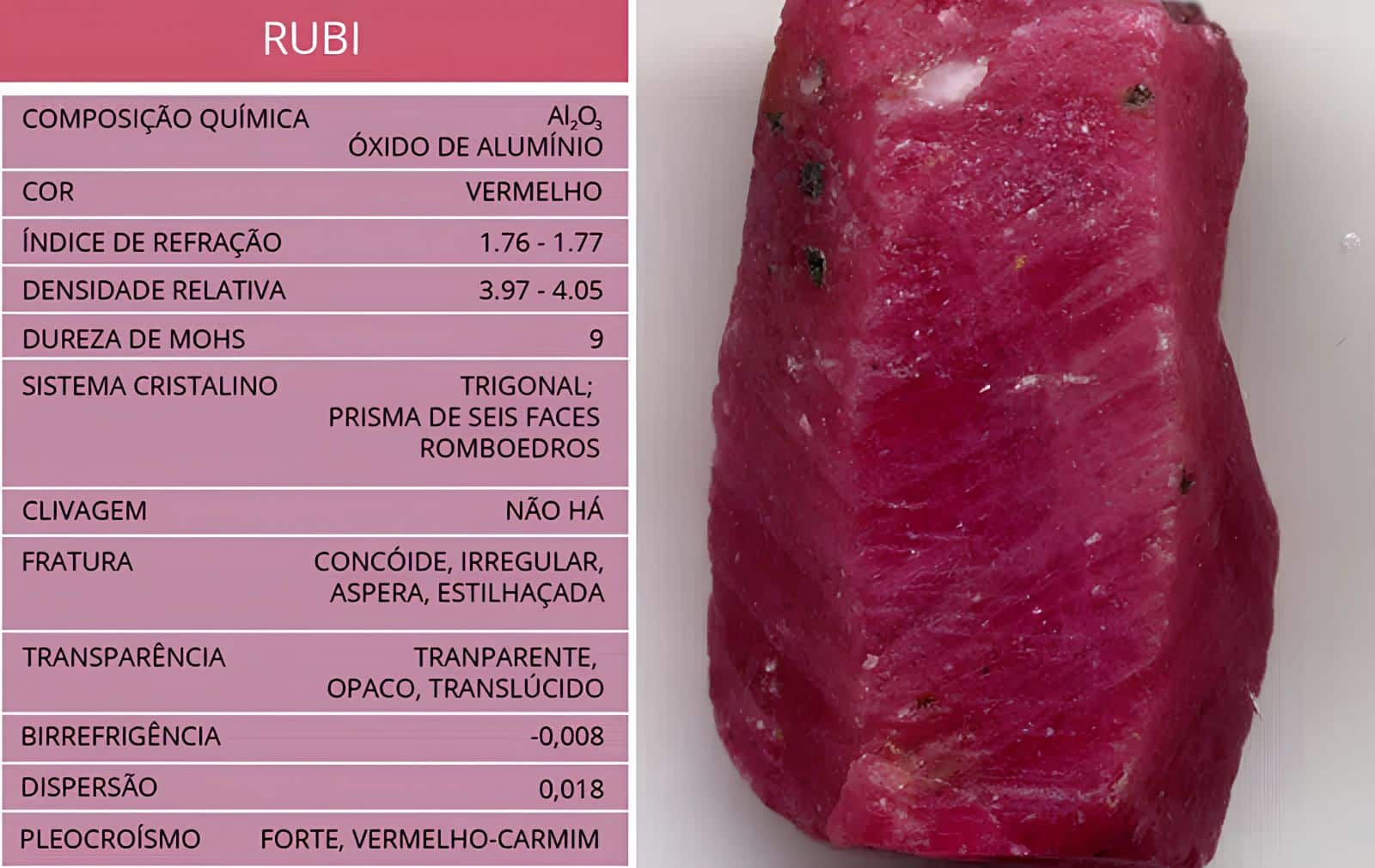
The ruby is aluminium oxide (Al₂O₃) and is one of the world’s most valuable gemstones, depending on its colour, origin and quality. All natural rubies have imperfections. The fracture is conchoidal to irregular, and the lustre is vitreous.
1. Hardness
Rubies and sapphires have a hardness of 9 on the Mohs scale, second only to diamonds amongst the gemstones most commonly used in jewellery. This indicates excellent resistance to scratching, although a heavy blow could still cause a stone to chip or crack.
2. Colour
The primary colour of a ruby is red, caused by chromium. Chromium also causes the ruby to fluoresce red under ultraviolet light. Iron tends to reduce this fluorescence and can make the colour darker or brownish, which is not desirable.
Knowing the colour of the stone helps you to understand the value of the jewellery. A stone that is too light or too dark loses its lustre. When buying a ruby pendant or ring, check the lustre and colour, and always ask for a report from a gemmological laboratory.
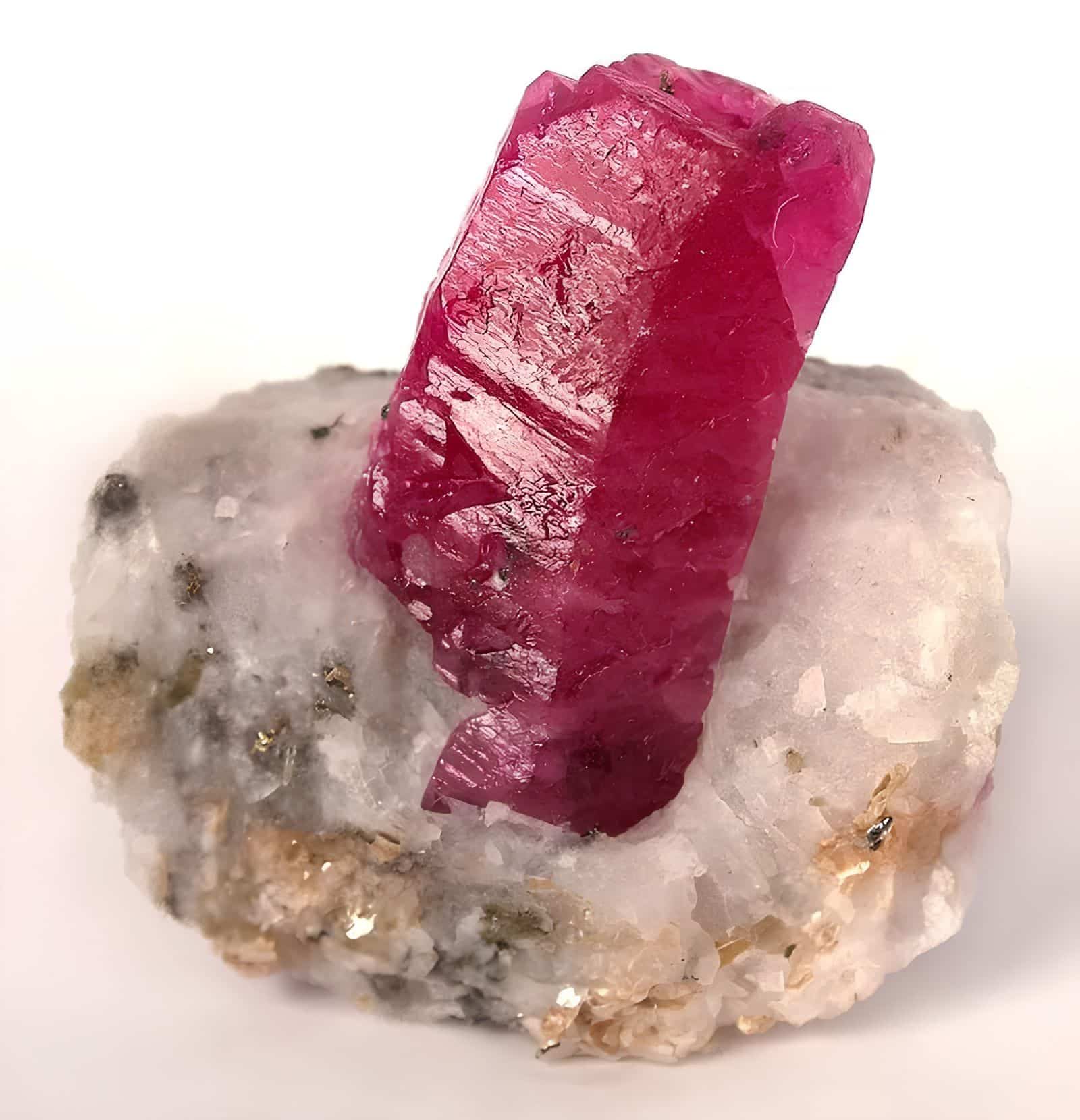
3. Transparency
From transparent to opaque. Star rubies are usually translucent.
4. Crystal system and cutting
Corundum crystallises in the trigonal (hexagonal) system, forming glassy crystals, and is found in rocks such as marble and metamorphic rocks, as well as basalt. Many stones are collected from river gravel. Rubies are often cut into cabochons, but are also cut in mixed cuts and as oval faceted stones.
5. Possible treatments
The most common treatment is heating, at temperatures ranging from around 1,300 to 1,800 °C. It improves the colour and transparency; the effect is permanent and is accepted by the market provided it is disclosed. Other treatments include:
- filling fractures with oil, resin or leaded glass, which improves the appearance but makes the stone more brittle;
- diffusion, in which elements such as beryllium are incorporated into the stone at high temperatures, which is less common.
Good-quality stones that have not been heat-treated are usually worth more. Always ask for details of any treatments before buying.
6. Possible misunderstandings
Rubies can be mistaken for red spinel (natural or synthetic), red garnet, red tourmaline (rubellite), synthetic rubies, glass and doublets (stones made by bonding two parts, such as sapphire with synthetic ruby or garnet with glass). For major purchases, ask for a report from a gemmologist or laboratory. Topaz, tourmaline and aquamarine are other gemstones that can also be mistaken for one another in shops.
7. Natural and synthetic rubies
Synthetic rubies have the same chemical composition and hardness as natural rubies, but are produced in a laboratory. The flame fusion (Verneuil) process was announced in 1903 for commercial production. Synthetic rubies cost considerably less and are sold as an alternative. The typical inclusions found in each type help the gemmologist to distinguish between them, but only laboratory tests can provide certainty.
Caring for ruby jewellery
- clean with warm water, mild soap and a soft brush;
- Ultrasound and steam are generally safe for untreated rubies, but avoid them on stones with filled fractures (lead glass), as these may be damaged;
- Keep each piece separate from the others to avoid scratching the other stones;
- Avoid harsh chemicals and intense heat.
Frequently Asked Questions
What is a ruby?
The ruby is the red variety of corundum, an aluminium oxide mineral. Its colour comes from the chromium present in the crystal.
What is the significance of the ruby?
The ruby is associated with love, passion, courage and vitality. These meanings are rooted in belief and tradition, and have no scientific basis.
Which month is the ruby the birthstone for?
It is the birthstone for July.
What is the difference between a ruby and a sapphire?
Both are corundum. Ruby is the red variety of corundum, and sapphire is the variety that comes in other colours. The distinction between ruby and pink sapphire depends on the intensity of the red.
How hard is a ruby?
It ranks 9 on the Mohs scale, second only to diamond amongst the gemstones most commonly used in jewellery. This makes it suitable for rings and other everyday jewellery.
What is a blood-of-lead ruby?
It is the traditional name for the most prized colour: a pure, slightly purplish red with vivid saturation. It has historically been associated with rubies from Mogok, in Myanmar.
Where do rubies come from?
The main sources are Myanmar, Mozambique, Thailand, Sri Lanka, Madagascar, Tanzania and Vietnam. In Brazil, rubies are rare, with occurrences reported in Santa Catarina.
How can you tell if a ruby is natural or synthetic?
Only a gemmological examination can provide certainty. Natural rubies usually have typical inclusions, but synthetic ones also have their own distinctive characteristics. When buying, ask for a laboratory report.
Are rubies treated?
Yes. Heating is very common and accepted in the industry, provided it is disclosed. Filling fractures with leaded glass is also practised, and this makes the stone more brittle.
How do you clean ruby jewellery?
Use warm water, mild soap and a soft brush. Avoid ultrasonic cleaning and steam on stones with filled fractures.
See also
- Sapphire: characteristics and properties
- Emerald: characteristics, varieties and quality
- The 4 basic diamond grades
- Amethyst: characteristics, trade and valuation
- Aquamarine: symbolism, characteristics and jewellery
- How to identify a precious stone or gemstone
- Opals: one of Brazil’s most beautiful gemstones and Malachite

Publicações Relacionadas
Emerald: Characteristics, Meaning and Jewellery
Aquamarine: Symbolism, Characteristics and Jewellery
Amethyst stone - characteristics, marketing and valuation
Pindobaçu (BA), known as the capital of emeralds
Sapphire is the purity of nature and a symbol of honesty
The malachite stone is a distinctive gemstone - Features
Opal: Meaning, Properties and Characteristics
Identifying a Precious Stone or Gemstone: A Comprehensive Guide
Jade: Meaning, Properties and Characteristics
Quartz: Meaning, Characteristics and Jewellery
Jewellery made from different types of coral - Features
Characteristics of the Paraíba Tourmaline, a rare gemstone
Diamonds: Characteristics, Meaning, Jewellery and the 4 Cs
Tiger Eye Stone - Characteristics and Cutting
Agate: Meaning, Characteristics and Jewellery
Topaz: Gemstone, Properties, Meaning and Characteristics
Tourmaline: Learn about its characteristics and varieties
This post is also on:
 Português
  English
  Deutsch
  Español
  Français