The opal is one of the world’s most admired gemstones, and Brazil has its own source of precious opal in Pedro II, in Piauí. In this guide, you’ll find out about the meaning of opal, its properties and characteristics, the different types and colours, the opal from Pedro II (Piauí), how to look after the stone and how to buy it safely. At the end, there’s an FAQ section covering the most common questions.
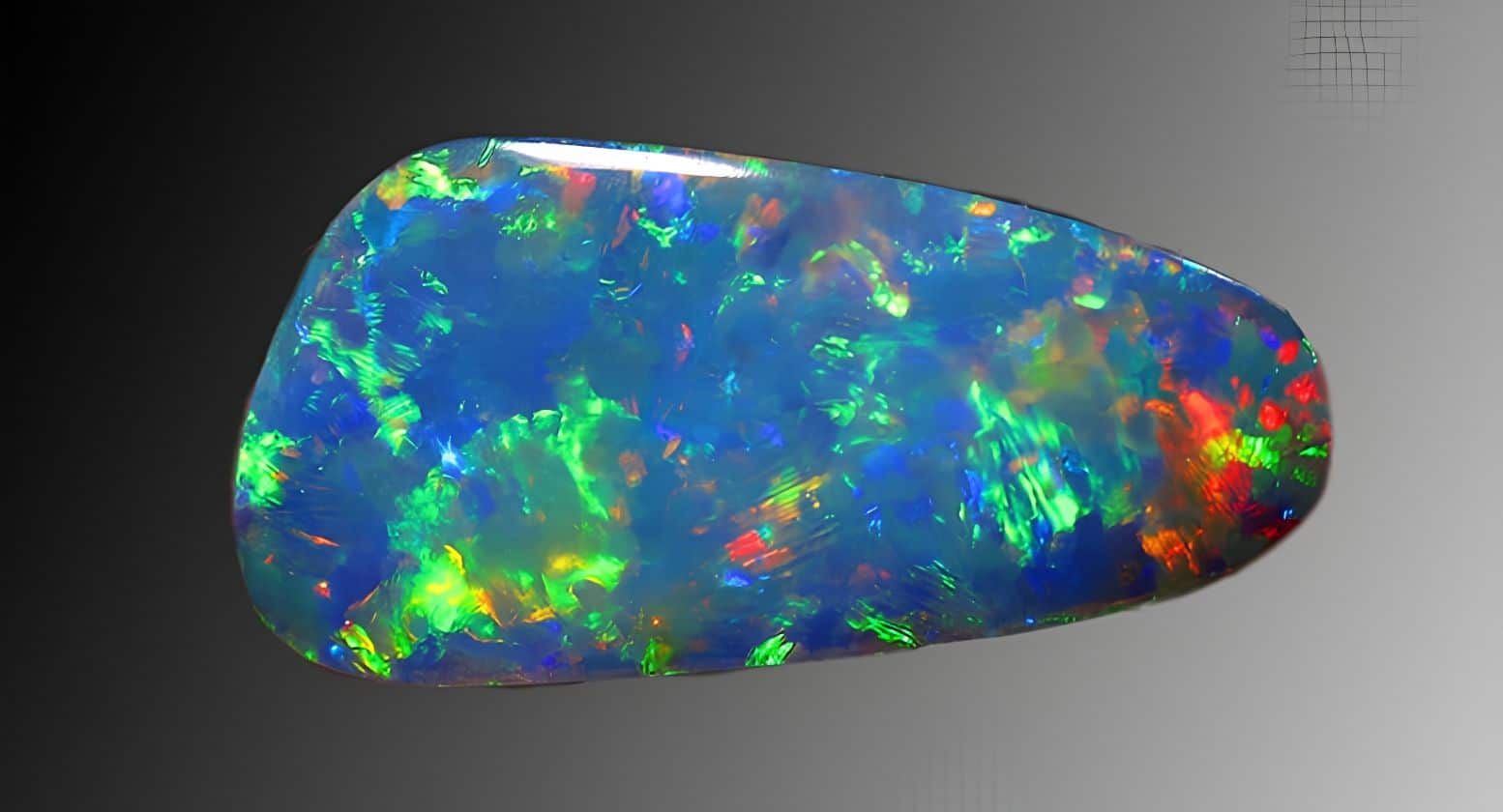
The opal is famous for its play of colour (or play-of-colour): when the stone is moved, it displays flashes of various colours of the spectrum. This effect is rare and is the main factor determining the gem’s value.
The name ‘opal’ probably derives from the Sanskrit upala, which means ‘gem’ or ‘precious stone’. According to the etymological dictionary Etymonline, the word entered the Portuguese language via the Latin opalus, a term that already appears in the writings of Pliny the Elder. The highest-quality opals are among the most valuable gemstones per carat, but there are also good-quality opal jewellery pieces available at more affordable prices.
Video about opal
Pedra Opala conquistou as joalherias do mundo inteiro
See also: Pedro II is a town steeped in history, with precious stones and archaeological sites
What is an opal?
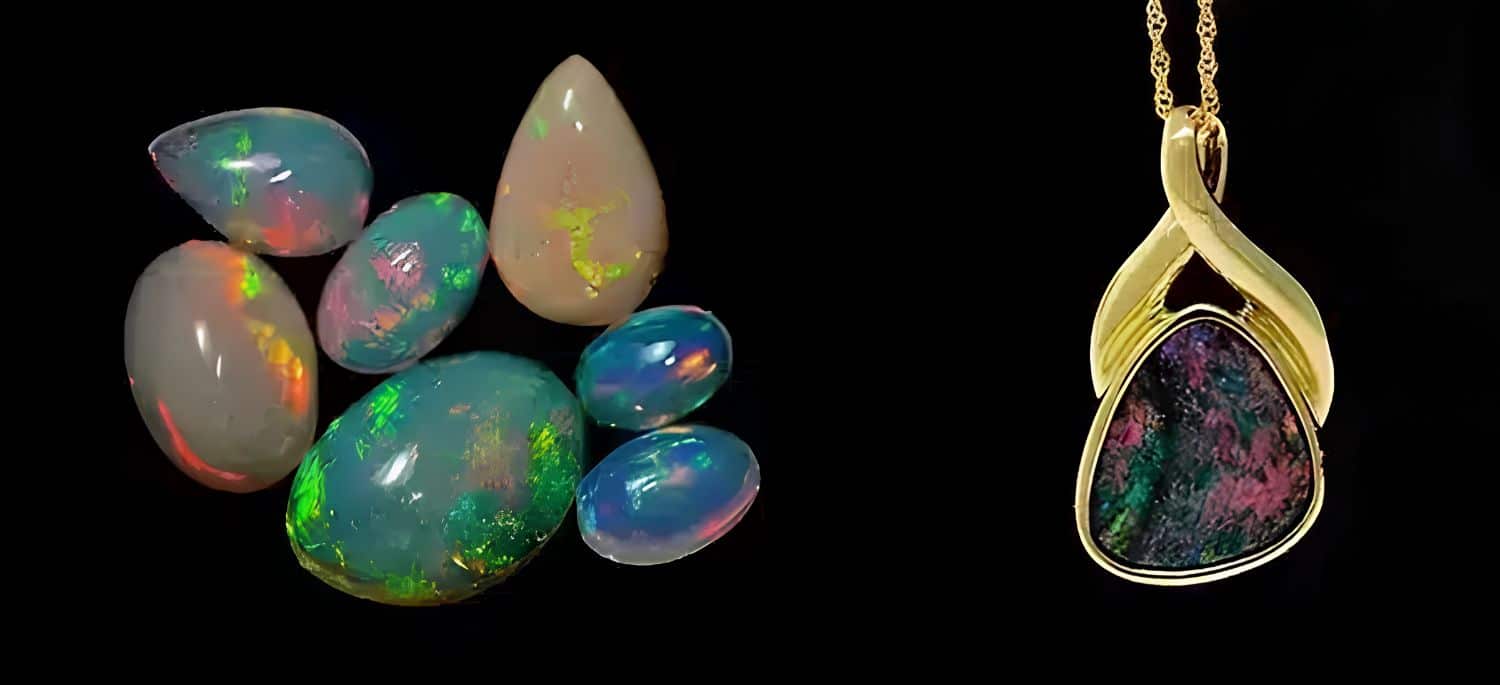
Opal is composed of hydrated amorphous silica (SiO2·nH2O). According to the GIA, the water content can be as high as around 20 per cent of the stone’s weight. As it lacks an organised crystalline structure, opal is considered a mineraloid rather than a mineral in the strict sense.
The play of colour occurs when the opal is made up of tiny spheres of silica, stacked in an orderly fashion. Light is diffracted between these spheres, and the colour depends on their size. For this reason, no two opals are alike, and the colour changes depending on the angle of the stone or the light. The common opal, on the other hand, which lacks this play of colour, is more abundant and less valuable.
Origin and main sources
Opals are formed when water containing dissolved silica seeps into cracks and cavities in rocks and, over a very long period of time, deposits the silica. Australia is the main source of precious opal: commercial mining began around 1890 and the country has historically accounted for almost the entire world market. Mexico is the most important source of fire opal, and Ethiopia began producing it in large quantities from 1994 onwards. Brazil also has precious opal, found at Pedro II in Piauí.
The meaning of the opal
The meanings attributed to the opal stem from tradition and belief, rather than scientific evidence. In many cultures, the stone is associated with luck, love, creativity and imagination, whilst the fire opal is often linked to energy and transformation. The opal is the birthstone for October.
Properties and characteristics of opal
- Composition: hydrated silica, SiO2·nH2O;
- Structure: amorphous (no crystals), and therefore exhibits no birefringence;
- Hardness: 5 to 6.5 on the Mohs scale;
- Density: approximately 2.15, which varies depending on the amount of water;
- Refractive index: 1.37 to 1.47;
- Fracture: conchoidal, without cleavage;
- Toughness: very low to moderate; in other words, the opal is brittle and may chip or break;
- Colour: it can be any colour, and it is the interplay of colours that makes the gemstone most valuable;
- Sensitivity: intense heat and sudden changes in temperature can cause fine cracks (crazing).
Its low hardness and brittleness mean that opal is a gemstone that requires careful handling, particularly when set in rings.
Types of opal
- White or light-coloured opal: white, cream or greyish body, with a play of colours. Coober Pedy, in Australia, is the best-known location;
- Black opal: dark body, usually black or dark grey. The dark background makes the play of colours more vivid, and the main source is Lightning Ridge, in Australia;
- Fire opal: transparent to translucent, red, orange or yellow in colour. It generally has little or no play of colour, and Mexico is the most important source;
- Boulder opal: the opal is embedded in a layer of the host rock, usually ironstone, and is cut into free-form shapes;
- Crystal opal: transparent to semi-transparent, with a good play of colours. Ethiopia now produces more than Australia;
- Common opal: without a play of colour, unlike the blue and pink opals from Peru.
As opal slices are thin, it is common practice to glue a layer of the stone onto a dark backing, creating a dublé. This is cheaper than solid opal, and the buyer should therefore be made aware of this.
Opals in Brazil
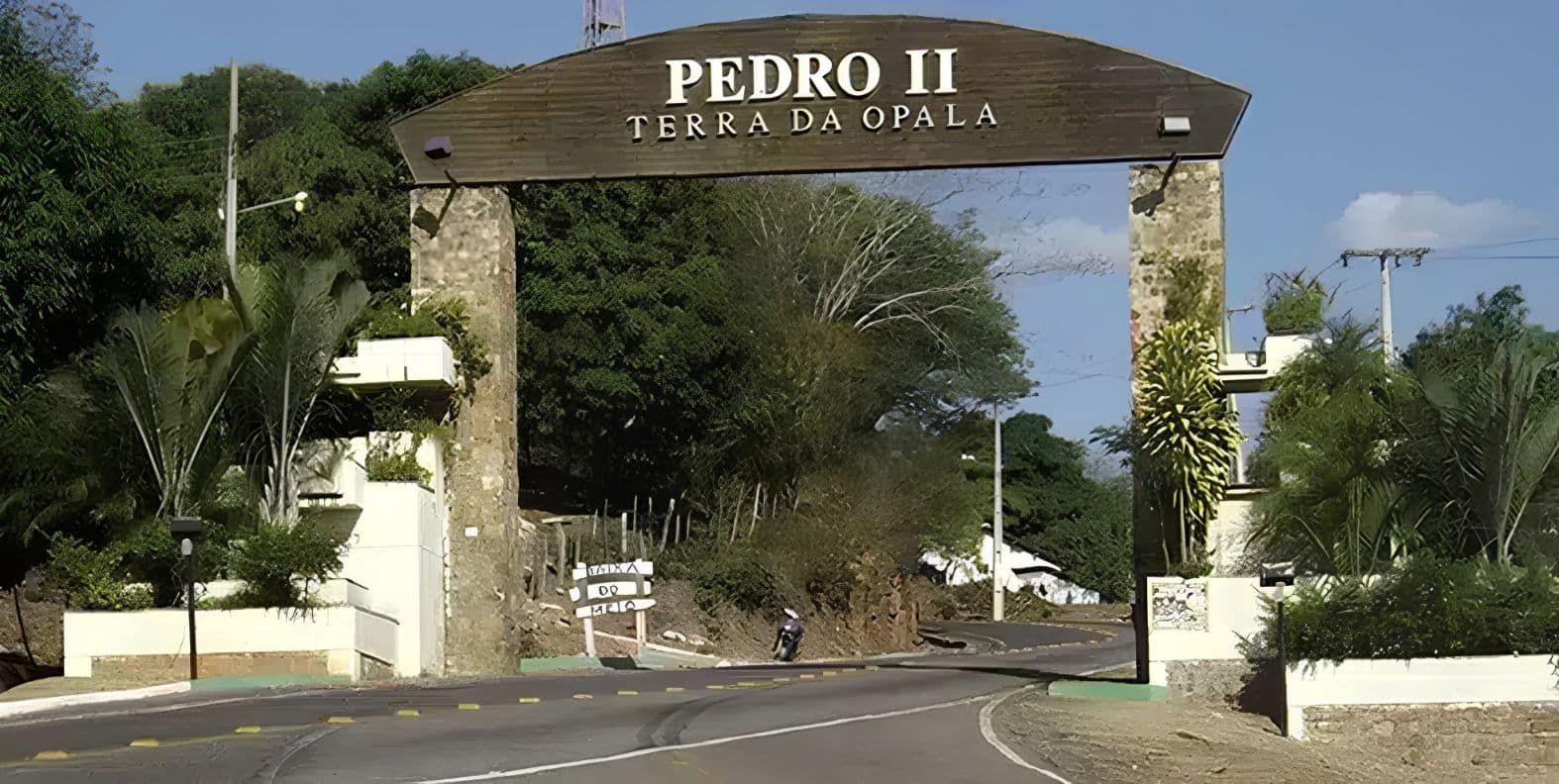
Brazilian opal comes from Pedro II, in the north of Piauí, which is Brazil’s main source of precious opal. According to local prospectors, the first precious opals were found in the late 1930s; some sources cite dates between 1930 and 1942. The deposits are spread over a radius of about 20 km around the town, in veins within the rock (sandstone) and in alluvial deposits.
The peak production period was from 1960 until the mid-1970s, when more than 30 mines were in operation. By the early 1980s, more than two-thirds had been abandoned. Today, mining is on a small scale and almost entirely manual, organised around the Pedro II Prospectors’ Cooperative (COOGP), and annual production amounts to just a few kilograms of gem-quality stone.
The Pedro II opal has a Geographical Indication recognised by the INPI. The stone usually has a white to light grey background with bluish or greenish colour patterns, whilst pieces with red hues are rarer and more sought-after. This material is cut into cabochons, free-form shapes, doublets and mosaics made from small pieces, and has previously been sold as if it were Australian. To find out more about the town, see the post on Pedro II, its history and its archaeological sites.
Colours and characteristics of opal
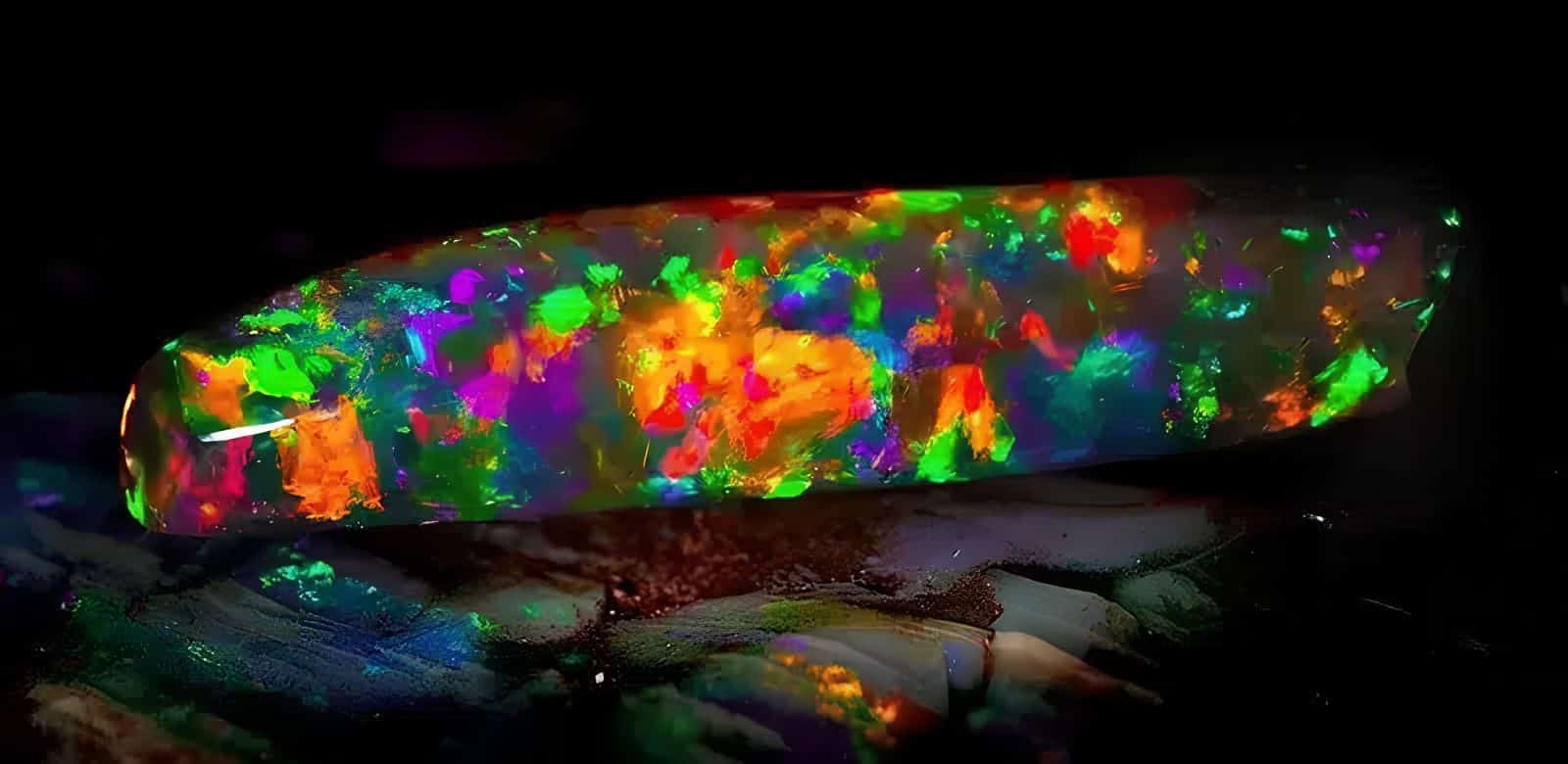
The opal has an unmistakable lustre and can have virtually any background colour: white, grey, black, orange, red, yellow, green, blue, pink, brown and others. As well as the background colour, what matters is the play of colour. According to the GIA, the factors that most influence value are the pattern and intensity of the play of colour. In practice, the price rises with:
- a more intense play of colours that can be seen from various angles;
- a wider range of colours, with red being the rarest;
- larger patches of colour with a distinctive pattern;
- type of stone (black opal and high-quality crystal opal are among the most highly prized);
- a cut that preserves the play of colours, usually in a cabochon or free-form style.
How to look after an opal and buy one safely
- Cleaning: according to the GIA, the only safe way to clean an opal is with warm soapy water. Avoid chemicals, particularly acids and strong alkaline solutions;
- Heat: avoid very strong sunlight and sudden changes in temperature, which can cause cracks;
- Usage: remove rings when engaging in activities involving impact or friction. Bezel settings offer greater protection for the stone than prong settings;
- Duplicates: avoid water, steam and ultrasonic cleaning on these parts;
- Treatments: opal may be impregnated with oil, wax or plastic, or undergo surface treatments known as ‘sugar’ and ‘smoke’. Ask the seller;
- Synthetics and imitations: synthetic opals have been available since the 1970s, as have imitations made from glass, resin or plastic. When making a significant purchase, ask for a report from a gemmological laboratory.
See also
- How to identify a precious stone or gemstone
- Jade: meaning, properties and characteristics
- Pindobaçu (BA), the emerald capital
- Emerald: characteristics, varieties and quality
- Ruby: characteristics, colours and cutting
- The 4 basic diamond grades
- Sapphire: characteristics and properties
- Aquamarine stone
- Amethyst: characteristics, trade and valuation
- Topaz: history and characteristics
- Tourmaline and Paraíba tourmaline
- Agate: characteristics, varieties, colour and cutting
- Malachite stone
- Quartz: characteristics, colours and varieties
Sources consulted
- GIA: opal and caring for and cleaning opals
- GIA, Gems & Gemology (Spring 2024): Precious opal from Brazil
- Geology.com: opala
- Etymonline: the origin of the word ‘opal’
- Gem Adventurer: opala brasileira
- Economic Movement: Pedro II’s opal in Piauí
- Wikipedia: Pedro II (Piauí)
- Beeghly & Co.: Types, Care and Symbolism of the Opal
Frequently Asked Questions
What is an opal?
Opal is a gemstone composed of hydrated amorphous silica (SiO₂·nH₂O), containing up to around 20 per cent water. It has no crystalline structure and is considered a mineraloid. Precious opal is the variety that displays a play of colours.
What is the significance of the opal?
Traditionally, the opal is associated with luck, love, creativity and imagination. These meanings stem from popular belief rather than scientific evidence. The opal is the birthstone for October.
What are the main properties of opal?
Hardness of 5 to 6.5 on the Mohs scale, density of around 2.15, refractive index of 1.37 to 1.47, conchoidal fracture and no cleavage. It is a fragile gemstone that is sensitive to intense heat.
Which month is the opal associated with?
According to the GIA, the opal is the birthstone for October.
What are the different types of opal?
The main types are white opal, black opal, fire opal, boulder opal, crystal opal and common opal. Precious opal displays a play of colours, whereas common opal does not. There are also ‘doubles’, which are thin layers of opal glued onto a dark base.
Why does an opal have so many colours?
The colours are caused by the diffraction of light by tiny silica spheres arranged in an orderly fashion within the stone. The colour you see depends on the size of the spheres and the angle from which you view them, which is why the colour changes as the stone moves.
Where does Brazilian opal come from?
It comes mainly from Pedro II, in the north of Piauí. Mining on a small scale, almost entirely by hand, and the opal from Pedro II has a Geographical Indication recognised by the INPI.
How much is an opal worth?
The value depends on the play of colour (pattern and intensity), the type, size and cut. Red opals, black opals and high-quality crystal opals are among the most highly prized, but the price varies greatly from one stone to another.
How should you clean and look after an opal?
Clean only with warm soapy water; avoid harsh chemicals, intense heat and sudden changes in temperature; and remove the ring when taking part in high-impact activities. When having the ring repaired, also avoid excessive water, steam and ultrasound.
How can you tell if an opal is genuine?
It is difficult to tell with the naked eye, as there are synthetic opals, imitations and fakes made of glass or resin. Be wary of very low prices, ask about any treatments and, for high-value purchases, request a report from a gemmological laboratory.

Publicações Relacionadas
Aquamarine: Symbolism, Characteristics and Jewellery

Pindobaçu (Bahia): Capital of Emeralds, History and Guide

Ruby: Characteristics, Meaning and Jewellery

Quartz: Meaning, Characteristics and Jewellery

Emerald: Characteristics, Meaning and Jewellery

Topaz: Gemstone, Properties, Meaning and Characteristics

Jade: Meaning, Properties and Characteristics

Agate: Meaning, Characteristics and Jewellery

Amethyst: Meaning, Characteristics and Jewellery

Tiger’s Eye Stone: Meaning, Characteristics and Jewellery

Sapphire: Meaning, Characteristics and Jewellery

Coral Jewellery: Species, Properties and Characteristics

Paraíba Tourmaline: History, Properties and Characteristics

Diamonds: Characteristics, Meaning, Jewellery and the 4 Cs

Malachite: Meaning, Properties and Characteristics

Tourmaline: Varieties, Properties and Characteristics

Identifying a Precious Stone or Gemstone: A Comprehensive Guide
This post is also on:
 Português
 English
 Deutsch
 Español
 Français