The emerald is the green variety of beryl and one of the most highly prized gemstones in jewellery. In this guide, you will learn about the significance of the emerald, its characteristics (colour, hardness, lustre, treatments and quality), where it comes from and how it is used in jewellery.
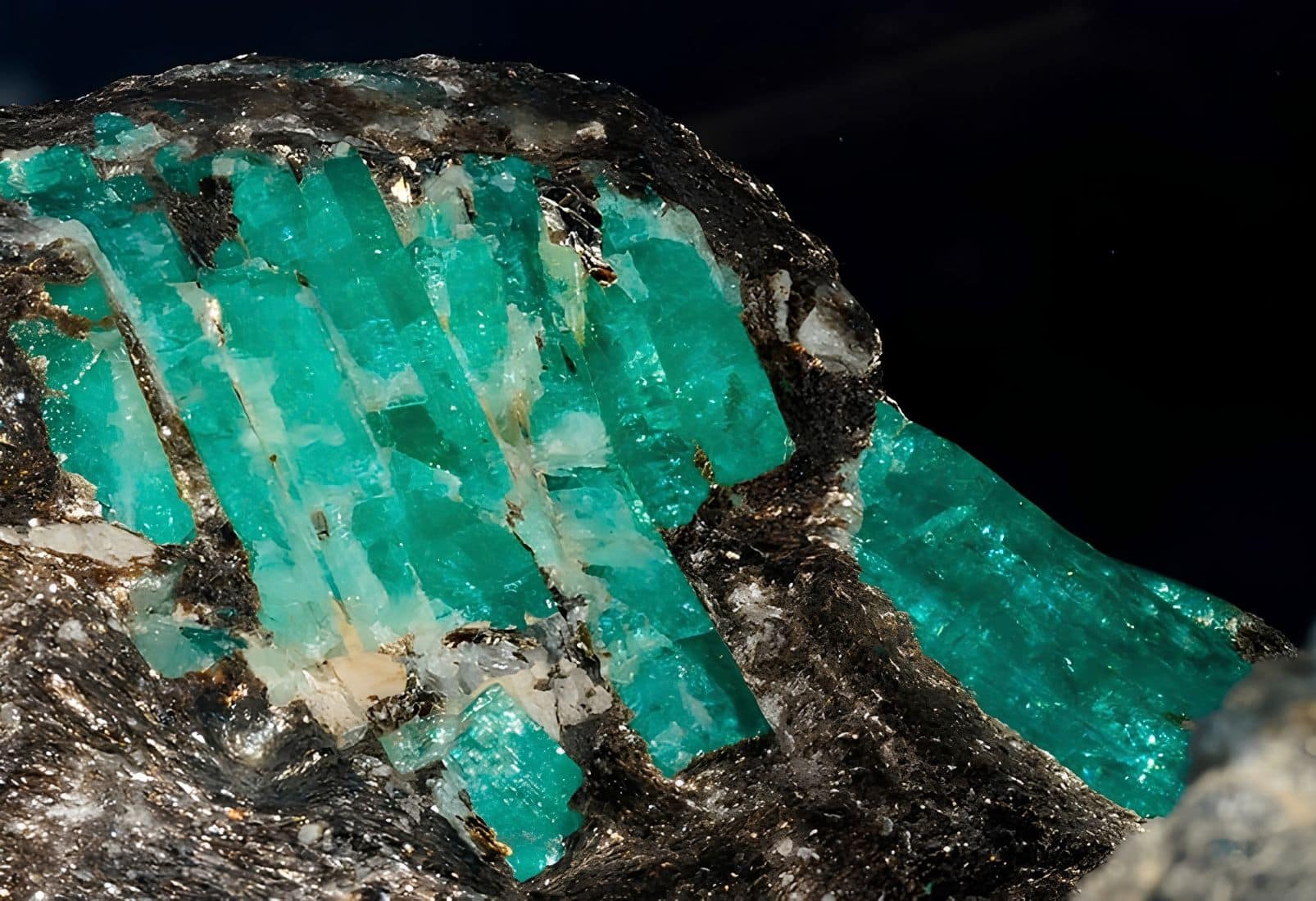
The green colour comes from small amounts of chromium and, in many stones, from vanadium in the crystal structure. Iron also influences the exact shade. A good-quality emerald has a vivid green colour, a medium to dark shade and good transparency.
What is an emerald?
The emerald is a beryl, a mineral with the formula Be₃Al₂(Si₆O₁₈) and a hardness of 7.5 to 8 on the Mohs scale. Aquamarine, heliodor (yellow) and morganite (pink) are other varieties of the same mineral. The emerald crystallises in the hexagonal system.
What distinguishes an emerald from ordinary green beryl is the intensity of its colour. According to the GIA, experts disagree on just how strong the green needs to be: some in the trade refer to any chromium-coloured green beryl as an emerald, but most gemmologists and laboratories reserve the name for darker, more saturated stones, and refer to the lighter ones as green beryl. There is no single chromium threshold accepted by all.
The meaning of the emerald
The green colour of the emerald is associated with nature, renewal, hope and love. The ancient Egyptians linked the gemstone to fertility and rebirth, according to USA Jewels.
The emerald is the birthstone for May and the traditional gemstone for the sign of Taurus. On wedding anniversary lists, the emerald anniversary varies according to tradition: 20 and 35 years on international lists, and 40 years on some Brazilian lists.
These meanings form part of popular and esoteric traditions and beliefs. There is no scientific evidence to support any effects the stone may have on health or emotions.
The origin and history of the emerald
The oldest known mines are in Egypt and date back to around 1500 BC, according to Wikipedia, but today they are of no commercial importance. Colombia is historically the largest producer of fine emeralds, with the regions of Muzo, Coscuez and Chivor. Zambia is the second-largest source, with the Kagem mines. The gemstone is also found in Zimbabwe, Afghanistan, Madagascar and Brazil.
In Brazil, emeralds come from Bahia, Goiás and Minas Gerais. According to the GIA, Bahia has been producing emeralds since the 1960s and supplies a great deal of material for carving, cabochons and commercial jewellery. In Goiás, the Santa Terezinha region has yielded many small crystals. In Minas Gerais, Itabira is a consistent producer, whilst Nova Era is known for its very large crystals.
In May 2024, a 137 kg rough emerald, with a dark matrix and green crystals, from a mine in Pindobaçu, in northern Bahia, was sold for R$ 175 million at a Federal Revenue Service auction in Campinas (SP), according to the Diario de Pernambuco.

Pedra Esmeralda - Caracteristicas, Variedades e Qualidade
Emeralds amongst the gemstones
The emerald is one of the four traditional gemstones, alongside the ruby, the diamond and the sapphire. See also other gemstones used in jewellery, such as amethyst, and how to identify a gemstone.

High-quality emeralds can cost more per carat than diamonds of equivalent quality. Prices vary widely and sources differ, but as a guide, ThePricer (data from 2024) cites commercial-grade stones at under US$500 per carat, fine-quality stones at over US$10,000 per carat, and rare Colombian emeralds sold at auction at between US$50,000 and over US$100,000 per carat. The price rises rapidly with size, as large, flawless stones are rare.
Emeralds in jewellery: uses
The main use of the emerald is as a gemstone in jewellery, such as rings, earrings, necklaces and bracelets. The best-known cut is named after the gem itself – the ‘emerald cut’ – which is rectangular with bevelled corners, but it is also found as a cabochon, in beads and in other shapes.

Because it has natural fractures, the emerald is more fragile than its hardness would suggest. For everyday jewellery, choose settings that protect the stone, and remove emerald rings before carrying out heavy work.
Names of emeralds used in the market
- Colombian: a market term for high-quality emeralds, characterised by a warm, pure green colour with a slight bluish tinge;
- Russian or Siberian: it is usually described as less bluish, with more inclusions and a lighter colour than Colombian gemstones;
- Brazilian: a term sometimes used for light green or yellowish gemstones;
- sandawana: deep green gemstones, usually small and with many inclusions;
- Zambian: it usually has a cooler, bluish green colour and good transparency.
These names mainly describe the colour style associated with each region. The true origin of a gemstone can only be determined by a gemmological laboratory.
Characteristics of the emerald stone

1. Hardness and toughness
Its hardness is 7.5 to 8 on the Mohs scale. Its toughness, however, is low, as most emeralds contain many inclusions and fractures. A blow can cause the stone to chip.
2. Colour
The colour ranges from light green to dark green, with variations towards bluish-green. Chromium, vanadium and iron are the elements that determine the exact shade. The most desirable colours range from bluish-green to pure green; they are vivid, but not too dark.
3. Transparency
From transparent to translucent.
4. Brightness
Glassy sheen.
5. Crystalline system
Hexagonal, in prismatic crystals.
6. Inclusions
Most emeralds have inclusions visible to the naked eye, known as jardin (French for ‘garden’), and so many buyers are willing to accept a few inclusions. Clear emeralds are rarer and more valuable, but inclusions that reduce transparency lower the value.
Possible treatments for emerald
Most emeralds undergo some form of treatment. According to Emeralds.com:
- oil (usually cedar oil): fills cracks that reach the surface and reduces the appearance of inclusions. It is not permanent and may need to be reapplied, particularly after exposure to heat or cleaning products;
- resin (such as Opticon): is injected into the fractures and allowed to set. It lasts longer than oil, but is less reversible, and the buyer must be informed of this as it affects the value;
- heating: this is less common than oil and resin, and using the wrong heat can damage the stone or change its colour;
- staining with dye or coloured oil: the dye accumulates in the fractures, and selling the product without disclosing this is considered fraud.
According to ThePricer, treatments that are disclosed tend to have little effect on the price. Always ask for a laboratory report before buying a valuable emerald.
Natural and synthetic emeralds, and possible sources of confusion
There are synthetic emeralds, produced in laboratories using flux and hydrothermal processes. The Carroll Chatham flux process is regarded as the first to have achieved commercial success. Synthetics cost considerably less than natural ones, and the difference can only be reliably determined by gemmological examination.
Emeralds can be mistaken for synthetic emeralds, chromium diopside, tsavorite, demantoid, uvarovite, dioptase, green tourmaline (see Paraíba tourmaline), composite gemstones, glass and plastic-coated beryl. See also how to identify a gemstone.
Emerald quality factors
Experts agree that quality depends, above all, on colour. But there are four factors:

1. Colour
This is the most important factor. The best shades are bluish-green and pure green, ranging from medium to dark in tone and with vivid intensity. A colour that is too yellowish or too light loses its value. The colour must be uniform and intense.
2. Clarity
Assessed by the naked eye. Clear emeralds are rarer and more valuable. Common inclusions are accepted, but those that impair transparency reduce the value drastically.
3. Cut
The cutter must take into account the depth of colour, durability and inclusions of the rough stone. As emeralds have natural fractures, the cut must minimise their effect. Cutting errors result in a loss of weight and reduce the value. The cut also alters the hue: a deep cut darkens a pale stone, whilst a shallow cut lightens it.
4. Carats
For the same quality, the price per carat rises significantly as the size increases. This is why the price of a piece of jewellery varies greatly depending on the weight of the emerald.
Caring for emerald jewellery
- clean using only warm water, mild soap and a soft cloth;
- avoid ultrasound and steam, which may damage the stone or remove oil from the fractures;
- avoid intense heat and strong chemicals;
- keep the part separate from the others and protect it from knocks;
- If the stone has been oiled, it may need to be re-oiled by a jeweller.
Frequently Asked Questions
What is an emerald?
The emerald is the green variety of beryl, a mineral composed of beryllium and aluminium. Its colour comes from chromium and, often, vanadium present in the crystal.
What is the significance of the emerald?
The emerald symbolises nature, renewal, hope and love. The ancient Egyptians associated the stone with fertility and rebirth. These meanings are part of tradition, with no scientific evidence to support them.
Which month is the emerald associated with?
It is the birthstone for May and the traditional gemstone for the sign of Taurus.
How hard is an emerald?
Between 7.5 and 8 on the Mohs scale. Despite this, it is brittle, as it has many natural fractures and inclusions, and may chip if struck.
What is the difference between an emerald and a green beryl?
It is the intensity of the colour. Most gemmologists and laboratories reserve the name ‘emerald’ for darker, more saturated stones and refer to the lighter ones as ‘green beryl’, but the criteria vary.
Where do emeralds come from?
The main sources are Colombia and Zambia. Emeralds also come from Brazil (Bahia, Goiás and Minas Gerais), Zimbabwe, Afghanistan and Madagascar.
Are emeralds treated?
Yes. The most common approach is to apply oil (usually cedar oil) or resin to the fractures. Heat treatment is less common. Always ask for a report and information about the treatments.
How much does an emerald cost?
The price varies greatly depending on colour, clarity, origin, treatment and size. As a guide for 2024, commercial-grade stones cost less than US$500 per carat, whilst fine-quality stones cost over US$10,000 per carat.
How do you clean emerald jewellery?
Use warm water, mild soap and a soft cloth. Avoid ultrasound, steam, heat and harsh chemicals, as these may damage the stone or strip away the oil.
How can you tell if an emerald is genuine?
Only a gemmological examination can provide certainty. Emeralds can be mistaken for synthetic stones, tsavorite, demantoid, green tourmaline, glass and other gemstones. Ask for a laboratory report when purchasing.
See also
- Ruby: characteristics, meaning and jewellery
- Sapphire: characteristics and properties
- The 4 basic diamond grades
- Aquamarine: symbolism, characteristics and jewellery
- Amethyst: characteristics, trade and valuation
- How to identify a precious stone or gemstone
- Tourmaline: characteristics and varieties, Opal and Malachite

Publicações Relacionadas
Jade: Meaning, Properties and Characteristics
Tiger Eye Stone - Characteristics and Cutting
Opal: Meaning, Properties and Characteristics
Amethyst stone - characteristics, marketing and valuation
The malachite stone is a distinctive gemstone - Features
Pindobaçu (BA), known as the capital of emeralds
Agate Stone - Characteristics, Types, Colour and Cutting
Aquamarine: Symbolism, Characteristics and Jewellery
Sapphire is the purity of nature and a symbol of honesty
Tourmaline: Learn about its characteristics and varieties
Diamonds: Characteristics, Meaning, Jewellery and the 4 Cs
Ruby: Characteristics, Meaning and Jewellery
Quartz: Meaning, Characteristics and Jewellery
Identifying a Precious Stone or Gemstone: A Comprehensive Guide
Characteristics of the Paraíba Tourmaline, a rare gemstone
Topaz: Gemstone, Properties, Meaning and Characteristics
Jewellery made from different types of coral - Features
This post is also on:
 Português
  English
  Deutsch
  Español
  Français