Published on · Updated on
Aquamarine is a blue to blue-green gemstone, widely used in jewellery and known as the birthstone for March. In this guide, you’ll learn about the symbolism and meaning of aquamarine, its characteristics (colour, hardness, lustre and treatments), where it comes from and how to look after your jewellery.
Aquamarine is a variety of beryl, the same mineral as emerald, heliodor (yellow) and morganite (pink).
Pure beryl is colourless. The colours are caused by elements present in the crystal’s structure: iron gives aquamarine its blue colour, whilst other elements give emeralds their green colour and morganite its pink colour. The crystals usually have a vitreous lustre and may be transparent.

What is aquamarine?
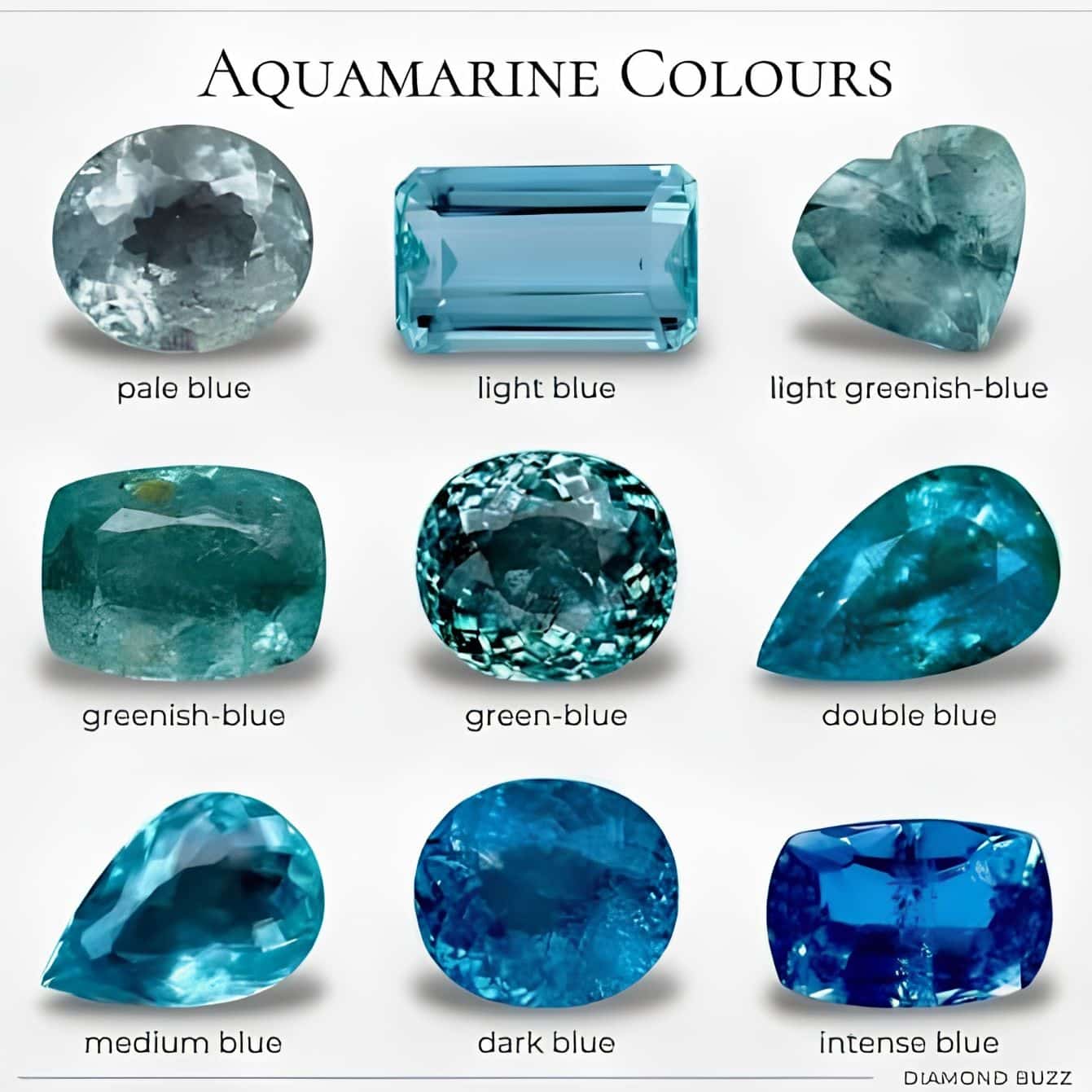
The name comes from the Latin aqua marina, which means ‘sea water’, because of its colour, which is reminiscent of clear water. The shade ranges from very light blue to a deeper blue, with a hint of green in many stones.
The colour comes from traces of iron in the crystal. In nature, many aquamarines have a greenish or yellowish tinge, which is why they are heated to remove the yellow component and produce a purer blue (see the section on treatments).
Where aquamarine is found
Brazil is one of the world’s leading sources of aquamarine, and Minas Gerais is the state most closely associated with this gemstone. The town of Teófilo Otoni, in the Mucuri Valley, is known as the ‘world capital of gemstones’ and is home to a major centre for gemstone cutting and trade, according to Estado de Minas. The rough stones come from mining sites in eastern Minas Gerais, western Espírito Santo and southern Bahia.
Outside Brazil, the gemstone is also found in Madagascar, Nigeria, Mozambique, Pakistan, Russia and the United States, amongst other countries. The colour and quality vary depending on the origin. The highest-quality gemstones are more transparent.

Como diferenciar topázio de água marinha
See also: Emeralds: characteristics, varieties and quality.
Symbolism and meaning of the aquamarine stone
Throughout history, aquamarine has been associated with the sea, calm and clarity. In popular tradition, it is seen as a symbol of youth, hope and eternal life, and is believed to bring serenity, emotional balance and clarity of thought. It is also the birthstone for March and the traditional gift for those celebrating 19 years of marriage, according to the GIA.
These meanings form part of popular and esoteric traditions and beliefs. There is no scientific evidence to support any effects the stone may have on health or emotions.
Aquamarine in jewellery: uses
Aquamarine is mainly used as a gemstone in jewellery. It is cut into various shapes and used in rings, earrings, necklaces and bracelets. Its light blue colour complements many styles, and it is common to find large, clear stones with few visible inclusions, making it a popular and highly sought-after gemstone.

The most highly prized colour is usually a medium to dark blue, with a slight hint of green and an even distribution, without any patches of a different shade.
Names used in the market
- Madagascar aquamarine: medium blue
- Brazilian aquamarine: blue-green and green-blue
Care and maintenance of aquamarine jewellery
Aquamarine is a relatively durable gemstone, but it can still become scratched or chipped if subjected to heavy knocks. To look after your jewellery:
- keep each piece separate from other stones to avoid scratches;
- clean with warm water, mild soap and a soft brush;
- Ultrasound cleaning is usually safe, but avoid it if the stone has cracks or fluid-filled inclusions, and consult a jeweller if in doubt;
- Avoid knocks and harsh chemicals.

Characteristics of aquamarine
1. Colour
Aquamarine is known for its blue to blue-green colour. The shade ranges from pale blue to deeper, more vibrant tones. The colour is caused by traces of iron in the crystal’s structure.
2. Transparency
The stone is usually transparent or translucent. The highest-quality gemstones are more transparent, allowing light to pass through the crystal unimpeded.
3. Crystalline system
Aquamarine crystallises in the hexagonal system and forms prismatic crystals with a hexagonal cross-section, often with faces that are striated along their length. The crystals can be small or very large.
4. Hardness
Its hardness is 7.5 to 8 on the Mohs scale. This indicates good resistance to scratching and makes it suitable for everyday use. Hardness, however, is different from toughness: a heavy blow can still chip or crack the stone.
5. Fracture and cleavage
Aquamarine has poor to indistinct cleavage; that is, it does not break easily along defined planes. When it breaks, the fracture is uneven or conchoidal (shell-shaped).
6. Brightness
The lustre is vitreous. Well-cut and polished, the stone has an intense lustre, similar to that of glass.
7. Identifying features
Aquamarine usually has few inclusions. When they do occur, they take the form of hollow or fluid-filled growth tubes running parallel to the crystal’s axis (the so-called ‘rain effect’), droplets of fluid arranged in a star-like pattern (‘snowflake’ or ‘chrysanthemum’) and, more rarely, mineral inclusions such as iron oxide.
8. Possible treatments
The most common treatment is heating. Blue-green or yellowish stones, when heated, lose their yellow component and turn blue. The gemmological literature refers to temperatures of around 400 to 450 °C, and the result is stable and considered permanent. A Brazilian study from 2025 on the heat treatment of aquamarine tested temperatures ranging from 300 to 500 °C and achieved the best result at 425 °C for 2 hours, without fracturing the samples.
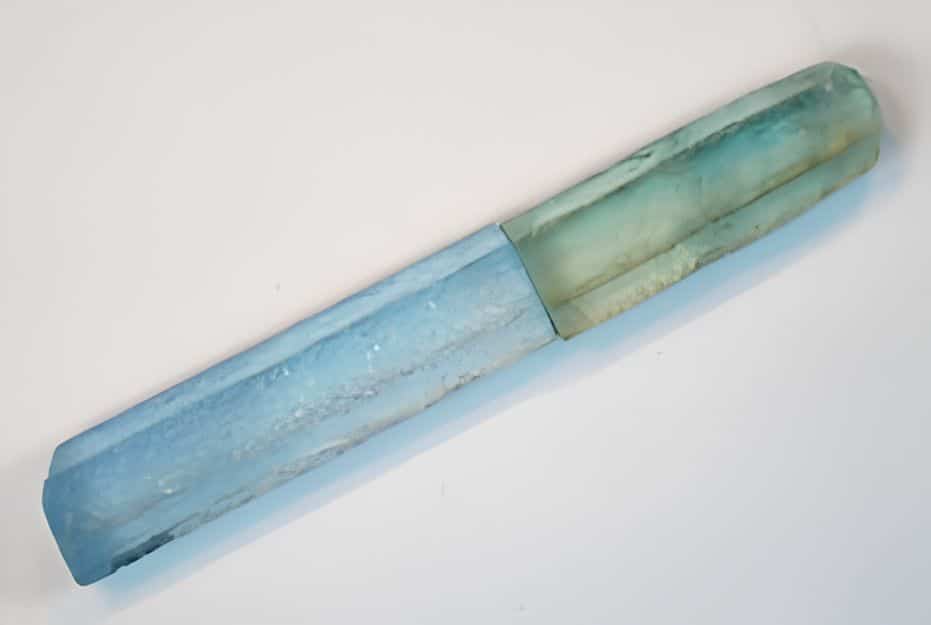
In the image, the heated half of the stone is the blue colour that most people associate with aquamarine. Heating does not alter the stone’s natural saturation: a pale stone remains pale, but becomes bluer.
9. Possible misunderstandings
Other blue gemstones can be mistaken for aquamarine, such as blue topaz, blue tourmaline, synthetic blue spinel and synthetic blue quartz. Maxixe beryl, a dark blue variety of beryl, can also be mistaken for aquamarine, but its colour fades when exposed to light and heat. To find out how to tell gemstones apart, see how to identify a gemstone. If you are in any doubt when making a purchase, ask for a report from a gemmologist.
Frequently Asked Questions
What is aquamarine?
Aquamarine is a blue to blue-green variety of beryl, the same mineral as the emerald. The colour comes from traces of iron in the crystal.
What is the significance of the aquamarine stone?
In popular tradition, aquamarine symbolises youth, hope, calm and clarity. These meanings are part of popular belief and have no scientific basis.
Which month is aquamarine associated with?
It is the birthstone for March. It is also the traditional gift for those celebrating 19 years of marriage.
What is the hardness of aquamarine?
Between 7.5 and 8 on the Mohs scale. This makes it suitable for rings and other everyday jewellery, but heavy knocks can still damage it.
Where does aquamarine come from?
Brazil is one of the main sources, particularly Minas Gerais, with the Teófilo Otoni region being of particular note. The gemstone also comes from Madagascar, Nigeria, Mozambique, Pakistan, Russia and other countries.
Is all aquamarine heat-treated?
No. But heating is common, as it removes the yellowish tint and makes the stone appear bluer. The treatment is considered stable and permanent. Always ask the seller for further information.
How do you clean aquamarine jewellery?
Use warm water, mild soap and a soft brush. Ultrasonic cleaning is usually safe, but avoid using it on stones with fractures or fluid-filled inclusions. If in doubt, consult a jeweller.
What is the difference between aquamarine and blue topaz?
They are different minerals. Aquamarine is a beryl, and blue topaz is a topaz, the colour of which is almost always achieved through treatment. Only a gemmological examination can confirm this with certainty.
Is aquamarine a gemstone?
In the traditional classification, only diamonds, rubies, sapphires and emeralds are considered ‘precious’. Aquamarine is a valuable gemstone that is very popular in jewellery, and in everyday language it is often referred to as a precious stone.
See also
- Emerald: characteristics, varieties and quality
- Topaz and Imperial Topaz: characteristics
- Sapphire: characteristics and properties
- Amethyst: characteristics, trade and valuation
- Tourmaline: characteristics and varieties and Paraíba tourmaline
- Opals: one of Brazil’s most beautiful gemstones
- Malachite: characteristics

Publicações Relacionadas

Pindobaçu (Bahia): Capital of Emeralds, History and Guide

Ruby: Characteristics, Meaning and Jewellery

Quartz: Meaning, Characteristics and Jewellery

Emerald: Characteristics, Meaning and Jewellery

Topaz: Gemstone, Properties, Meaning and Characteristics

Jade: Meaning, Properties and Characteristics

Agate: Meaning, Characteristics and Jewellery

Amethyst: Meaning, Characteristics and Jewellery

Tiger’s Eye Stone: Meaning, Characteristics and Jewellery

Sapphire: Meaning, Characteristics and Jewellery

Coral Jewellery: Species, Properties and Characteristics

Paraíba Tourmaline: History, Properties and Characteristics

Diamonds: Characteristics, Meaning, Jewellery and the 4 Cs

Malachite: Meaning, Properties and Characteristics

Tourmaline: Varieties, Properties and Characteristics

Identifying a Precious Stone or Gemstone: A Comprehensive Guide