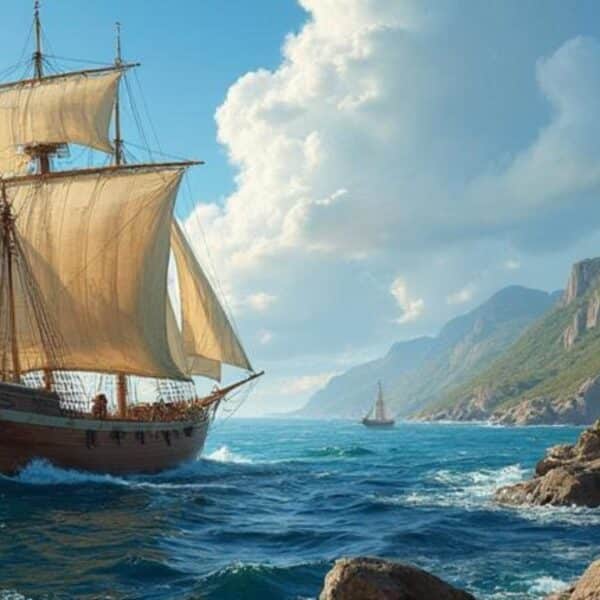
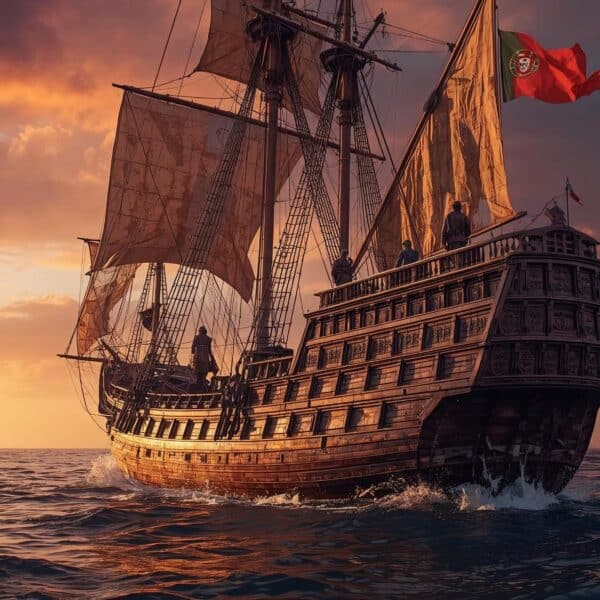
This text brings together and compares the main types of ships used by Portuguese navigators in the 15th and 16th centuries — nau, caravel (and its variants) and galleon — highlighting their construction characteristics, types of sails, operational functions and uses in exploration, trade and warfare. Reading it allows us […]
History of Brazil
History of Brazil: Overview
The history of Brazil is marked by a long and complex process of struggles over various national projects, passing through moments of significant political, social and economic instability.
Although there is no universally defined starting point, the arrival of the Portuguese, led by Pedro Álvares Cabral, on the southern coast of what is now Bahia on 22 April 1500 is generally regarded as the beginning of the European presence in the territory. This event is traditionally known as the Discovery of Brazil.
However, it is important to emphasise that this was a discovery from a European point of view. Various indigenous peoples had inhabited Brazilian territory for thousands of years, with their own cultures, languages and social organisations.
Brazil is the historical result of several different projects that took place within a specific geographical delimitation. Initially, it was a project of conquest; later, a project of colonisation; in the 19th century, a project of empire and the constitution of a nation-state; and finally, a project of Republica Brasileira, which we are still trying to maintain today.
Main periods of Brazilian history
1. Pre-Cabral period (until 1500)
Refers to the period before the arrival of the Portuguese, characterised by the presence of various indigenous peoples in Brazilian territory, which marked a diversity of cultures, languages and social practices.
2. Pre-colonial period (1500-1530)
It began with the arrival of Cabral and lasted until the beginning of actual colonisation. During this period, the first contacts between colonists and indigenous peoples took place, with cultural exchanges, conflicts and exploratory activities standing out.
3. Colonial period (1530-1822)
Covers the period when Brazil was a colony of the Kingdom of Portugal. It is characterised by economic exploitation, especially through agriculture and mining, and by the establishment of colonial administrative structures.
4. Imperial period (1822-1889)
It began with the independence of Brazil in 1822 and lasted until the proclamation of the Republic in 1889. This period was marked by the consolidation of the Brazilian state, internal conflicts and the abolition of slavery in 1888.
5. Republican period (1889-present)
Divided into several phases:
- First Republic (1889-1930): also known as the Old Republic, characterised by politics dominated by state oligarchies.
- Vargas Era (1930-1945): a period of centralisation of power and implementation of labour policies.
- Populist Republic (1945-1964): characterised by political instability and economic growth.
- Military dictatorship (1964-1985): Authoritarian regime established after a military coup.
- New Republic (1985-present): a period of redemocratisation and consolidation of democratic institutions.
These periods show how Brazilian history is made up of ruptures and continuities, always centred on the search for a national identity and more stable forms of political and social organisation.
Portugal’s Maritime Expansion – Navigation in the 15th and 16th Centuries
The Age of Discovery transformed Portugal into a maritime power whose nautical knowledge had a profound impact on world history. This text examines the technical and scientific advances — navigational instruments, charts, route maps, cosmographers and types of vessels — that made it possible to cross oceans and explore new […]
Portugal’s Maritime Expansion – The Portuguese in North America
The Portuguese in North America The Portuguese presence in North America dates back to the 15th and 16th centuries, a period marked by intense maritime exploration. Motivated by the search for new trade routes and the desire to expand geographical knowledge, Portuguese navigators were pioneers in various areas of the […]
Portugal’s Maritime Expansion – The discovery of the sea route to India
The discovery of the sea route to India was a decisive milestone in the age of great navigation. At the end of the 15th century, the search for direct trade routes to the rich eastern lands became a priority for European powers, especially Portugal. Driven by the growing demand for […]
Portugal’s Maritime Expansion – Exploration of the West Coast of Africa
The exploration of the west coast of Africa was a milestone in Portuguese maritime expansion in the 15th and 16th centuries, driven by economic, strategic and scientific motivations. The initiative of Prince Henry and the expeditions of navigators such as Gil Eanes, Diogo Cão and Bartolomeu Dias opened up new […]
Portugal’s Maritime Expansion – Discovery of the Atlantic Islands
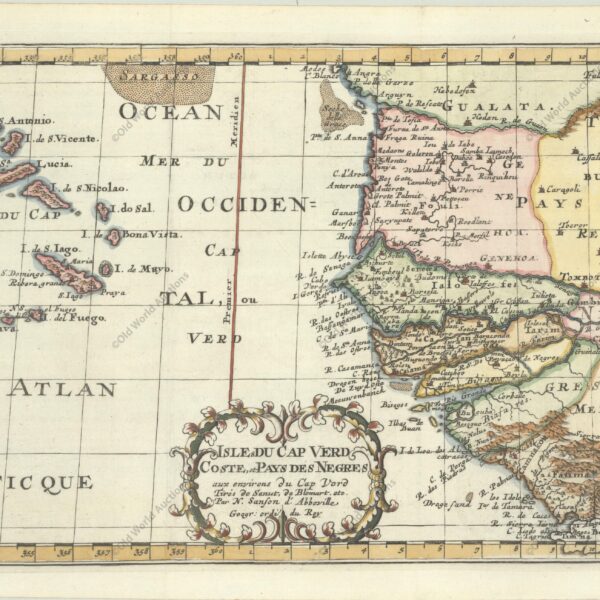
The Atlantic islands — Madeira, Porto Santo, the Azores and Cape Verde — played a central role in the early days of Portuguese maritime expansion. This text presents their discovery, the model of exploration adopted, the economic activities implemented and the demographic consequences that led to emigration to the mainland […]
Portugal’s Maritime Expansion – Prince Henry the Navigator
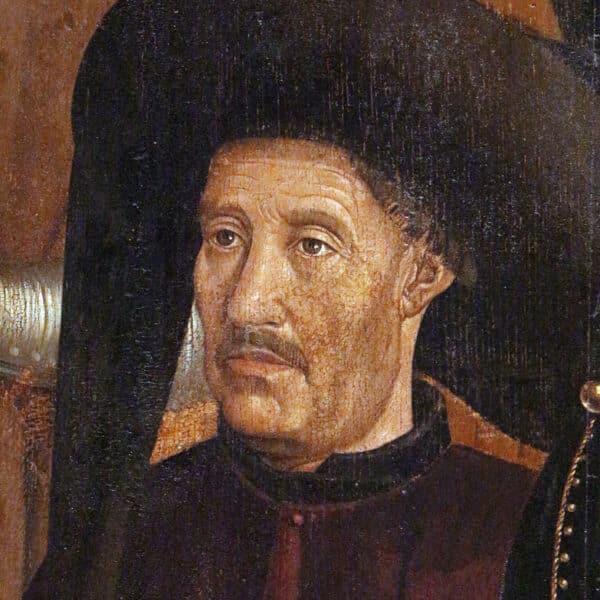
Infante Dom Henrique, known as the ‘Navigator,’ was a central figure in the early days of Portuguese discoveries: born in 1394, he participated in the expedition to Ceuta and, as Master of the Order of Christ and 1st Duke of Viseu, founded a centre for nautical studies in the region […]
Portugal’s Maritime Expansion – Navigation before the Discoveries
Navigation before the discoveries was a crucial period in maritime history, marked by innovations and adaptations that paved the way for the great explorations of the 15th century. During this time, Portuguese navigators began to improve their navigation techniques, developing more agile and resistant vessels, such as caravels, which became […]
Portugal’s Maritime Expansion – First Naval Operations
Portugal’s first naval operations marked the beginning of the systematic use of the navy as a military and political instrument. Since the time of Afonso Henriques, ships and coastal pilots began to play a decisive role in combat, sieges of cities and protection of routes, supporting both offensive actions and […]
Portugal’s Maritime Expansion – Fishing as the Origin
Portugal’s Maritime Expansion – Fishing as the origin of navigation The need to fish on the high seas led coastal communities to improve their vessels, navigation techniques, knowledge of winds and currents, and trade networks, which ultimately led to increasingly longer voyages and maritime exploration. 1. Dependence on Fishing Portugal, […]
Carlos Julião: The Military Engineer and Artist Who Depicted Colonial Brazil
Carlos Julião, a military engineer and a draughtsman of Italian origin in the service of the Portuguese Crown, never actually lived or settled in Brazil. He lived in Portugal, where he worked in the colonial administration, but produced a vast body of work on the Portuguese colonies, including Brazil. His drawings and watercolours document the social life, cultural life and ethnic life of the colonies and […]
Jews in Colonial Brazil: A Hidden History
Jews in colonial Brazil faced a complex and often difficult situation. During the colonial period, Brazil was a Portuguese colony, and the Inquisition had a great influence on social and religious life. Judaism was therefore prohibited, and any Jewish practices were strictly repressed. Judaism had four phases in colonial Brazil […]
Chronology of Portuguese discoveries and maritime expansion
Portuguese discoveries were the result of Portuguese maritime expansion, which marked the history of Portugal and the world. Throughout the 15th century, the Portuguese transformed and perfected all known shipbuilding and navigation techniques. Portuguese maritime expansion was an unprecedented development. One gets the impression that if it took eighty years […]
Chronology of slavery in colonial and imperial Brazil – History
Sunday 13 May 1888 dawned sunny in Rio de Janeiro, the capital of the Brazilian Empire. It was a day of celebration. Slavery was ended by a law passed by the Senate and signed by Princess Isabel. Brazil was the last country in the Americas to abolish slavery. Over the […]
Historical Periods of Brazil: Summary and Timeline
Historical periods of Brazil at a glance Period Dates Key milestones Pre-Cabraline up to 1500 Indigenous peoples, sambaquis (shell mounds), Tupi and Macro-Jê language stocks Pre-Colonial 1500–1530 Arrival of Cabral, expeditions, brazilwood extraction Colonial 1530–1815 Captaincies, General Government, sugar, gold, slavery United Kingdom 1815–1822 Royal Court in Rio de Janeiro, […]
Independence of Brazil – breaking of colonial ties in Brazil
Brazilian Independence – The End of Colonial Ties in Brazil 1. introduction As you may have noticed, we have presented a reading of various factors related to the emancipation of Portuguese America. The growth and diversification of society, the establishment of the Portuguese Court in Brazil, and the protest movements […]
Portuguese Empire in Brazil – Portuguese Royal Family in Brazil
Portuguese Empire in Brazil – Portuguese Royal Family in Brazil 1. introduction We have seen the influence of revolutionary ideas on the main liberation movements in Portuguese America. We have also studied certain events linked to the arrival of the Court in Brazil. In this chapter, we will look at […]
Transfer of the Portuguese court to colonial Brazil
Transfer of the Portuguese Court to Brazil 1. Introduction In the previous chapter we looked at the main liberation movements influenced by French and English revolutionary ideals. However, these egalitarian ideals were part of the projects of an educated elite who looked to the Old Continent as an example to […]
Foundation of the city of São Paulo and the Bandeirantes
The founding of the city of São Paulo and the Bandeirantes 1 Introduction In this chapter we will study the founding of the city of São Paulo and its importance in the process of colonisation and settlement in colonial Brazil. We will also examine the actions of the São Paulo […]
Transition between colonial and imperial Brazil
Between the colonial regime and the establishment of empire in Brazil Brazil’s independence did not come about overnight, based on the individual wishes of the Prince Regent, but was in fact the result of a political, economic and cultural process involving a series of circumstances and interests. After reading this […]