The Age of Discovery transformed Portugal into a maritime power whose nautical knowledge had a profound impact on world history.
This text examines the technical and scientific advances — navigational instruments, charts, route maps, cosmographers and types of vessels — that made it possible to cross oceans and explore new routes.
By highlighting the innovations and protagonists of this journey, we aim to show how the art of navigation evolved from empirical practices to systematic knowledge, laying the foundations for Portuguese maritime expansion in the 15th and 16th centuries.
Portugal's Maritime Expansion - Navigation in the 15th and 16th Centuries
Navigation in the 15th and 16th centuries
In order for Portugal to achieve maritime expansion in the 15th and 16th centuries, it was necessary to improve navigation, making it transoceanic and not just coastal.
1. Instruments and orientation
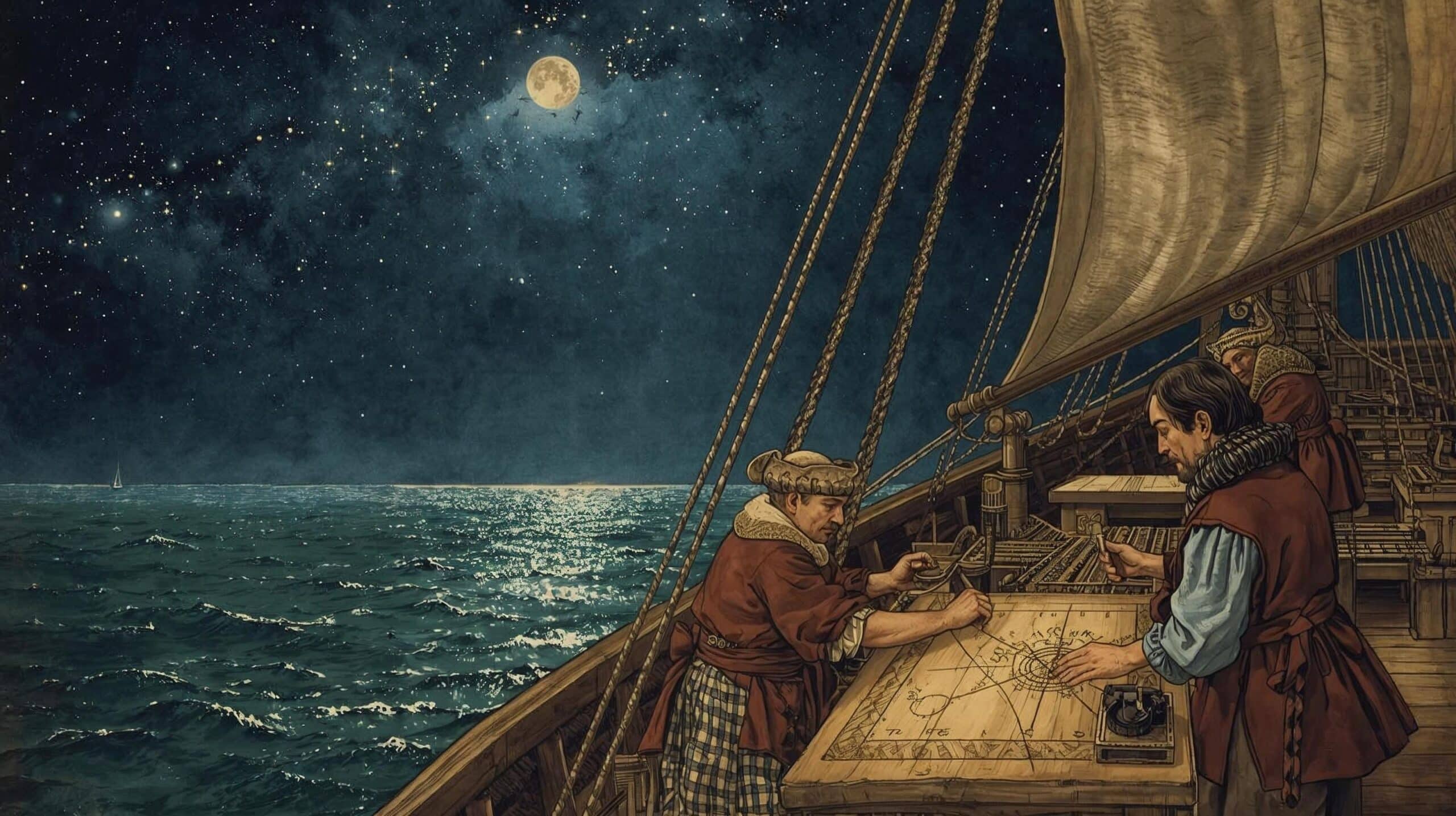
In the early days of the discoveries, navigational compasses were already known, as were other instruments of observation such as the cross-staff, the astrolabe and the quadrant.
In the northern hemisphere, navigators used the North Star for orientation; when crossing the Equator, they also began to use the Southern Cross.
2. Tables, regulations, charts and routes
Declination tables were developed to calculate latitudes based on the height of the sun. Many regulations facilitated the use of the quadrant and astrolabe.
The nautical charts carried on board improved on the old portolanos, bringing together the observations of pilots recorded in the royal archives.
Later, itineraries appeared, with all the practical information needed for navigation.
3. Cosmographers and major works
Notable figures include Jácome de Maiorca, assistant to Prince Henry the Navigator, and, during the reign of King John II, the cosmographers José Vizinho, Rodrigo and Dom Diogo Ortiz (Bishop of Ceuta and Viseu).
Another notable figure was Duarte Pacheco Pereira, author of Esmeraldo de Situ Orbis.
4. The position of chief cosmographer
In 1529, the position of chief cosmographer of Portugal was created, first held by Pedro Nunes.
Until the end of the 17th century, eight more cosmographers followed him, including João Baptista Lavanha, Dom Manuel de Meneses, Antônio de Mariz Carneiro, Luís Serrão Pimentel and Manuel Pimentel — the latter two authors of itineraries, including for the route from Portugal to Brazil.
5. Types of Vessels
- Caravel: Of Moorish origin, with lateen or triangular sails, agile and suitable for exploration. It was one of the first vessels used by Portuguese navigators in the Age of Discovery.
- Nau: After the caravel came the nau, which was larger and equipped with square sails. This vessel was suitable for known routes and became important in colonial history, functioning as a mixed warship and transport vessel, armed with cannons and with holds for cargo.
- Galleon: Combined the characteristics of cargo and warships. It was equipped with large square sails, which were the main source of propulsion, allowing navigation on the high seas. However, the galleon also had oars, which offered greater manoeuvrability in shallow waters and when entering or leaving ports, as well as allowing rapid movement in combat situations, even when the sails were not suitable.
- Round Ship: A round ship was one whose length did not exceed three or four times its width.
- Bergantim: In Brazil, for coastal navigation, the bergantim was used, in which prisoners rowed.
6. Seafaring and legacy
According to Fontoura da Costa, seafaring developed from the time of Prince Henry the Navigator until the mid-16th century.
At that time, the art of navigation began, which only gave way to nautical science at the beginning of the 19th century.
In all phases, the Portuguese contribution was remarkable, especially during the discoveries.
7. Final quote
As Pedro Nunes said, the Portuguese ‘discovered new islands, new lands, new seas, new peoples; and what is more: new skies, new stars’.


This post is also on:
 Português
  English
  Deutsch
  Español
  Français