Portugal’s Maritime Expansion – Fishing as the origin of navigation
The need to fish on the high seas led coastal communities to improve their vessels, navigation techniques, knowledge of winds and currents, and trade networks, which ultimately led to increasingly longer voyages and maritime exploration.
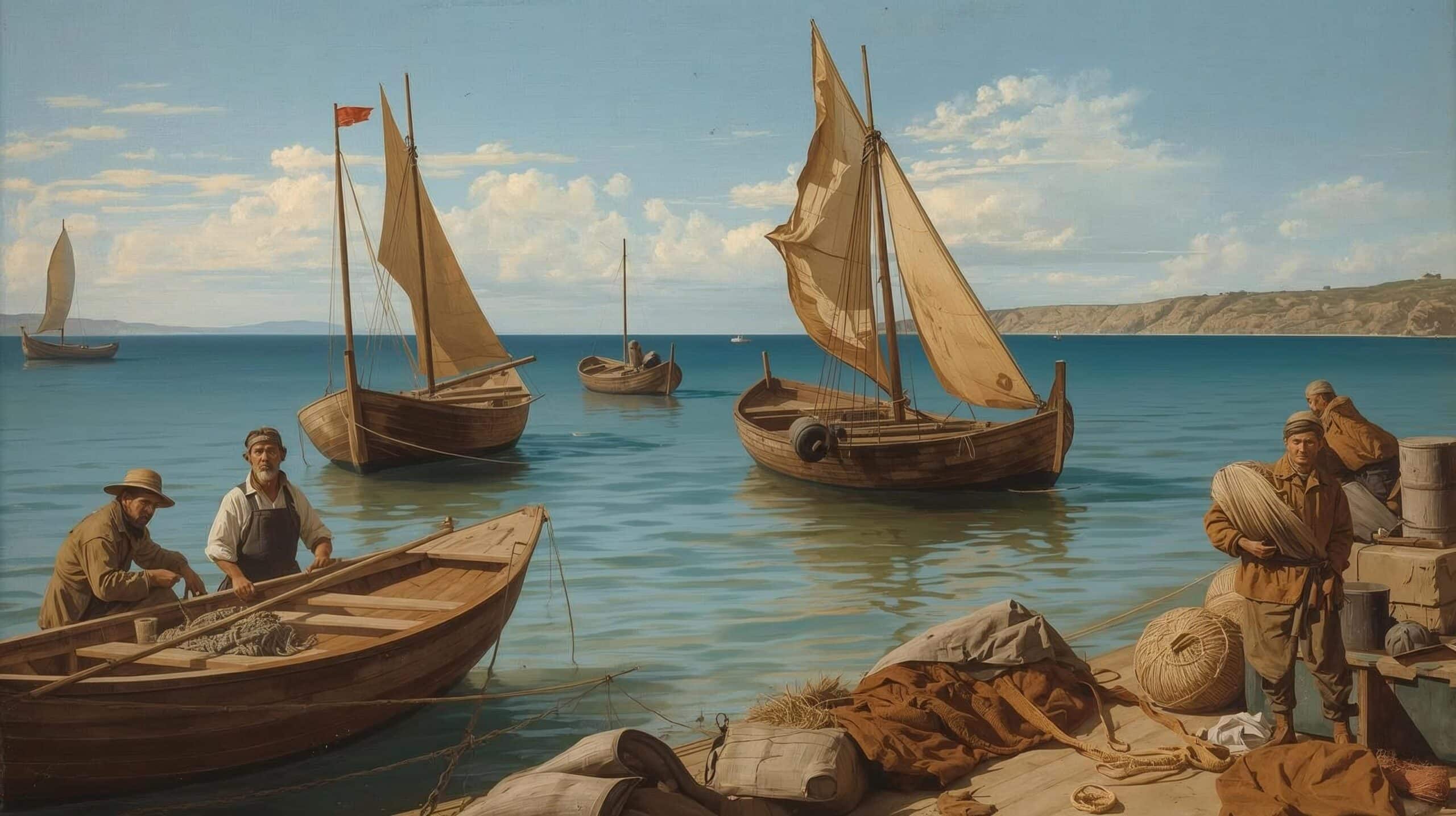
Portugal's Maritime Expansion - Fishing as the Origin
1. Dependence on Fishing
Portugal, a country with soil that is not always fertile and productive, with many barren areas prone to drought, has to resort to sea fishing to supplement the food supply of its inhabitants.
This economic activity, as well as its geographical location on the edge of the ocean, resulted in its devotion to navigation.
2. Growth of Fisheries
Thus, as Oliveira Martins recorded, ‘from the 12th to the 16th century, fisheries grew, and colonies of fishermen swarmed the Portuguese coasts.’
3. Historical References
There are references to whaling and the production of whale oil dating back to the 13th century. During the reigns of Afonso III and Dinis, coral fishing was already practised, perhaps initiated by the Genoese.
In 1353, a treaty was signed between Edward III of England and the residents of Lisbon and Oporto, establishing reciprocal fishing rights on the coasts of both countries for 50 years.
During the reign of King Fernando I, a contract was signed with the Order of Santiago regarding the tithe on fish entering the River Sado. Tuna fishing was also important, yielding as much as 80 contos, but it declined in the 15th century.
4. Fishing in the 15th century
In this century, the fishing of Lagos, in the Algarve, and coral fishing figured among the revenues of Prince Henry.
A company was also organised for the exploitation and export of tuna and sardines, providing income to the Crown, which also happened as a result of successive contracts with other bidders.
5. Discovery of Newfoundland
In the 16th century, the discovery of Newfoundland, an area rich in cod, salmon and herring, led the Portuguese to engage in long-distance fishing.
Viana, in Minho, was, until the following century, a notable centre for fishing, both ‘near and far’.
Portugal’s Maritime Expansion – Fishing as the origin of navigation

This post is also on:
 Português
  English
  Deutsch
  Español
  Français