Piranha: A city of charm and history
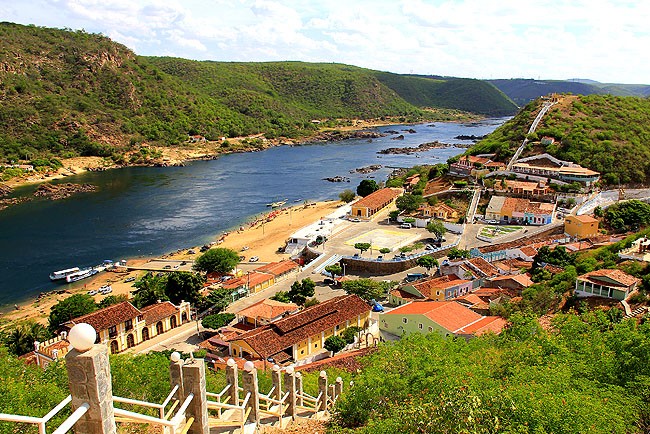
Piranhas is a charming colonial town on the banks of the São Francisco River, with its colourful old houses. Dom Pedro II was charmed by it and spent much time here – according to rumours he was also charmed by a local nobleman.
As well as centuries-old houses and gossip, Piranhas has another surprise in store: it’s a must see for those who want to learn more about the cangaço.

It’s worth noting that the town was never attacked by Lampião, for two good reasons: firstly, because it has only one entrance, which would leave the cangaceiros trapped in the event of a confrontation; and secondly, because the local patron saint, Nossa Senhora, was the patron saint of the so-called “King of Cangaço”.
Lampião spared the piranhas, but he wasn’t spared himself: one of the troops that came to capture the cangaceiro and his gang left here – it left and returned with its hands full, with eleven heads, to be displayed in the public square. Among them were those of Lampião and Maria Bonita.
The loot was sent to Bahia, but Piranhas was pleased to be the first to reveal the failure of the cangaço; it was here that the historic photograph was taken, later sold to newspapers all over the country.
The history of the cangaço can be learned at the interesting Museu do Sertão, one of the city’s attractions, where tourism is still developing.
Video about Piranhas in Alagoas

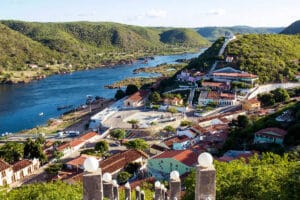
Piranhas no interior de Alagoas - Guia de Turismo05:51

Piranhas em Alagoas02:01
Piranhas - Guia de Turismo37:37
Tourist attractions in Piranhas AL
1. Cangaço Route and Cangaço Eco Park
Piranha became nationally known because of the Cangaço. Many stories about the band of Virgulino da Silva, or Lampião, populate the region.
Near the town, in Grota de Angicos, the cangaceiros of Lampião’s gang were ambushed and beheaded.

The catamaran trip along the São Francisco River takes about 30 minutes and the scenery is breathtaking.
At the Cangaço Eco Park, tourists are greeted by a team of distinctive cangaceiros.
The story of Lampião’s gang is told by one of these distinctive guides, who leads the group along a trail to the Grota de Angicos. The trail is about 1.5 kilometres long and of medium intensity.

At the end of the trail, we find the site of the ambush where Lampião’s group was surprised and killed by police volantes.
2. Historic Centre of Piranhas
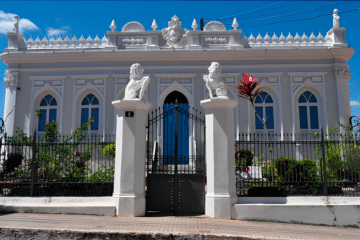
It’s no wonder that the Historic Centre of Piranhas has been declared a National Historic Site. The architecture of the city is simply charming.
The city is full of old, houses and mansions, all very colourful. And to make it even more beautiful, the banks of the Velho Chico frame the city.

At night, the city’s bars come alive, like the classic Pizzaria e Cachaçaria Altemar Dutra (named after the singer who lived there).
And it feels like, as the song says, a good old-fashioned ‘country party’. The whole town seemed to be there, in the historic centre square, chatting, listening to forró and drinking beer.
The party takes place in the centre, under two cosy trees, with tables set up in the street, creating an imaginary partition between the restaurants. A very cosy atmosphere!
During the day, you can take advantage of the city centre to stroll around the old churches.
There are two in the centre: the Nossa Senhora da Saúde Church, built in the 19th century in neoclassical style, and the Santo Antônio de Lisboa Church, the oldest in Piranhas (1790), where the remains of the city’s founders are buried.


Other attractions: Visit the Xingó Handicraft, Art and Culture Centre, housed in the old Railway Network Machine House; take a dip in the river at the Altemar Dutra Waterfront (him again!).
3. Marília Rodrigues Rural Museum
The Building of the old Municipal Railway Station in Piranhas, with its neoclassical architecture, has housed this museum since 1983.
One of the rooms displays material related to the navigation of the São Francisco River, the popular culture of the Northeast and the history of the railway that passes through Piranhas.
The second contains pulpits, oratories and other religious items.
In the third room, visitors have access to a large collection dedicated to the cangaço – from photographs and objects belonging to Lampião and his gang, to posters from the 1930s offering rewards to anyone who captured the feared gang, dead or alive. The old Piranhas station building.
The Sertão Museum is a great opportunity to learn more about the history of the city, the cangaço and the sertanejo man.
The museum has beautiful pieces of equestrian equipment, sertanejo houses, religious items, fishing equipment and many photographs. There are even pieces commemorating the visit of Pedro II to the region.
4. Clock Tower
It’s right opposite the Sertão Museum. The Tower was built in 1879 and its architecture stands out in the centre of Piranha. The site is home to the Café da Torre, which operates from the top of the building.

5. Viewpoints
Talking about beautiful views from above: Piranhas has a beautiful terrain, which has given the town two fine viewpoints.
The Mirante da Igreja (Church Viewpoint ) is at the top of a steep, uneven staircase with 250 steps. At the top is the church of Nosso Senhor do Bonfim and the view is well worth the effort!
The Secular Viewpoint is opposite the Church Viewpoint and houses an obelisk, built at the end of the 19th century to welcome the 20th century.
6. Village of Entremontes
Entremontes is a district of Piranha. It is also historically important, having hosted Dom Pedro II during his tour of the region. Like Piranha, Entremontes has the charm of historic mansions.
A distinctive feature is the handicrafts of the lace makers, who make beautiful redendê and cross-stitch embroidery. The art of Entremontes is highly regarded in the region and even by international fashion designers.
7. Xingó Hydroelectric Power Station
The Xingó Hydroelectric Power Station is located on the road between Piranhas and Canindé de São Francisco. The guided tour takes about 50 minutes.

The tour begins with an explanatory video about the construction of the plant, then we visit the wooden model, carved in incredible detail, a true work of art!
Finally, we are taken to the power station itself for a tour of the exterior and interior. The view from the top of the dam is breathtaking.
The sluice gates were not open when we visited, but you can imagine the force of the water! A monumental feat of engineering!
8. São Francisco River Canyon
The Xingó Canyon tour is what brought us here in the first place. This tour offers some of the best scenery in the region.

Sail down the São Francisco, the River of National Integration, in a way you’ve never imagined. There’s a feature about this trip!

Publicações Relacionadas

The Best Beaches in Alagoas That You Must Explore
Where to Stay in Maceió: Best Areas Revealed
3 Days in Maceió and Surroundings: A Guide
Marapé Dunes: where the river, lagoon and sea meet in Jequiá da Praia

Explore the best beaches in Maceió and the surrounding area

A 5-day tour of Alagoas: The best destinations

Barra Grande Beach: Discover Stunning Landscapes
Beaches of Maragogi and neighbouring towns: Complete guide
Maceió: Your Guide to Visiting Alagoas in Brazil
The Best Beaches in Alagoas: Hidden Gems Revealed
Beaches on the North Coast of Alagoas: Maceió to Maragogi
Nine Islands Archipelago: A Guide to Paradise
Maceió’s Beaches — A Complete Guide: Pajuçara, Ponta Verde and Ipioca
Beaches in Maceió: A coastal paradise awaits

Coral Coast: Discover the Beauty of Alagoas
Southern Coast of Alagoas: A Nature Paradise
The Southern Coast of Alagoas: Beaches, Lagoons and Towns
Piaçabuçu: Adventure on the banks of the São Francisco River
Penedo, Alagoas: things to do, history and sights
Maragogi Attractions: Snorkeling in Natural Pools
Japaratinga: Your Guide to Coral Coast Relaxation
São Miguel dos Milagres: Explore Untouched Beaches
Barra de Santo Antonio: The Best Beaches to Visit
Barra de São Miguel: Beaches and Attractions Guide

Marechal Deodoro: Historical Heritage and Paradise Beaches
Maceió: Top Beaches and Attractions to Explore
Alagoas: Discover the Brazilian Caribbean Beaches
This post is also on:
 Português
  English
  Deutsch
  Español
  Français