From Ancient Surveys to Medieval Mappa Mundi: The Evolution of Cartography
Introduction
It is often noted that contemporary primitive peoples, ranging from the Inuit of the Canadian Arctic to the Bedouin tribesmen of the Arabian Desert, possess an innate ability to produce rough yet precise sketches on animal hide or in the sand, depicting the locations and distances of places familiar to them.
It is reasonable to suppose that map-making began as a development of these abilities among the early inhabitants of the Middle East and the shores of the eastern Mediterranean.
Egypt and the Near East
In Egypt, for example, geometrical methods were used early on for land measurement, stimulated by the need to re-establish boundaries after Nile floods.
However, these cadastral records were not combined to create maps of large areas on a smaller scale, and the few ‘maps’ in the papyri are more akin to plans.
However, the idea of maps as guides for travellers was evidently commonplace, as evidenced by the placement of conventional ‘maps of the nether regions’ in coffins to guide the deceased.
In Assyria, a clay tablet containing a map of part of northern Mesopotamia dates back to around 3800 BC.
In Babylonia, a much later depiction of the known world shows it as a circle surrounded by the sea and the heavenly bodies.
Such speculation about the form of the universe and the place of the known world in it, along with attempts to represent it graphically, had an important influence on map-makers.
Greeks and Early Maps
The Greeks adopted the Babylonian conception of the earth as a flat circular disc surrounded by the primordial ocean, along with much else of greater importance in astronomy and mathematics.
In the Hellenic world, the Ionians took the first steps in the development of scientific thought, being favourably placed to receive Babylonian culture and sharing in the expanding commerce of the Mediterranean.
Traditionally, one of them, Anaximander, is credited with constructing the first Greek map in the early sixth century BC.
The earliest reference to a map in Western literature occurs in Herodotus‘s account of the interview between Aristagoras, the tyrant of Miletus, and the Spartans, from whom he sought help against the Persians.
According to Herodotus, Aristagoras produced a bronze tablet inscribed with the circumference of the whole earth, the whole sea and all the rivers.
However, when the Spartans learned that Susa, the Persian capital, was three months’ march from the Mediterranean coast, they refused to listen to him further.
Apart from those of Ptolemy, our knowledge of the form and content of Greek maps is based on references in the writings of historians and geographers.
From these, it has been deduced that the Greeks possessed written itineraries and itinerary maps of their main trading routes in the eastern Mediterranean region from an early date.
They certainly also had written descriptions of the coasts sailed by their merchant skippers, but they do not seem to have constructed sailing charts.
As the voyages were mainly coastal, written directions were probably favoured over charts, especially since the lack of precise instruments meant that charts could not be very accurate.
There are, at least, no clear references to marine charts. However, information gleaned from sailors contributed much to general maps, in which coastlines formed a significant part.
Itinerary Maps and Composite World Maps
Itinerary maps showed stages along important routes; for example, from the Mediterranean coast through Asia Minor to the Persian capital, Susa.
This was depicted as a straight line with details of the main geographical features on either side.
General maps of the known world were created from sectional maps such as this. Sir John Myres has demonstrated how this was achieved through his study of Herodotus.
First, a few fundamental lines were established, corresponding roughly to our parallels and meridians. One such parallel was the Royal Road to Susa mentioned above, while others were provided by lists of peoples who were believed to succeed each other from east to west.
One meridian was taken to run down the Nile and through the Cilician Gates and Sinope to the mouth of the Ister (Danube).
As these lines were far from ‘straight’, considerable distortion was introduced into the map. In this way, an east–west axis was also established for the Mediterranean.
Since the change in direction was gradual and not easily perceptible when coasting along considerable stretches of the west coast of Italy and the south coast of France, for example, these portions tended to be shown as parallel to the east–west axis.
The Mediterranean was thus narrowed in proportion to its length.
Symmetry and Conception of the World
A general principle that governed much Greek thinking at the time was incorporated into the design of the map: the symmetry of nature. Features north of the axis had to be balanced by similar features to the south: the Pyrenees by the Atlas Mountains, the Adriatic by the Gulf of Syrtes, Greece by the Cyrenaica promontory and so on.
This principle was also applied further afield: since the Nile was thought to flow from west to east in its upper course, the unknown upper course of the Ister was made to do likewise.
It is important to emphasise this point, as it strongly influenced later ideas about the Earth’s configuration.
Ptolemy probably conceived of his enclosed Indian Ocean as a counterpart to the Mediterranean. The world map continued to be circular in shape and centred at Delphi, an assumption that philosophers often derided.
Scientific Advances: Sphere, Latitude and Longitude
Meanwhile, scientific progress was revolutionising conceptions of the Earth and suggesting much more precise methods of determining position on its surface.
The idea that the Earth was spherical rather than flat was first advanced by Pythagorean philosophers and brought to the attention of the general public through Plato‘s writings.
Once the spherical nature of the Earth had been recognised, and later the obliquity of the ecliptic, astronomers were able to deduce latitudes from the proportions between the lengths of the shadow and the sundial’s pointer.
This was the precursor to the modern method of obtaining latitude by observing the altitude of the sun at midday and applying the necessary correction from tables in the Nautical Almanac.
Thus, alongside the ‘mapping’ of relatively small areas for practical purposes, which corresponded to what the Greeks called ‘chorography‘, the science of ‘geography‘ slowly developed. This involved mapping the entire known world using scientific methods — what we would call cartography today.
Unlike the determination of latitude, for which the Earth’s axis provides an established reference datum, the problem of longitude long baffled astronomers because no meridian is marked out as the initial one in the same way that the Equator serves as the initial parallel.
Since the Earth makes one revolution in approximately one day, it was quickly realised that simultaneous observations of a celestial phenomenon, such as a lunar eclipse, would provide a value for the difference in longitude (1 hour = 15° of longitude) due to the difference in local times at the moment of observation.
However, without the necessary astronomical tables or accurate portable timekeepers, this method was impractical, although a few attempts were made to observe eclipses for this purpose. Until the seventeenth century, all early maps showed longitudes by converting distances into angular values in relation to the circumference of the globe.
To do this, it was necessary to calculate the circumference of the Earth, which, when divided by 360, would give the length of a degree.
This was achieved with a high degree of accuracy by the Greek astronomer Eratosthenes, who measured the meridian arc between Alexandria and Syene.
He arrived at a figure of 252,000 stadia for the circumference of the Earth, which — assuming he used the short stadium — was equivalent to 24,662 miles.
This result was only some fifty miles short of the actual value. From this result, it followed that a degree was equivalent to 68.5 miles. Unfortunately, this accurate figure was not accepted by his successors, which had significant consequences for the history of cartography.
Projections and Graticules
The Greeks also attempted to solve the problem of projecting the Earth’s surface onto a plane in order to create an organised arrangement of parallels and meridians, which could be used to locate positions.
Drawing parallels was relatively simple, at least within the limited area for which observations were available.
Eratosthenes attempted to extend two parallels eastwards based on the directions noted by travellers between important places, and on the assumption that districts with similar climates and products would lie on or near the same parallel. In this way, he established two main parallels: one running along the assumed axis of the Mediterranean (Gibraltar–Messina–Rhodes), continuing through the Taurus and the Caspian Gates, and along the Imaus Mountains. Secondly, he assumed that Meroe in Egypt lay on the same parallel as southern India.
The establishment of meridians presented even greater difficulties for reasons already stated. Without the aid of the magnetic compass, it was extremely difficult to determine the bearing of one place from another.
This knowledge was derived from approximate astronomical observations, such as the position of the sun at the equinoxes or the position of the constellations in the night sky. Using these observations, Eratosthenes established an initial meridian which assumed that the mouth of the Don, Lysimachia on the Dardanelles, Rhodes, Alexandria, Aswan, and Meroe all lay on a direct north–south line.
His successors criticised these attempts to provide a fixed framework for the world map on the grounds that the available data were insufficient. Hipparchus, the greatest of the Greek astronomers, refuted these claims and laid the foundation for further progress by compiling a table of latitudes.
Marinus and Ptolemy
As more detailed knowledge accumulated and the known world expanded through the achievements of Alexander the Great and the Romans, later cartographers could take up the task outlined by Eratosthenes and Hipparchus with greater assurance of success.
Two names stand out in the second century AD: Marinus of Tyre and Claudius Ptolemy of Alexandria. Marinus‘s work is known to us almost entirely from Ptolemy‘s references to him in his ‘Geographical Exposition’.
Marinus built on earlier ideas to create a network of meridians and parallels, but on his world map, he depicted them as straight lines intersecting at right angles. He considered this neglect of the meridians’ convergence justifiable in view of the relatively small area of the Earth’s surface that could be mapped and the uncertainty of much of the data.
Ptolemy criticised him on this point, devising two projections and amending and supplementing Marinus’ work with later information.
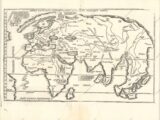
When discussing Ptolemy’s maps, it should be noted that no manuscripts older than the twelfth century AD have survived, and it is debatable whether the maps we have are those that Ptolemy drew or indeed if he drew maps at all.
Apart from general sections on cartography and projections, the Geography is essentially an extensive table of the geographical coordinates of around 8,000 locations.
As there were very few astronomical observations available, Ptolemy obtained the positions of these localities through careful study of itineraries, sailing directions and topographical descriptions of various countries.
He endeavoured to allow for the windings of routes by reducing many itinerary distances, as he shared Marinus‘s distrust of travellers’ estimates, as evidenced by Marinus’s assertion that ‘merchants, being wholly intent on business, care little for exploration, and often, through boasting, exaggerate distances’.
The simplest method of arriving at the coordinates would be to construct maps from such data and read them off the network of meridians and parallels.
Given all this laborious preliminary work, it is hard to believe that he would have refrained from supplementing his text with maps. This is not to suggest that the maps survive in their original form. It is definitely stated that the world map was drawn by Agathodaimon of Alexandria, who may have been a contemporary of Ptolemy.
However, there are also inconsistencies in the text and between the text and the maps. Father Joseph Fischer, a leading expert on Geography, believed that the maps were originally drawn by Ptolemy but became separated from the text.
He also thought that both the text and the maps underwent modifications before being reunited. However, a more drastic interpretation has been put forward by a recent student, Leo Bagrow.
Through a critical study of the text, which he admits lacks unity, he believes it was compiled from Ptolemy’s writings by a Byzantine scribe in the tenth or eleventh century.
From the tribal names in European Sarmatia (western Russia), he concludes that the maps could not have been drawn before the thirteenth century. He also found a record of a Byzantine named Maximos Planudes (c. 1260–1310) who owned a manuscript of the text and drew a set of maps for it.
Bagrow believes that the later manuscript maps stem from these. While it is clear that the surviving maps are not Ptolemy‘s original work, this does not necessarily mean that he did not draw maps; the cases of Agathodaimon and the world map suggest that his data were being used for maps quite early on.
More importantly, the Ptolemy manuscripts transmitted a vast amount of topographical detail to Renaissance scholars, profoundly influencing their conception of the world, whatever the truth about their history.
Manuscript Maps and Influence
The manuscript maps fall into two categories: one consisting of a world map and twenty-six regional maps. This set accompanied the Latin translations of the fifteenth century and was used for the earliest printed editions.
The second class contains sixty-seven maps of smaller areas. The world map is drawn using the simpler of the two projections described by Ptolemy: a simple conic with one standard parallel.
The special maps use a rectangular projection with straight parallels and meridians that intersect at right angles. They show the boundaries of provinces and the locations of important nations, cities, rivers and mountains.
These maps deserve closer examination due to their influence on the Renaissance of cartography. From the second century until the early fifteenth century, they had almost no influence on Western cartography.
However, they were known to Arab geographers, who had translations of his works. Through these, they seem to have influenced fourteenth-century cartographers such as Marino Sanudo.
Following the translation of the text into Latin in the early fifteenth century, Ptolemy dominated European cartography for a century. His insistence on a scientific approach promoted cartographic progress.
However, his ideas also hindered the development of an accurate world map in several ways. One of his main errors was adopting a value for the length of a degree equivalent to 56.4 miles, as opposed to Eratosthenes‘s more precise figure.
Consequently, when converting distances into degrees, he obtained figures that were greatly exaggerated, an error that was exacerbated by travellers’ tendency to overestimate the distances they had covered.
For example, he estimated the longitudinal extent of the Mediterranean to be 62°, rather than 42°, and he also exaggerated the easterly extension of Asia, placing its eastern shores 50° too far east. However, this was a reduction of 45° on the figure adopted by Marinus.
He also incorporated erroneous ideas about the shape of the Old World. For instance, he greatly overestimated the size of Taprobana (Ceylon) and overlooked the peninsular shape of the Indian subcontinent, perhaps confusing it with Ceylon.
He conceived the Indian Ocean to be a landlocked sea and extended the southeastern African coastline eastwards to meet a southerly extension that he probably intended to represent the Malay Peninsula.
Another conspicuous error is the easterly direction he gave to Scotland, which was probably due to a mistake when joining two sectional maps together.
His depiction of the hydrography of northern Africa, showing a large river flowing eastwards, possibly the Niger, ending in a central swamp, was followed until the early nineteenth century.
His delineation of the Nile was less erroneous: it rose from lakes at the foot of the Mountains of the Moon, some degrees north of the Equator.
These misrepresentations are useful to keep in mind when studying Renaissance maps, as well as noting their gradual elimination as exploration progressed.
Roman Cartography
The Romans seem to have been singularly unconcerned with Greek achievements in scientific cartography. For them, maps remained practical aids for the journeys of their officials and the campaigns of their legions.
Judging by the sole surviving example of any size, we might conclude that they were little more than graphical renderings of written itineraries.
This example is the ‘Peutinger Table‘, named after the sixteenth-century humanist who once owned it, and is a very late copy. The table is essentially a road map of the Roman Empire, designed to fit a long, narrow scroll, presumably for ease of carrying.
Straight lines indicate the roads, and distances are marked between each stage. Changes in direction are shown by ‘kinks’, and branch roads diverge in a similar way.
True directions are therefore neglected, resulting in considerable distortion of the shape of countries and the relative positions of features. However, it was simply an efficient guide for road users, as it was intended to be.
From literary references describing the use of maps in campaigns and their value to commanders, it is clear that not all Roman maps could have closely resembled the Table.
An idea of their general character can be formed from references to the most famous Roman map: the Orbis Terrarum, or ‘survey of the world’, created by M. Vipsanius Agrippa, son-in-law of Emperor Augustus, who authorised the project and oversaw its completion following Agrippa’s death in 12 BC.
Pliny testifies to Agrippa‘s ‘extraordinary diligence’ and the care he devoted to the work, which was displayed in the Porticus Vipsania in Rome to inform citizens.
In his topographical descriptions of countries in his ‘Natural History’, Pliny, who had seen the map, quotes Agrippa several times on the dimensions and boundaries of countries, presumably obtained from the map.
Since these quotations refer to seas, rivers, mountains, islands, provinces and towns, the map must have been drawn in great detail.
The map was undoubtedly based on distances along the Roman road system and official returns supplied by provincial administrators. Various opinions have been expressed about the probable shape of the map, but most people think it was circular.
The popularity of the small T–O maps in late Roman times is indirect evidence of this. Given the official nature of the Agrippa map, it was probably circulated in reduced-scale copies, such as the map Eumenius recounts was studied by schoolboys in Autun in the fourth century.
It can be argued that maps derived ultimately from the Agrippa model persisted through the Middle Ages, of which the Hereford mappa mundi is an example.
The contrast often drawn between ‘practical’ Roman and ‘scientific’ Greek cartography is exaggerated.
While it is true that the Greeks had arrived at a more scientific conception of the essentials, their methods of obtaining the necessary data were less advanced than their theory.
It was only towards the end of this period that Greek cartography culminated in the work of Claudius Ptolemy, and even then it had serious limitations.
It is not difficult to believe that, to the Romans, a map based on the road system would have been more appealing than the work of the Greek geographers, however scientifically conceived.
Early Medieval Maps
There is not enough space here to examine early medieval cartography in great detail, but certain points should be kept in mind. For several centuries, geographical knowledge remained static, if not declining.
Consequently, geography and cartography became a mere routine of copying accepted authorities, with an increasing number of errors introduced. Many of the so-called maps from this period were simplified diagrams inserted into standard descriptions of the known world.
A common example is the numerous T–O maps, which are oriented with east at the top.
The O represents the boundary of the known world, the horizontal stroke of the inset T represents the approximate meridian running from the Don to the Nile, and the perpendicular stroke represents the axis of the Mediterranean.
Other versions occur within a rectangular frame, which may have been adopted for its economy of space or because it complied with Biblical references to the ‘four corners of the earth’.
The main type of circular world map, or ‘mappa mundi‘, which was perpetuated throughout this period, appears to be distantly related to Agrippa‘s world map, modified to align with orthodox Christian theology.
There are variations in shape; for example, the map of Henry of Mainz in the Corpus Christi College Library in Cambridge is elliptical, which may have been done to fit more conveniently on the manuscript page.
In any case, the content of such maps does not differ significantly from that of the circular type.
The Hereford Mappa Mundi and British Cartography
The largest and most interesting surviving example of a circular world map is the mappa mundi preserved in Hereford Cathedral.
Though dating from as late as c. AD 1300, it is clearly the last in a long line of copies. One of these links is the Hieronymus map, dating from around 1150 AD, which is now in the British Museum.
There are several reasons to believe that it derives from a Roman original, apart from the inscriptions on it that associate it with the fourth-century writer Orosius and refer to the survey of the world by ‘King’ Agrippa.
Broadly speaking, the area it represents corresponds to the limits of the Roman Empire, extending to include the conquests of Alexander the Great.
The provincial boundaries shown correspond fairly closely to those of the time of Diocletian.
The shapes assigned to certain countries resemble those in popular Roman-era writings, and some groups of named towns, though jumbled up on the map, correspond to sections of the Antonine Itinerary.
While accepting this Roman pedigree for the Hereford map, it must be acknowledged that it underwent significant alterations at the hands of Christian theologians.
Jerusalem is at the centre of the map, which is not a serious distortion since the centre of the original may well have been in the vicinity of Rhodes.
While it is disputed whether the original Roman map was oriented with the east at the top, this would not have been a difficult alteration to make, and it enabled the Christian scribe to place the terrestrial paradise in a position of honour.
Furthermore, the area of Palestine has been considerably enlarged, as one of the objectives was to depict sites hallowed in Holy Scripture.
The general scheme resembles that of the T–O maps, though it is somewhat distorted by the emphasis placed on Palestine, Asia Minor, and so on.
Rome, Antioch and Paris are drawn very conspicuously, with the prominence of the latter suggesting that a French scribe may have been responsible for one of the ‘links’.
Other cities and towns are represented by conventional drawings of towers and gates, while mountains and rivers abound, the former depicted in a stylised profile.
Most of the otherwise empty space is filled with neatly executed drawings depicting themes from popular histories and bestiaries of the time. The whole work is as much an encyclopaedia of medieval lore as it is a map and provides fascinating material for study.
For this outline, of greater interest is the fact that, although it was mainly copied from older sources, it contains additions showing that interest in cartography had not entirely died out.
Several towns that were prominent in the English administration of Gascony in the thirteenth century have been added, and there are traces of a commercial route from northern Germany towards the Rhine dating from an earlier period.
Though crude, the depiction of the British Isles on the Hereford map is later than the general content and features medieval forms of town names and four cities in Ireland.
The representation of the Trent–Ouse river systems of northern England also indicates local knowledge. However, the evidence for medieval cartographic activity in Britain is not confined to this map.
Dating from around 1250 are the four maps of Matthew Paris, the chronicler from St Albans: one is based on a straight-line itinerary from Dover to Newcastle.
Though they present difficulties in interpretation, they nevertheless show that attempts to draw maps, however crude, were being made.
Even more striking is the ‘Gough‘ map from the following century (c. 1325), which features an elaborate road system and precise distinctions in the status of the depicted towns. R. A. Pelham has suggested that this may be a copy of an official road map prepared for Edward I.
Byzantine and Arab Transmission; al-Idrisi
As mentioned above, Ptolemy‘s Geography had little influence on the medieval West, but it was known and studied in Byzantium.
It is possible that we owe the surviving maps to Byzantine scholars. Further study of the precise role of Byzantine culture in the history of cartography may yield significant findings.
Ptolemy’s influence was also felt in another centre: the Arab world.
The Geography was translated into Arabic in the ninth century, and Arab scholars such as Masʿudi were familiar with versions of his maps in the following century.
However, except in one instance, there was no direct contact between Arab and European cartography. In the twelfth century, the geographer al-Idrisi was welcomed at the court of Roger II, the Norman king of Sicily.
There, he compiled a world map with a written description incorporating Arabic and Western sources. The latter were obtained for him by royal order.
These sources are generally assumed to be written reports by sailors and merchants. However, al-Idrisi‘s description of the English coasts bears some striking similarities to the outline of the earliest marine charts, although the place names do not correspond.
As will be shown in the next chapter, these charts are considered to have originated around 1250 AD. Were these charts based on material similar to that used by al-Idrisi, or should their origin be set back a century? This is another problem that would repay investigation.
Even if the direct influence of Arab cartography on Western Europe was minimal, works on astronomy and mathematics, translated from the Arabic, stimulated progress from the thirteenth century onwards, as will be seen later.
Transition to the Renaissance
Clearly, by c. A.D. 1300, cartography was beginning to emerge from its ‘dark ages’, apart altogether from the great advance in sea charts discussed in the next chapter.
However, there is certainly no clean break at this date, as features of medieval mappae mundi persisted in Renaissance maps for a long time.
However, expanding horizons presented greater incentives to cartographers and encouraged them to solve more complex problems than those faced by their medieval predecessors, who were confined to Western Europe by poor communications, threatened on almost all sides and dependent on the limited resources of monastic libraries.



This post is also on:
 Português
  English
  Deutsch
  Español
  Français