The evolution of European cartography (16th-17th centuries): Mercator, Ortelius and the Dutch centres
Index
- Introduction
- The first atlases and supplements
- Gerhard Mercator: background and early work
- The problem of navigation and loxodromes
- Mercator’s map of Europe (1554)
- Methods and limitations of ancient cartography
- The reception of Mercator and other maps
- Mercator’s world map (1569) and the projection
- Mercator’s overview and concepts
- The Arctic region and lost reports
- The influence of Mercator’s map
- Mercator’s Atlas
- Abraham Ortelius and the Theatrum
- Sources and Dutch cartographic activity
- Dutch practice and hand-drawn charts
- The Blaeu company and its contributions
- Plancius, world maps and projections
- Characteristics, merits and shortcomings
1. Introduction
As exploration advanced and the demand for topographical maps from travellers, statesmen, merchants and antiquarians grew, an increasing number of maps, large and small, were produced as the sixteenth century progressed.
The task of coordinating and generalising this varied material largely fell to the teachers of cosmography at the universities, or failing them, the publishers and their assistants.
This could be achieved by revising earlier decades’ world maps, which often appeared in multiple sheets and were susceptible to damage or destruction, as evidenced by the few surviving copies.
The varying sizes of smaller maps of continents, countries, provinces and counties also made them difficult to preserve conveniently in bound volumes.
The evolution of European cartography in the 16th and 17th centuries was driven by technical innovations, publishing standards and the flourishing of Dutch cartographic centres.
Gerardus Mercator
Gerardus Mercator (1522–1594) was a Flemish cartographer and instrument maker; he created the conformal cylindrical projection (1569) that facilitated navigation and published maps and globes, whose collection gave rise to a posthumous atlas.
Abraham Ortelius
Abraham Ortelius (1527–1598) was a cartographer and publisher from Antwerp; author of Theatrum Orbis Terrarum (1570), considered the first modern atlas for bringing together uniform maps and citing sources.
Dutch cartographic centres
Main hubs and characteristics:
- Antwerp — publishing and information exchange hub.
- Amsterdam — main centre of the Golden Age of cartography (Blaeu, Hondius, Janssonius).
- Haarlem & Leiden — engraving workshops and technical dissemination.
- Delft & Rotterdam — nautical charts, instruments and links with maritime trade.
Common characteristics: commercial networks (VOC), engraving/printing workshops, collaboration between cartographers and pilots, and strategic management of nautical information.
2. Early atlases and supplements
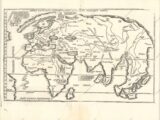
In the early years of the century, the Waldseemüller edition of Ptolemy, with its twenty ‘tabule novae‘, was the closest thing to a modern atlas as we know it today.

Sebastian Münster’s “Cosmographia“, published in Basel in 1550, contained what could be considered an atlas supplement comprising rather crude woodcut maps.
Some of these ultimately derived from Waldseemüller, while others depicting special regions were supplied by his friends.
In Italy, it had become common practice to bind some of the finely engraved maps published in Venice and Rome together to suit the tastes of individual collectors.
The map engraver and publisher Antoine Lafreri, based in Rome, produced an engraved general title page for such volumes: ‘Geographia: tavole moderne di geografia de la maggior parte del mondo‘, 1560–1570.
These so-called Lafreri atlases sometimes included reduced copies of large maps which would otherwise be unknown or extremely rare.

A notable example is Olaus Magnus’s ‘Carta marina‘ of 1539, a map of northern European countries that Lafreri republished on a smaller scale in 1572.
However, it was the Flemish cartographers Ortelius and Mercator who, in addition to their other achievements, met the public’s demand for a comprehensive, up-to-date and convenient collection of maps by creating the first modern atlases.
3. Gerhard Mercator: background and early work
Gerhard Mercator (the Latinised form of his surname Kremer) was born in Rupelmonde, Flanders, in 1512.
He owed much to his relationship with Gemma Frisius, a cosmographer and editor of Peter Apian. As a pupil of Frisius’s at the University of Louvain, Mercator demonstrated an aptitude for practical tasks.
He is first mentioned as the engraver of the gores of Gemma’s globe around 1536. He was also a maker of mathematical and astronomical instruments and, in his early days, a land surveyor.
This aptitude undoubtedly led him later to examine and solve the problem of interest to practical navigators: how to represent constant bearings (loxodromes) as straight lines on a chart.
During his long life, he acquired profound knowledge of cosmography and topographical developments in Europe and beyond, winning him general recognition as the most learned geographer of his time.
While studying at the University of Louvain, he established himself as an authority on these subjects within the intimate circle of Emperor Charles V.
This position brought him into contact with Portuguese and Spanish navigators and cartographers, who were at the forefront of progress in these sciences at the time.
His most notable achievements were his globe of 1541, his renowned world map of 1569, his large map of Europe (1554), his edition of Ptolemy (1578), and his Atlas, which was still being published at the time of his death in 1594.
4. The navigation problem and loxodromes
The practical seaman of the time needed a chart on which a line of constant bearing could be drawn as a straight line.
This was impossible on contemporary charts, which made no allowance for the convergence of the meridians.
In order to preserve a constant bearing on the globe, a line must cut each meridian at a given angle.
Since the meridians converge at the North Pole, this line would clearly become a spiral, circling closer and closer to the North Pole but never actually reaching it.
On his 1541 globe, on which these loxodromes were laid down for the first time, Mercator marked them using a simple drawing instrument that could be set at the required angle. However, the problem of representing these lines as straight lines on a flat chart remained unsolved.
The claim that Mercator was the first to recognise the true nature of loxodromes has been disputed.
The celebrated Portuguese mathematician and navigation expert Pedro Nunes was already investigating them, and given the close relations between Portugal and Flanders at the time, it is quite probable that Mercator was aware of his work.
However, as far as is known, Nunes never progressed to the point of projecting a chart on which the loxodromes could be drawn as straight lines.

Mercator finally achieved this with his great world map of 1569, which uses the projection now named after him. It may be noted that Nunes was highly critical of the charts of his time.
For instance, he complained that pilots persisted in attempting to express distances in degrees instead of setting down the actual run in leagues, thus introducing endless confusion.
5. Mercator’s map of Europe (1554)
Before creating his famous world map in 1569, Mercator had already gained an international reputation as a cartographer, primarily thanks to his 1554 map of Europe, which demonstrated exceptional skill.
Only one copy of this map, which was engraved on fifteen sheets with overall dimensions of 132 × 159 cm, is now known. It was published in Duisburg, where Mercator had established himself as a mapmaker and lecturer at the university in 1552.
The map is an excellent example of engraving, with lettering in the italic style that he popularised in Western Europe.
The main improvement he made was reducing the length of the Mediterranean. Ptolemy‘s figure of approximately 62° had generally been followed by cosmographers.
Mercator accepted Ptolemy’s position for Alexandria but, using marine charts, established that the Canary Islands, through which the prime meridian of the Alexandrians ran, were much further west of the Strait of Gibraltar than had previously been recognised.
Consequently, by allowing for this and revising other distances, he reduced the longitudinal length to approximately 52°. Although this was still about 10° 30′ in excess of reality, it was a considerable advance.
For over a century and a half, map makers did not improve upon this, though navigators had a more accurate understanding. In contrast to the longitudes, the latitudes on the map are quite accurate for Western Europe, though errors of 2 to 3 degrees occur towards the north and east.
This calculation is typical of the kind of reasoning upon which Mercator based his map. Having accepted Ptolemy’s position for Alexandria, he determined the locations of the key points through thorough research into distances from the most reliable available itineraries, paying particular attention to relative directions. He was greatly aided in this task by marine charts.
He then coordinated the results to the best of his ability with the known latitudes of the principal cities. In a note on the map, he dismissed attempts to calculate differences in longitude based on simultaneous observations of eclipses for the perfectly sound reason that the precise moment of an eclipse is extremely difficult to observe. An error of four minutes in determining this would result in an error of one degree of longitude.
Another of his improvements rendered the ‘waist‘ of Eastern Europe, between the Baltic and the Black Sea, much more accurately; on earlier maps, it had been far too constricted. Conversely, the Black Sea is elongated by several degrees on the map.
6. Methods and limitations of early mapmaking
These brief comments will demonstrate the general methods used to compile maps of larger areas in the sixteenth and seventeenth centuries and illustrate the types of errors that could occur.
Maps depended largely on the labour expended in the cartographer’s office attempting to reconcile a mass of disparate and often conflicting data.
Outside of Europe, the only reliable features on maps of the continents were the coastlines, which were obtained from marine charts.
A partial exception was Asia, though even there, knowledge of the interior was often outdated and inaccurate.
This remained the general position for a long time until, in the nineteenth century, explorers and travellers were equipped with reasonably accurate instruments for rapidly determining positions.
Gradually, the work of precise surveying within modern limits of accuracy was extended.
Even today, much of the Earth’s surface remains unmapped to this standard. This is a key point to bear in mind when discussing the work of mapmakers for at least two centuries after Mercator.
7. Mercator’s reception and further maps
The unique quality of his map of Europe was recognised immediately, and demand was high for the period.
A second edition (1572), with considerable improvements, especially in the northern regions, was published.
Mercator was able to use the results of English voyages to the White Sea and English observations of the latitude of Moscow, combined with itineraries of the Russian interior.
Another important work from this period is his 1564 map of the British Isles. Oriented with the west at the top, it measures 129 × 89 cm.
Mercator merely stated that he engraved it for an English friend, leaving the compiler’s identity unknown.
8. Mercator’s world map (1569) and the projection
Mercator’s posthumous fame rests upon his world map, which was published in Duisburg in 1569: Nova et aucta orbis terrae descriptio ad usum navigantium emendate accomodata.
This great map, of which only four copies have survived, comprises twenty-four sheets, with full dimensions of 131 × 208 cm.
Although the title refers only to its use by navigators, Mercator states that it was also intended to accurately depict land surfaces and demonstrate how much of the Earth’s surface was known to the ancients.
As mentioned above, lines of constant bearing on the surface of the globe are spirals that ultimately circle the Pole. In order to depict these lines as straight on a flat map, the meridians and parallels must be arranged so that the loxodromes intersect the meridians at constant angles; in other words, the meridians must be parallel.
However, since the meridians converge in reality, this distorts east–west distances and therefore direction and area at any given point.
However, if the distances between parallels are increased proportionately to the increase in the intervals between the meridians from the equator towards the poles, the correct angle relationships, i.e. direction, are preserved.
Mercator adopted this solution, and charts on his projection were said to have ‘waxing latitudes‘.
The projection has a further useful property: since the angles are correct at any point, the shape of small areas is preserved (i.e. the projection is conformal).
This property, combined with the representation of loxodromes as straight lines, makes the projection extremely useful for depicting small areas. For large sections of the globe, however, it has obvious disadvantages.
Due to the ‘waxing latitudes‘, the scale increases progressively from the Equator to the Pole, so measuring distances is not straightforward. (The length of a degree of longitude is zero at the poles, whereas on the Mercator projection, it is theoretically the same as at the equator.)
Mercator therefore included two lengthy notes on his map, explaining how it was possible to determine the other two elements — difference of latitudes, difference of longitudes, direction and distance — given two of the following. The main difficulty lay in determining distance due to the variation in scale.
He solved this using the principle of similar triangles. The triangle formed by the bearing between the two points on the chart whose distance was to be determined and their difference in latitude was constructed proportionally on the equator.
The required line length was then measured in equatorial degrees and converted into miles by multiplying the figure by the appropriate conversion factor: one degree equalled fifteen German miles, sixty Italian miles or twenty French miles.
It took many years for Mercator charts to be generally adopted by seamen, who preferred empirical methods. Some complained that the coastlines were not clearly shown on the original world chart, but it is difficult to believe that this in itself led to its early neglect.
The theoretical construction of the projection was not clearly set out until Edward Wright published Certaine Errors in Navigation (1599).
Its merits would not be recognised by navigators until charts of relatively small areas were constructed on its principle.
Such charts began to be drawn by the end of the century, but it was not until nearly a century after its invention that Sir Robert Dudley produced a collection of charts on this projection in his Arcano del Mare (1646).
Even at the end of the century, the famous navigator John Narbrough could still write: “I wish all seamen would stop sailing by the false plain charts and sail by Mercator’s chart, which is true to the principles of navigation.
But it’s difficult to convince any of the old navigators to abandon their method of sailing by the plain chart. Show most of them the globe, yet they will continue to talk in their accustomed way.”
Mercator was interested in continental outlines and was also interested in the problem of terrestrial magnetism and accepted the observation commonly made by navigators that the line of no magnetic variation passed through the Cape Verde Islands.
Accordingly, “since it is necessary that the longitudes of places should, for good reasons, have as their origin the meridian which is common to the magnet and the world… I have drawn the prime meridian through the said islands”.
As he was also aware that magnetic variation differed from place to place, he concluded that there must be a magnetic pole towards which magnets turned in all parts of the world. He marked the position of this pole in the region of the modern Bering Strait.
In his continental outlines, Mercator broke away completely from Ptolemy‘s conceptions, although the latter’s influence on the interior of the Old World can still be traced.
9. Overview and Mercator’s Conceptions
Mercator recognised three great landmasses: the Old World (Eurasia and Africa), the New Indies (North and South America) and a great southern continent, Continens Australis.
This was based on the Greek idea of a southern continent counterbalancing the “inhabited world”.
Support for this theory came from misreadings of Varthema and Marco Polo, which led to the conclusion that the hypothetical regions of Beach and Lucach lay south of Java Major.
Magellan’s observations of Tierra del Fuego were incorporated into this southern continent, with the coastline extended northwards to the vicinity of New Guinea. It is possible the map preserves traces of early knowledge of the Australian coastline.
Southeast Asia is based fairly closely on Portuguese discoveries, though much of the interior derives from Marco Polo’s narrative, and the outline resembles maps of the previous century and late medieval world maps.
Mercator’s mistaken belief that the ‘river of Canton‘ must be the classical Ganges confused the geography of the southeastern interior. South America has a curious quadrilateral outline, not corrected until Drake’s voyage along the western coast.
The northern continent is considerably exaggerated in width; at the latitude of Newfoundland it amounts to 140° of longitude. Along the west coast California is correctly shown as a peninsula.
In the far northwest appears the narrow strait, ‘Stretto de Anian‘, said to separate America and Asia.
In the interior, partly obscured by a cartouche, a body of water inscribed ‘Mare est dulcium‘ suggests some awareness of the Great Lakes, although placed too far north in relation to the St. Lawrence.
10. Arctic Region and Lost Reports
The depiction of the Arctic is notable. Mercator included a special inset because “our chart cannot be extended as far as the Pole, for the degrees of latitude would finally attain infinity.”
That inset shows open water at the North Pole surrounded by an approximately circular landmass.
Part of this idea derives from the now‑lost report Inventio fortunatae by an English minorite from Oxford, Nicholas of Lynn, who travelled there with an astrolabe around 1360.
11. Influence of Mercator’s Map
Mercator’s map influenced exploration: it was hoped the northwest and northeast passages to Cathay might be found through Arctic channels.
Drake envisaged discovering and annexing part of the southern continent; his Nova Albion was placed in the Quivira region of north‑west America, conveniently near the Stretto de Anian.
Tasman planned to circumnavigate Australia to determine its relation to the hypothetical continent, which intrigued geographers until Cook revealed its true extent.
Mercator regarded his world map as part of a coordinated cartographic research scheme, intended to form the basis for a series of maps — modern maps, maps to accompany Ptolemy’s Geographia, and maps of ancient geography.
His edition of Ptolemy (1578) was the first to appear, redrawn on a trapezoidal projection with a central meridian.
12. Mercator’s Atlas
In 1585, aged seventy‑three, Mercator published in Duisburg the first part of the collection he called the Atlas — the first use of the term for a map collection.
The first part covered France (Gallia), Belgium (Belgia Inferior) and Germany — 51 maps; four years later he published the second part (Italy, Slavonia, Greece) with 22 maps.
In 1595, a year after his death, his heirs issued the complete work: Atlas sive cosmographicae meditationes de fabrica mundi et fabricati figura.
The initial publication saw limited demand because it was issued in sections; the complete edition still lacked maps of the Italian peninsula and other regions.
After a second, unchanged edition (1602), Jodocus Hondius bought the plates from Mercator’s heirs and added 36 maps. Following the Mercator–Hondius (1606) edition in Amsterdam, about thirty editions were published before 1640 in Latin, French, German, Dutch and English.
Eventually it was superseded by the atlas of Willem Janszoon Blaeu (1st ed. 1630).
13. Abraham Ortelius and the Theatrum
The main reason for the delayed success of Mercator’s Atlas was Abraham Ortelius’s Theatrum orbis terrarum, first published in 1570.
Ortelius (Antwerp, 1527) was a scholar and craftsman: he began as a map illuminator and seller, built a large library and antiquities collection, and maintained wide correspondence (including John Dee, William Camden, Richard Hakluyt and Humphry Lhuyd), obtaining much material through these contacts.
Ortelius may have begun the project as early as 1561; he had issued separate maps by 1570, including a world map (1563) and an Asia map largely based on Jacopo Gastaldi.
The Theatrum’s distinguishing features were critical selection of the best available maps for comprehensive coverage, uniform size and style, citation of authorities for each map, and the publication of Additamenta to update the collection. Ortelius’s list of authorities (87 names in the 1st ed., 91 in the 2nd) is a valuable resource for cartographic history, used by Leo Bagrow.
The first edition contained 70 maps on 53 plates — a world map, four continental maps, 56 European maps, six Asian maps and three African maps — many engraved by Francis Hogenberg. The Theatrum was an immediate success: 41 editions appeared up to 1612, in Latin and several vernaculars. From 1579 it included the Parergon, a series of historical maps that formed a historical atlas by Ortelius.
14. Sources and Dutch Cartographic Activity
Ortelius drew on leading contemporary cartographers — for example: maps of Westphalia and Gelderland by Christopher Schrot; Flanders by Mercator; Austria, Hungary, Tyrol and Carinthia by Wolfgang Lazius; Italy by Jacopo Gastaldi; Bavaria by Philip Apian; Switzerland by Aegidius Tschudi; Russia and Tartary by Anthony Jenkinson; maps of England and Wales by Humphry Llwyd.
Mercator stated he used Spanish and Portuguese charts for his 1569 map; for decades these remained the main sources for much of the New World and the East Indies.
When the Dutch broke with Spain and began overseas expansion they sought those charts for their pilots. J. H. van Linschoten spent five years in Goa (1583–88) and published the Itinerario (Amsterdam, 1596) with East Indies maps based on Luiz Teixeira.
The brothers Cornelius and Frederick de Houtman were sent to Lisbon (1592) and returned with 25 charts obtained from Bartolomeu Las Casas.
An important figure in making such charts available to Dutch pilots was Petrus Plancius, who contributed a world map to Linschoten’s Itinerario, advocated the northeast passage, and advised on Barentsz’s 1595 voyage.
A map by Pedro de Lemos (c.1586) rejected Mercator’s Arctic conception and showed a plausible northern route. After northern failures, Plancius concentrated on the African route and in 1602 became the Dutch East India Company’s official cartographer, publishing many charts and attempting to determine longitude by observing compass variation.
15. Dutch practice and manuscript charts
During the seventeenth century, it became standard practice for pilots returning from the East to hand their charts, complete with additions and amendments resulting from their observations, to the official cartographer. The cartographer was responsible for collating these and preparing revised charts for subsequent voyages.
A considerable body of such manuscript charts has survived as evidence of Dutch hydrographic activity. However, the information they contained was slow to find its way onto published engraved charts, probably as a matter of policy.
Successors to Plancius as official cartographers included Hessel Gerritsz and the Blaeus (father and son). In 1622, Gerritsz created a magnificent manuscript map of the Pacific Ocean, largely based on Spanish sources, but which also incorporated the routes of the circumnavigators Le Maire and Schouten. Among the charts he engraved and published was the Caert van ‘t Landt Eendracht (1627), which depicts the coast of Western Australia, discovered by the Dutch vessel Eendracht.
16. The Blaeu firm and its contributions
Willem Janszoon Blaeu succeeded Gerritsz in 1633. A student of mathematics and astronomy, he founded a famous cartographic establishment in Amsterdam producing maps, atlases, wall maps and globes.
Willem’s tenure was short; in 1638 his son Joan Blaeu succeeded him and made notable contributions to standard charts for Dutch navigators. With Joan’s death in 1673, the Blaeu house’s great work effectively ended when his printing house and engraved plates were destroyed by fire.
These men were draughtsmen, cartographers, engravers and publishers, catering both to an informed public and to pilots. A characteristic feature of their work was the production of large world maps suitable as wall maps.
17. Plancius, world maps and projections
Petrus Plancius led the way in this style. At the outset of his career in 1592 he published a world map of eighteen sheets (146 × 214 cm), based chiefly on Mercator’s 1569 map and a manuscript by Portuguese cartographer Pedro de Lemos.

Plancius abandoned Mercator’s projection in favour of Lemos’s simple cylindrical projection (plate carré).
Because Mercator’s projection distorted the polar regions, Plancius engraved the length of a degree of longitude at each degree of latitude to offset distortions.
He also added two insets using the equidistant zenithal projection, centred on the north and south poles, and adopted the Portuguese conception of the Arctic rather than Mercator’s.
He retained Mercator’s notion of a great southern continent and improved depictions of interior China using maps from Ortelius’ Theatrum.
The map featured an elaborate border with inscriptions, ships, native peoples and sea monsters. Though only one copy survives (Valencia), it was popular; Thomas Blundeville translated its inscriptions in Exercises (1594).
In 1604 J. van den Ende re‑engraved the map with modifications including Barentsz’s Novaya Zemlya discoveries, improved Guiana (based on Sir Walter Raleigh), the addition of Davis Strait, and adjustments to the coasts of southern Africa and South America. Insets of important straits and passages were added.
In 1605, W. J. Blaeu published a large two‑hemisphere map using the stereographic projection. Plancius published a similar map in 1607.
In 1608–1611, Jodocus Hondius experimented with Mercator’s projection but returned to two hemispheres in 1611. The series concluded with J. W. Blaeu’s large world map issued for the Peace of Westphalia (1648).
18. Characteristics, merits and defects
These maps generally used the Portuguese–Spanish outline familiarised by Plancius, progressively augmented by Dutch exploration. Inland areas received little attention, so interiors were often poorly represented despite improved coastal outlines.
Blaeu’s 1648 world map is often seen as the pinnacle of Dutch cartography: it shows coastlines of northern and western Australia, southern Tasmania and parts of New Zealand (Abel Tasman’s discoveries); improved Chinese coastline likely based on Dutch charts; and emergent coastline north of Japan from Maerten Gerritsz Vries’s voyage. In the Arctic, Spitsbergen is partially shown, and English work in Baffin Bay and Hudson Bay appears, though Baffin Bay is misoriented.
Blaeu abandoned the hypothetical southern continent and Mercator’s four polar islands, but defects remained: incorrect orientations of the Amazon and Rio de la Plata, and the retrograde depiction of California as an island.
A common error was excessive longitudinal extent allotted to continents (notably Asia), owing partly to Ptolemaic authority and lack of reliable longitude observations. On Blaeu’s map Africa’s longitude is exaggerated by ~12°, Asia by ~5°, and South America by ~9°; on Hondius’s 1608 map exaggerations are larger.
Despite these defects, the maps provided recognisable continental outlines and little further progress was possible without advances in methodology, especially in determining longitude.
They also displayed high technical and artistic quality: compass roses, period ships, scenes of native life, navigational instruments and finely executed lettering (Hondius’s italic lettering being especially notable).
Owing to their content and presentation, these maps functioned as encyclopaedias of contemporary geography and fittingly crown the century of Dutch supremacy in cartography.



This post is also on:
 Português
  English
  Deutsch
  Español
  Français