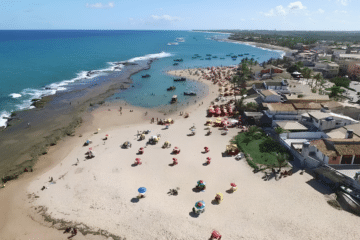
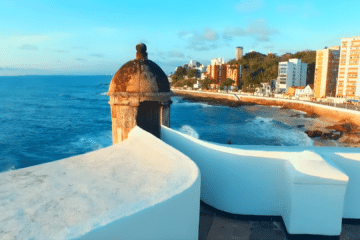
The history of Bahia began with the arrival of the Portuguese in Porto Seguro and continued with Colonisation, Empire and Republic.
The official history of Brazil began in Bahia; history records that the discoverer, Pedro Álvares Cabral, landed on the coast of the region where Porto Seguro is now located, on the southern coast of Bahia.

It is possible that the messenger ship sent by Cabral to report to King Manuel I about the newly discovered lands (at first it was thought that an island had been discovered, named Santa Cruz Island) travelled along the coast of Bahia from Porto Seguro northwards before setting off to cross the Atlantic to Portugal.
However, the first official records of the history of Bahia and the region of Salvador were made by the expedition of 1501; Amerigo Vespucci, who took part in the expedition, was the first to mention the bay, which he called “All Saints” because it was discovered on 1 November, All Saints’ Day.
The name “Bahia” would extend to the territory formed by the lands of the hereditary captainships donated to Francisco Pereira Coutinho, Pero de Campos Tourinho, Jorge de Figueiredo Correia, D. Antônio de Ataíde and D. Álvaro da Costa.
From the occupation of Salvador and its surroundings during the first two general governments, there was a very clear distinction between Salvador (and the region bordering the bay, called the Recôncavo) and the more distant interior.
Despite the excellence of the anchorage discovered in 1501, the Portuguese abandoned it during the first two decades of the colony’s existence, allowing the French to trade with the indigenous people there.
Given this abandonment, it is understandable that Pero Lopes de Sousa, who travelled there in 1530, was surprised to find the legendary Caramuru in Bahia, who had been living among the savages since 1510 or 1511, when he was shipwrecked.

The captaincies on the central coast of Brazil offered no prospect of return and were therefore awarded to the least wealthy of the grantees; the captaincies that attracted the most attention were those in the far north (near the mouth of the Amazon River) and the far south (near the mouth of the River Plate) for the same reason: The rivers provided easy access to the interior of Brazil, where it was believed that rich gold and platinum mines could be found, as had happened on the west coast of America.
This was also the reason why the captaincies did not prosper; the grantees had few human, material and financial resources and were dependent on aid from the Crown; the Crown, seeing no prospect of immediate return, sent little aid to the captains.
To replace the failed captaincy regime, D. João III decided to set up a General Government based in Bahia, which, although unequally distant from the extremes of the coast occupied by the Portuguese, offered good conditions for “favouring and assisting the other captaincies and for administering justice, providing for the royal treasury and the welfare of the parties”.
To carry out this policy, Tomé de Sousa was appointed to build, according to the decree of 17 December 1548, “a large and strong fortress and settlement in a suitable place”.
After violent wars against the Jaguaripe and Paraguaçu Indians (1558 and 1559), possession of Matuim and Passé was secured.
It was not only cattle and corrals that completed the incorporation of the hinterland into Bahia, but also wars against the amoipiras, acroás and paiaias tribes.

Religion also played an important role; Rome sent the first bishop of the Americas, Bishop Sardinha, to Salvador; in addition, the religious missions of the priests of the Society of Jesus and the friars of St. Francis and Mount Carmel contributed greatly to the civilising, productive and constant activity.
The discovery of gold in the mountains of Jacobina also stimulated settlement.
In the 18th century, Bahia had 77,000 inhabitants. Following the conquest of the territory and the orientation of Portugal, four production zones were established:
- Recôncavo, for sugar cane;
- Jaguaripe and Camamu, for manioc flour;
- Trays or sandboxes, for smoking and cassava;
- the backlands, for livestock.
The main characteristic of the economy, not only in Bahia but throughout colonial Brazil, was its orientation towards the foreign market, with the lands of Bahia serving as suppliers of raw materials and tropical agricultural products of interest to Europe.
Implemented under the constraints of a mercantile economy, the export economy was based on slave labour.
However, it developed in a varied and complex way, with a wider and more expressive range of articles and products, such as pau-brasil, sugar, cotton, tobacco, gold, wood, raw leather, cachaça and flour.

History of Bahia during Colonisation, Empire and Republic
Bahia’s history is rich and varied, reflecting the complexity of its cultural, political and economic interactions over the centuries.
From the Dutch occupation in the early 17th century, which challenged Portuguese hegemony, to the struggle for independence that shaped national identity, each period has left its mark.
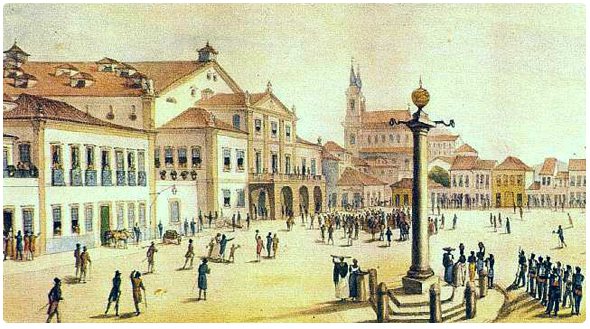
História da Bahia na colonização, império e república
During the Empire, Bahia stood out as an important political and economic centre, while the Republic brought new social and political dynamics, including the revolution of 1930, which drove the modernisation of the state.
Industrialisation, especially since the second half of the 20th century, has transformed Bahia’s economy, consolidating the state as an industrial and tourist centre in contemporary Brazil.
This historical overview reveals not only the struggles and achievements of the Bahian people, but also their resilience and adaptability in the face of challenges.
- Dutch occupation
- Fight for independence
- Empire
- The Republic
- The 1930 revolution and modernisation
- Industrialisation
1. Dutch occupation
Serious events interrupted the wave of prosperity that was sweeping Bahia at the beginning of the 17th century.
Not only because of the union of the Portuguese and Spanish crowns (Spain forbade Brazil to trade with the Netherlands), but also because of the greed aroused by the sugar wealth, the Netherlands decided to attack Bahia in 1623.

In May 1624, the fleet commanded by Jacob Willekens arrived in Salvador, with 26 ships and 500 cannons under his command. The invaders easily occupied the city and remained there for a year, until they were repelled by the Portuguese-Spanish armada commanded by D. Fradique de Toledo Osório.
Unhappy with the loss of the metropolis, the Dutch returned in 1638, already firmly established in Pernambuco, which they had taken in 1630 (see History of Pernambuco).
This time, the attack was led by Maurício de Nassau, who began the siege on 16 April and withdrew on 29 May, defeated. The defence was led by the Count of Bagnuolo.
It is clear that the Dutch presence in Bahia was shorter and left fewer traces than in Pernambuco.
Once the storm of these invasions, which seriously affected local production, had passed, Bahia resumed its previous progress.
2. The struggle for independence
At the end of the 18th century, 164 exporters and importers were active in Salvador.
All trade was destined for Europe, Africa and Rio Grande do Sul and the ports of the Prata. However, in the political, social and economic structures that were established at that time, there were several conflicts between those born and living in the captaincy and the authorities that governed on behalf of the King of Portugal.
In the cases of the so-called Maneta Mutiny (October 1711) and the Terço Velho Uprising (May 1728), the insurgents no longer saw colonialism as the main cause of Bahia’s difficulties and problems; By the time of the attempted uprising in 1798, known as the Bahian Conspiracy or the Tailors’ Uprising, the colonial status appeared as the main cause of the monopoly of trade, the fixed price of sugar, tobacco, cotton and sole, the extortionate collection of taxes, the meagre wages of the military, and there were already demands for a political regime capable of guaranteeing equal rights for all, regardless of colour or social origin.
Even after the seat of the Portuguese colonial empire was moved to Rio de Janeiro in 1763, Salvador continued to stand out as a centre of political influence, where groups of patriots and military personnel gathered.
These groups were involved in the 1817 uprising in Pernambuco, and in February 1821 they promoted Bahia’s accession to the constitutionalist movement, which abolished the absolute monarchy in Portugal.
However, as the Constitutional Liberals in Lisbon adopted a stance clearly contrary to Brazil’s interests and eventually agreed to the military occupation of Salvador by Portuguese soldiers and sailors (February 1822), the struggle for independence in Bahia developed into a slow and painful war.
The conflict began with the “25th of June” in Cachoeira in 1822 and accumulated heroic episodes, among which the battle of Pirajá on 8 November 1822 stands out.
The year 1823 brought new and repeated battles in the bay of Todos os Santos and around Salvador.
After the disagreement between the French officer Pedro Labatut and the Brazilian officers in charge of the army was quickly resolved, Colonel José Joaquim de Lima e Silva, Viscount of Majé, ordered a major offensive on 3 June, which ended with the withdrawal of the Portuguese troops.
On 2 July 1823, Bahia celebrated Brazil’s victory; to this day, 2 July is a public holiday in Bahia, celebrated with the same reverence as 7 September. When the fighting began in the province, Maria Quitéria, a woman from Bahia, formed a women’s company that fought throughout the war.
3. Empire
After the separation, Bahia’s support for the national demand for the unification of all the provinces into a single country did not prevent the federalist movements of 1832 and 1833 in the state, associated with the name of Captain Bernardo Miguel Guanais Mineiro, and the movement of 1837, better known as Sabinada, named after its leader, the doctor and journalist Sabino Vieira.

In its military form, the Sabinada lasted four months and extended into the sertão (Feira de Santana and Vila da Barra), with some battles of great violence.
Other aspects of the instability of the socio-political structures at the time included various slave revolts (the most serious of which was that of the Muslim blacks, the Revolta dos Malês in 1835), the circulation of counterfeit coins, and family feuds, such as those that bloodied São Francisco between the Guerreiro and Militão families.
In 1843, diamond deposits were discovered in the mountains of Açuruá. Subsequent plans reiterated the need for efficient means of communication between the Recôncavo and its hinterland. Inaugurated in 1819, the Steam Navigation extended its lines to the river towns (Santo Amaro, Cachoeira, Nazaré) and the maritime towns on the south coast (Camamu, Ilhéus).
In 1853, the government signed the first contract for the construction of the Bahia-São Francisco Railway, which, together with the Alagoinhas-Itabaiana, Central, Santo Amaro-Bom Jardim and Nazaré-Santo Antônio lines, formed the railway network of Bahia in the 19th century.
There was also an interest in improving sugar cane cultivation and sugar production, so some planters introduced new varieties of cane and some mills adopted steam engines. One example is the large mill built by Francisco Gonçalves Martins in 1859.
As early as 1841, a company was set up in Bahia to introduce useful factories. With the abolition of the slave trade and the subsequent decline in trade with Africa, many merchants pooled their capital to form banks, credit unions and insurance companies.
With this growth in economic activity, administrations generally sought to expand opportunities for schooling and to systematise teaching and education.
Nevertheless, crises in the price of sugar on the foreign market, competition from South African diamonds in the mines, the difficulties of adapting free labour to an economy based for centuries on slave labour, the appalling health and hygiene conditions in the most densely populated urban centres, and the lack of financial resources led the province into the dire situation that unfolded in the great crisis of 1873.
Sugar prices did not compensate for the raw materials consumed, and trade came to a standstill. Economic and financial decline was evident. However, in relative political calm, Bahia participated in the abolitionist movement (1888) and the proclamation of the Republic (1889).
4. The Republic
In Bahia, the Republic was proclaimed by Colonel Frederico Cristiano Buys on 16 November 1889. The province was governed by the councillor José Luís de Almeida Couto, and the commander of the armed forces was the Alagoas marshal Hermes Ernesto da Fonseca, known for his monarchist convictions.
With the first news from the court on the morning of the 15th, monarchist, liberal and conservative politicians began to plan armed resistance to the new regime. In anticipation, Colonel Buys summoned the republican leader Virgílio Clímaco Damásio to the São Pedro fort, where he proclaimed the republic at six o’clock in the afternoon of the 16th.
Marshal Hermes was also present and informed the troops of his decision, especially after the Emperor and Princess Isabel had left for Europe.
Counsellor Rui Barbosa, Minister of Finance in the provisional government, appointed Manuel Vitorino Pereira as governor, to the detriment of Damásio. Vitorino, a professor of medicine and a liberal federalist politician, was another Bahian who would later briefly hold the presidency of the republic.
Colonel Buys supported the appointment of Damásio, the most senior republican leader.
Dissatisfied with the rise of the former liberals, remnants of the conservative party took part in the events that led to Vitorino’s resignation in April 1890 and the appointment of Marshal Hermes da Fonseca to govern Bahia. This was followed by the drafting of the state’s first constitution, the election of José Gonçalves da Silva by indirect vote, his dismissal during the political crisis of November 1891 and the appointment of Rear Admiral Leal Ferreira.
It was a confusing period, with the slow assimilation of monarchist politicians into the new regime, some of whom went on to occupy positions in the administration. The first governor elected by direct suffrage was the doctor Joaquim Manuel Rodrigues Lima (1892-1896).
During the administration of his successor, Councillor Luís Viana (1896-1900), the bloody episode of Canudos took place, revealing to coastal Brazil the painful situation of poverty and cultural backwardness in the interior.
From the end of the 19th century to the beginning of the 20th century, the export economy developed. Cocoa production accounted for 20% of the national budget and contributed to the overall movement of the country’s exports.
In 1904, 141 factories and manufacturing plants were registered, including 12 spinning and weaving mills, three shoe factories, 12 cigar factories and others.
The governments of Severino Vieira (1900-1904) and José Marcelino de Sousa (1904-1908) improved navigation and infrastructure. João Ferreira de Araújo Pinho (1908-1911) resigned amid political tensions. The Chamber of State, under José Joaquim Seabra, challenged the federal government, culminating in the bombing of Salvador on 10 January 1912.
From 1912 to 1916, Seabra urbanised Salvador, while Antônio Muniz de Aragão (1916-1920) faced the Sertanejo uprising. In 1920, Seabra attempted to be re-elected but faced strong opposition, resulting in the “War of the Sertão against the Capital”.
The government of Epitácio Pessoa decided to intervene in February 1920. Bahia’s export-import trade, linked to various crops, was dominated by foreign companies.
During the First World War, trade was restricted, and after the 1929 crisis, exports of cocoa and other crops fell dramatically.
The industrial park in Bahia, although small, included nine textile factories and 16 sugar mills, while large areas of land were occupied by cattle ranching and the production of hides for export.
5. The 1930 revolution and modernisation
In the 1930 elections, Bahia nominated the former governor Vital Soares as vice-presidential candidate on the official ticket, but conspiracies had been underway in the state since 1929, during the campaign of the Liberal Alliance.
While passing through Salvador in April 1929, Juarez Távora left instructions for the movement that erupted the following October.
It is undeniable that Bahia resisted the revolution of 1930, which led to a kind of military occupation during the first two years of the decade.
The intervention of Lieutenant Juracy Magalhães (1931-1935), who later became a captain, changed the situation so that his constitutional election truly reflected a new political landscape.
Juraci Magalhães supported and promoted cocoa and tobacco farming, industry and cattle breeding, defining some of the planning perspectives that would be expanded in the 1950s and 1960s.
On 10 November 1937, however, Getúlio Vargas proclaimed the Estado Novo (New State). Juraci Magalhães rejected the coup and decided to resign from the government the same day and return to the barracks.
After the end of the Second World War and Brazil’s return to constitutional political institutions, the Social Democratic Party (PSD) and the National Democratic Union (UDN), in coalition, elected the liberal Otávio Mangabeira, former foreign minister in the Washington Luís government, as governor.
Mangabeira returned to Bahia, where he had been before the Estado Novo, and launched a programme of reforms.
However, modernisation did not really begin until the 1950s, when the state government promoted economic planning with milestones such as the Landulfo Alves refinery, the Paulo Afonso hydroelectric plant and the Rio-Bahia motorway.
Several campaigns led to increases in Petrobras’s royalties and tax incentives for industry.
6. Industrialisation
In the 1960s, Bahia experienced rapid economic growth, driven by the creation of the Aratu Industrial Centre, which focused on industries such as cement and metallurgy, and the promotion of agriculture in the São Francisco basin.
In the following decade, this type of agriculture was promoted by the São Francisco Valley Development Company (Codevasf).
One of the main figures responsible for modernising the state was the controversial Antônio Carlos Magalhães, who held prominent political positions and used his influence to attract investment to Bahia.
Industrial development received a major boost with the inauguration of the Camaçari petrochemical complex in 1978, which became a landmark in the local economy. At the same time, tourism began to establish itself as a major source of wealth.
In the 1990s, cocoa farming in southern Bahia, an economic mainstay of the state, faced serious difficulties due to a crisis caused by witch’s broom, a disease that led to a significant drop in production and an increase in unemployment.
In 1997, the Companhia de Eletricidade da Bahia (Coelba) was privatised, marking an important change in the management of public services in the state.
Bahia.ws is the largest tourist guide for Bahia and Salvador.
History of Bahia – Salvador, Bahia has 450 years of history

Publicações Relacionadas
Historical periods of Brazil - Colonial period to the New Republic
The Iberian Union and the Dutch invasion of colonial Brazil
Defences of Porto da Barra - Fortifications of Santa Maria and São Diogo
Chronology of slavery in colonial and imperial Brazil - History
Chronology of Portuguese discoveries and maritime expansion
This post is also on:
 Português
  English
  Deutsch
  Español
  Français