Discover Alcântara: History, Culture and Attractions of Maranhão
Alcântara, located in the state of Maranhão, Brazil, is a city rich in history and culture, offering an enchanting tourist destination.
Between the 18th and 19th centuries, Alcântara was one of the most prosperous cities in Maranhão. To explore this historic stronghold, you need to take a boat trip from the Praia Grande neighbourhood in the historic centre of São Luís.
The city’s main attraction is the vestiges of past eras, such as the ruins of the slave market Black Palace and the town hall building, which housed a public jail in the 18th century.
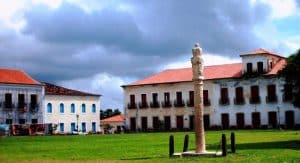
Other attractions include Pelourinho Square, the Historical Museum, and the ruins of the Igreja Matriz de São Matias and the Igreja de Nossa Senhora do Carmo, where the remains of two mansions built by families who competed to host Emperor Dom Pedro II can be found, in addition to the beautiful beaches in the region.

Access and Distance
The streets of Alcântara, just 22 kilometres from São Luís do Maranhão, take tourists on a journey through history.
Historical Heritage
They alternate between ruins and houses that document the heyday and decline of the city, whose origins date back to the early 17th century.
In the following centuries, Alcântara grew thanks to agriculture, mainly sugar cane and later cotton, supported by slave labour — the massive presence of African descendants is a legacy of that era.

Regional Importance
At the beginning of the 19th century, Alcântara was the third most important city in the region, behind only Belém and São Luís. As with São Luís, the end of the slave trade contributed to its decline; unlike the capital, however, many of its buildings were reduced to ruins.
From centuries of prosperity, a collection of more than three hundred buildings remained, which in 1948 elevated it to the status of national heritage.
Modern Contrast
The placidity of the old town contrasts with the fact that, since 1980, it has been home to a rocket launch base, 7 kilometres from the centre.
Visits and Attractions
Visits to the site take place on Tuesdays, departing from São Luís, by appointment only with the State Tourism Secretariat. Alcântara lacks good hotels and accredited guides, so the city is worth a day trip for those staying in São Luís.

Transport
The best way to reach it from the capital is to take a motorboat from the waterway terminal: although it is on the mainland, travelling there by car — on a road in very poor condition — can take up to two hours, compared to an hour and fifteen minutes by boat.
The boats leave at 7am and 9am and return around 5pm, depending on the tide.

Tourist Attractions in Alcântara
- Historical Museum
- IPHAN Historic House
- Churches of Alcântara
- Pillory
- Feast of the Holy Spirit
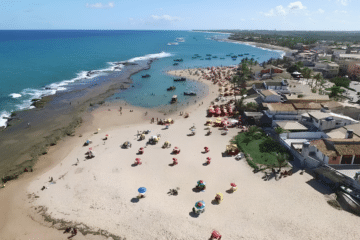
- Beaches and Nature
1. Historical Museum
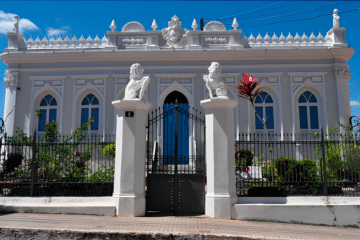
This blue and white tiled townhouse almost had the honour of hosting Dom Pedro II.
When it was announced that the emperor would be coming to Alcântara, the Viveiros family, who lived there, began to prepare to host him; the same was true of the Ferreiras, who lived on the other side of Praça da Matriz.

With the proclamation of the Republic, the visit was cancelled. Left behind in the former residence of the Viveiros, which has functioned as a Historical Museum since 1977, was an iron bed that would have served the emperor.
It is one of the highlights of the house where the jurist Clóvis Beviláqua lived. His desk, paintings, old photos of the city, jewels from the Church of São Matias and a collection of hollow wood saints complete the collection. Praça da Matriz, s/n, Historic Centre.
2. IPHAN Historic House
Its collection includes objects from the English and Portuguese dating from the 17th to 19th centuries. A beautiful collection of tiles, paintings, furniture and porcelain are the main attractions. Praça da Matriz, 7, Historic Centre.
3. Churches of Alcântara
The postcard from Alcântara shows the ruins of a church — that of São Matias (Praça da Matriz, Historic Centre). There are reports that in 1662 a chapel dedicated to that saint already stood on the site.
The church itself began to be built in 1648, but was never completed and fell into disuse in 1884.

In the Church of Nossa Senhora do Carmo (Largo do Carmo, Rua Grande, Historic Centre), dating from 1665 and whose interior was restored in 2000, the high altar, the sacristy, the pulpit, the tribune and the balconies attract attention for their exuberant Rococo style.
The main nave houses ancient tombs and Portuguese tiles.
In the Church of Our Lady of the Rosary of Black People (Largo do Rosário, Rua Dr. Silva Maia, Caravelas), the high altar stands out.
As in the rest of Brazil, in Maranhão this is the saint to whom black people devote themselves; even today, it is in her churchyard that the festival in honour of São Benedito — another black saint — is celebrated on the first full moon in August.
4. Pillory
When news that slavery had been abolished reached Alcântara, the pillory, which stood in front of the Church of São Matias in the main square, was torn down with hammers — and disappeared. in the main square, was torn down with hammers — and disappeared.
It was not until 1948 that he returned to the site, rediscovered by a team from the Rondon Project, who were working in the city at the time of its listing as a heritage site.

Made of stone, this cylindrical column, almost 5 metres high and 40 centimetres in diameter, is today a symbol of a time that has passed but cannot be erased — like everything that is history.
5. Feast of the Holy Spirit
Of Portuguese origin, the celebration of the Divine Holy Spirit arrived in Maranhão in the 17th century, brought by Azoreans.
Today, it lasts for two weeks, always in May (the date varies), and mobilises the entire population, especially those of African descent.
The festival, one of the most significant in Brazil, begins on the Wednesday before Pentecost Sunday, when the 10-metre-long Divine Mast is carried from the port to Matriz Square, where it will remain standing for the duration of the festivities.
At the top of the mast is placed the flag of the Divine.
In the so-called Quinta da Ascensão, a colourful and lively procession, formed by mestre-sala, caixeiras, bandeirinhas (flag bearers) and an orquestra (orchestra), makes its way to the Casa do Divino (House of the Divine), the residence of the emperor or empress — the characters alternate annually — who joins the group, accompanying them on their walk to the Igreja do Carmo (Carmo Church), where mass is said and ladainhas (litany) are sung.
There, the sovereign is crowned, and a white dove, symbolising peace, is released. The procession then returns to the Casa do Divino, where the entourage is served offerings: chalices of liqueur, cups of chocolate, cakes and the traditional doce de espécie (a type of sweet), made by cooks from Alcântara, who keep the recipe a secret.
The party continues with the participation of various characters: on Saturday and Sunday, the royal butler welcomes the court and the revellers into his home; the following week, the lower butlers do the same.
On Friday, several oxen decorated with flowers parade through the city before being slaughtered on Saturday morning, when the emperor or empress and the stewards distribute alms.
On Sunday, after a large mass and lunch at the sovereign’s house, the emperor or empress of the next festival is elected.
6. Beaches and Nature
- Itatinga Beach: A quiet beach, perfect for relaxing and enjoying the natural beauty.
- Cururupu Extractive Reserve: A protected area that offers opportunities for ecotourism and wildlife viewing.
History of Alcântara
The exact date of the founding of Alcântara cannot be determined, but what is certain is that in 1612 there was a cluster of villages of which it was a part, with the name of Tapuitapera (land of the Indians).
Relations with the French
With the arrival of the expedition led by Daniel de La Touche, Lord of La Lavadière, and the constant infiltration of Frenchmen into the indigenous tribes, friendly relations were established between the Indians and the French. The latter built a chapel on the site.
Portuguese domain
After the expulsion of the French, Portuguese rule was established, and the village’s importance remained undiminished. Between 1616 and 1618, Portuguese colonisation began in the area, with a small fort that was destroyed by the indigenous people years later.
The entire area – including the indigenous people who lived there – became the property of Matias de Albuquerque. A garrison was established there, but it was destroyed during an indigenous uprising. In 1621, due to the economic and strategic importance of the Maranhão region, the Portuguese Crown created the Colonial State of Maranhão, composed of the independent captaincies of Maranhão and Grão-Pará.
Captaincy of Cumã
With the subdivision of the captaincies of Maranhão and Grão-Pará, Tapuitapera became the head of the captaincy of Cumã, donated by the first governor of Maranhão, Francisco Coelho de Carvalho, to his brother Antônio Coelho de Carvalho in 1624. In 1641, during the Dutch invasion, the village was abandoned after a brief period of occupation and, in 1648, the village was elevated to the status of town, with the name Alcântara.
Churches and Mills
At that time, there was already a stone and mortar church dedicated to Saint Bartholomew, and the first mills were being installed in the region.
Economy
Alcântara prospered progressively in all sectors and became the largest production centre in Maranhão, where the great fortunes of the time were built due to the high number of slaves.
The local economy was diversified, with an emphasis on the production of cotton, sugar, and fishing. European influence was evident in the plantations, which were often managed by owners who sent their children to study in Coimbra (Portugal), bringing back new ideas and agricultural practices.
The region also served as an important trading hub, facilitating the trade of foreign products or products from other parts of Brazil, which were sent to the interior of Maranhão. This commercial dynamic contributed to the city’s growth and economic development.
Decline
Gradually, however, Alcântara lost importance in Maranhão’s production, reflecting the reduction of economic activities in its social life.
The decline began to accelerate after the Abolition of Slavery, when the slave labour-based economy collapsed.
The settlement of other regions of Maranhão also contributed to the decline in the population and local trade.
The competition from São Luís, with its infrastructure and resources, as well as the migration of families in search of better opportunities, resulted in an irreversible process of decline for Alcântara.
Although the town was elevated to the status of city in 1836, its grandeur did not last long.
However, the grandeur of the past has been preserved in the valuable and beautiful 18th-century architectural ensemble, in which the iron balconies and stone walls scattered throughout the city stand out.
Travel Tips
- Best Time to Visit: The dry season, from June to December, is generally the best time to visit, as rainfall is less frequent.
- Accommodation: Alcântara offers a range of accommodation options, from charming guesthouses in colonial mansions to more modern options.
- Gastronomy: Try typical Maranhão dishes, such as cuxá rice, fried fish and prawns.
Tourist Guide to Alcântara in Maranhão

Publicações Relacionadas
Rua do Giz in São Luís do Maranhão - History and Architecture
Exploring Caburé: The Enchanting Peninsula of Maranhão
Access to the Lençóis Maranhenses National Park
Historical and Artistic Museum of Maranhão Overview
Casa de Nhozinho: A Journey Through Maranhão Culture
João do Vale Theatre and Its Rich History
Convento das Mercês: Historical Significance Unveiled
Chapada das Mesas National Park Adventure Guide
São Luís do Maranhão: A Journey Through History
Santo Amaro do Maranhão: The Paradise of the Lagoons
History and Colonial Architecture of São Luís do Maranhão
Casa Real Empório: History and Culture Combined
Cine Éden: A Historic Cinema in São Luís
Palácio dos Leões: A Historical Landmark Tour
Convent and the Church of Nossa Senhora do Carmo History
Catarina Mina: The Story Behind the Alley
Macapá Waterfall: A Natural Treasure in Maranhão
Pedra Caída Complex: Your Guide to Adventure
Barreirinhas: the gateway to Lençóis Maranhenses
Historical curiosities about São Luís do Maranhão
Carolina Travel Guide: Visit Waterfalls in Maranhão
Cristo Rei Palace: Architecture of the 19th Century
Arthur Azevedo Theatre and its Rich History
Environmental Wealth of Maranhão: A Tropical Paradise
Kitesurfing in Atins: Your Ultimate Guide
Josué Montello House of Culture in Maranhão History
7-day itinerary through Maranhão
History of João Lisboa Square in São Luís do Maranhão
Lençóis Maranhenses National Park: A Natural Wonder
Church of Nossa Senhora dos Remédios History
História da Igreja de São José do Desterro em São Luís do Maranhão
Maranhão Natural History and Archaeology Research Centre
Maranhão: A Journey Through Nature and Culture
Tutóia: Discover the Beauty of Maranhão's Coast
Best Time to Visit Lençóis Maranhenses for Water Fun
Church of Our Lady of Victory: Historical Significance
This post is also on:
 Português
  English
  Deutsch
  Español
  Français