Spanish exploration of the South American coast between 1499 and 1500: Ojeda, Pinzón, and Diogo de Lepe.
Following the discovery of America by Christopher Columbus, who was working for the Kingdoms of Castile and León, a series of maritime explorations of the New World began.
Christopher Columbus was the first person to sight the northern coast of South America, although he did not realise it at the time. This occurred during his third voyage to the West Indies in 1498.
Shortly afterwards, Spanish navigators reached what is now Brazil before the Portuguese. Among them were Alonso de Ojeda, Vicente Yánez Pinzón, and Diogo de Lepe.
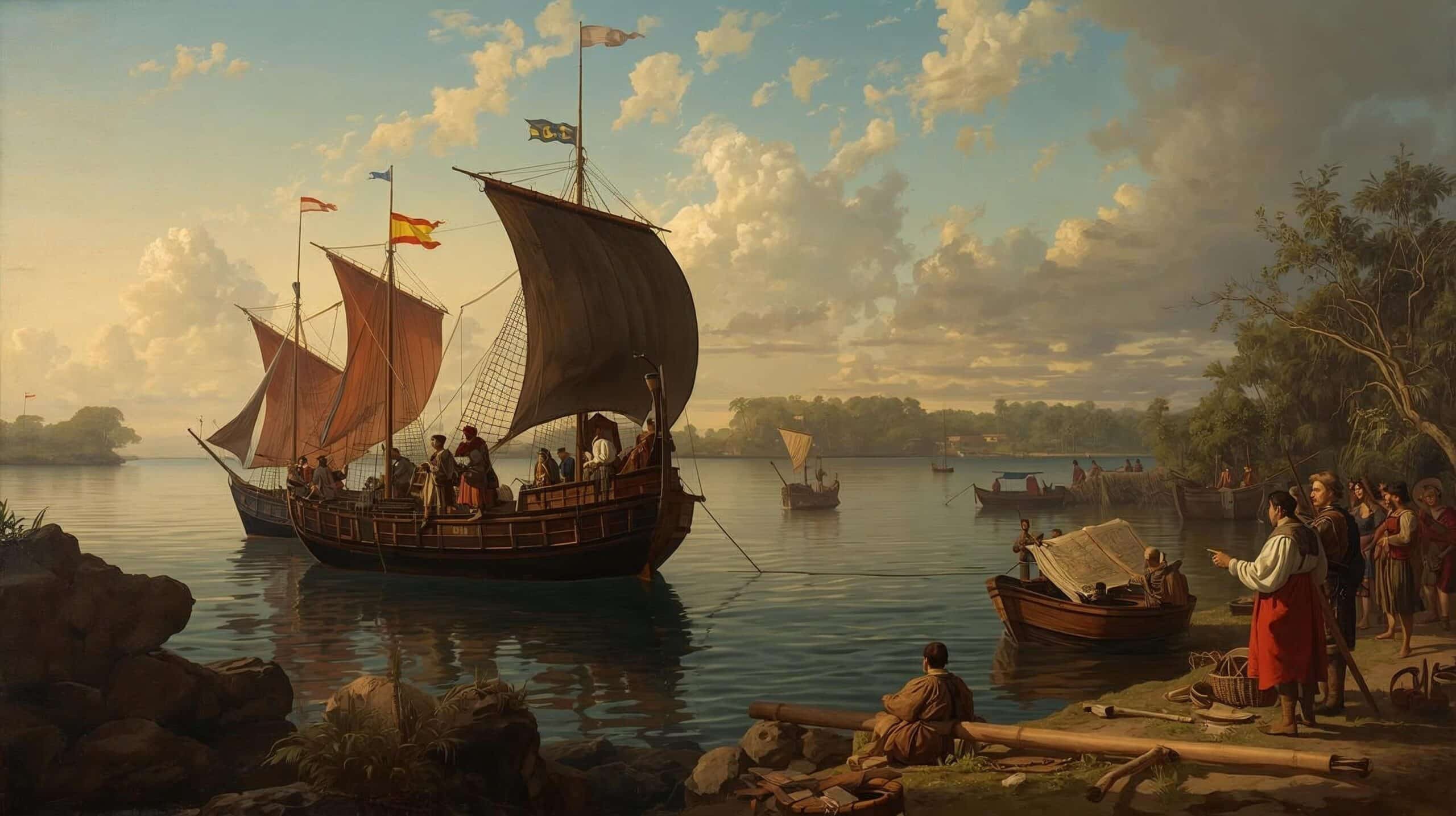
Primeiros contatos espanhóis com o litoral brasileiro entre 1499 e 1500
1. The Voyage of Alonso de Ojeda
Alonso de Ojeda departed from Spain in mid-1499 with the aim of continuing Columbus’ exploration of the Paria region (now Venezuela).
Accompanying him were the cartographer Juan de la Cosa and the Florentine Amerigo Vespucci. According to Vespucci, on 27 June of that year, they reached lands located at 5° south latitude — therefore already in Brazil.
However, the commander himself stated that the location reached was at a latitude of 4.5°, outside the current Brazilian territory.
There are discrepancies regarding the location of the landing. Varnhagen (followed by Rodolfo Garcia) places it near the mouth of the Açu River in Rio Grande do Norte, while Vignaud, Vespucci’s biographer, suggests it was near Cabo de São Roque.
However, according to Joaquim Caetano da Silva, Capistrano de Abreu and the Baron of Rio Branco — who are considered to be better informed — Ojeda would have reached the South American coast about 200 leagues south of the Paria Peninsula, and therefore outside Brazilian territory.
The Paria Peninsula is situated in the north-east of Venezuela.
2. The Voyage of Vicente Yáñez Pinzón
At the end of 1499, another Spanish expedition led by Vicente Yánez Pinzón set sail for South America.
He left one of the Cape Verde islands and sailed southwest. After crossing the Equator on 26 January 1500, he reached a cape which he named Santa Maria de la Consolación.
Since the 16th century, this point has been identified as Cabo de Santo Agostinho (now Pernambuco), although Varnhagen suggested Ponta de Mucuripe (Ceará). More recently, Thomaz Pompeu Sobrinho has indicated either Ponta Grossa or Ponta da Jabarana in Ceará.
Upon reaching the cape, Pinzón took possession of the lands in the name of Spain, sailed north, encountered indigenous resistance, and discovered the so-called “Mar Dulce” (generally associated with the mouth of the Amazon). He then reached Cape St. Vincent — now known as Cape Orange — near the river called Vicente Pinzón (now Oiapoque) and, crossing that boundary, continued through the Guyanas and Venezuela to the island of Hispaniola (Haiti).Hispaniola (now Haiti).
Despite doubts about the specifics of the voyage, historical research to date suggests that Pinzón’s expedition was the first proven discovery of the Brazilian coast by foreign navigators.
Only Duarte Leite contested this priority, and he had few followers.
In addition to 26 January, the date of 2 February was suggested as the date of arrival on the coast. This is a day dedicated to Saint Mary by the Church.
3. The Journey of Diogo de Lepe
In the wake of Pinzón, and still in 1499, another small expedition led by Diogo de Lepe departed from Spain.
He also reached Cape Saint Augustine, but, unlike Pinzón, he initially explored the coast heading south. Only later did he resume his northward course, passing by Cape Rostro Hermoso (identified by many as Cape San Roque, although Varnhagen suggested Ponta de Jericoacoara, in Ceará). He continued in this direction until he reached the Antilles.
It is likely that Lepe changed course when he realised that he would be entering Portuguese waters further south, where Spanish exploration or occupation would be improper.

This post is also on:
 Português
  English
  Deutsch
  Español
  Français