National Surveys and Modern Atlases: Evolution, Methods, and Global Practices in Cartography
Cartograthy since the early decades of the nineteenth century is characterized by the execution of regular topographical surveys as national undertakings.
Most has been accomplished in Europe, in some countries of Asia (e.g. India, Japan, the Dutch East Indies); in the United States and Canada; and in Egypt and parts of North Africa.
Though similar surveys have been begun elsewhere, progress has not been rapid, and great areas of the earth’s surface are still unmapped at medium scales on a systematic trigonometrical framework.
For these the cartographer depends upon miscellaneous and unco-ordinated material of varying quality, produced by travellers, boundary commissions, railway and road development, settlement schemes, and mining and similar concessions.
To these must now be added rapid reconnaissance surveys, mainly from the air, of considerable areas carried out during the last war.

Expansion of atlases and printing techniques
The second major advance has been in the enlarged scope of atlases, and the increasing use of mapping as a technique in dealing with a wide variety of problems in physical and human geography, and in administration.
This progress was considerably assisted by the change from engraving on copper plates to colour lithography and its modern developments, which allow a great variety of detail to be clearly shown.
Nineteenth-century survey methods and corrections
The great national surveys of the nineteenth century rested upon methods resembling in general those of the Cassinis. These were gradually refined as instrumental design progressed, and corrections were applied to the observations to allow for factors previously neglected.
These included corrections for refraction and the curvature of the earth’s surface, for changes in temperature and other conditions affecting the measurement of base lines by metal tapes, and for the reduction of the standards of length employed in the field to the official national standard.
By the further careful comparison of national standards such as the yard and the metre, it was possible to determine, from the results of surveys in many parts of the world, the figure of the earth with considerable accuracy.
The shape of the earth approximates to a spheroid, flattened at the Poles; the International Union of Geodesy in 1924 adopted a figure for the major semi-axis of 6,378,388 metres and of 1 in 297 for the flattening.
Correction for the figure of the earth is of course essential in the computation of the triangles. It should be noted that maps are drawn as though projected on to the plane of the sea-level surface, so that distances measured on them are independent of irregularities in the relief.
Stages in a systematic topographical survey (pre-aerial photography)
- Determination of mean sea level at one point at least, to which all altitudes are referred.
- A preliminary plane-table reconnaissance to select suitable points for the triangulation, and the erection of beacons over them.
- Determination of initial latitude, longitude and azimuth (for direction), which will ‘tie’ the map to the earth’s surface.
- Careful measurement of the base or bases with a tape or wire of a special alloy.
- Triangulation, the theodolite being used to observe horizontal angles from the base and beaconed points, and to measure altitudes by readings of vertical angles.
- Calculation of the triangulation and heights, and the transference of the trig. points to the sheets issued to the plane tablers.
- The filling-in on the sheets by the plane tablers of the required topographical detail — contour lines, rivers, woods, settlements, routes, and names.
Modern flexibility and instrumental development
In the present century, the measurement of long meridian arcs has tended to go out of fashion, partly because they of necessity take no account of local topographical features and consequently may not be particularly useful for local surveys.
In areas of excessive local gravity anomalies, they do not furnish the expected data for determining the figure of the earth.
On the whole, methods of survey have become much more flexible, and are adapted to local conditions.
It is found that “it is better to be content with small triangles easily accessible than to make enormous efforts at rays longer than nature easily allows’. With improved equipment, the necessary base lines can be measured rapidly and accurately.
Instrumental development has also given the surveyor greater freedom. In place of the old cumbrous theodolites, light and accurate instruments have been evolved, such as the 34-inch “Tavistock” theodolite, which allows the mean of readings on each side of the glass circle to be read directly through the same microscope to one second of arc.
The invention of wireless has also simplified the troublesome problem of determining longitudes. It is relatively simple to receive Greenwich mean time by time signal and to compare it with local time.
Air survey — development and challenges
The development which has perhaps attracted most public attention has been that of air survey, though often its merits have been exaggerated.
As long ago as 1858, the value of vertical air photographs, taken from balloons, was appreciated, but there were obvious difficulties in obtaining them.
A combination of the camera and theodolite was later successfully used in ground survey, particularly in Canada.
Experience of air photography gained in the First World War gave a considerable impetus to research into air survey, and by the end of the last war, owing to the demand for the rapid mapping of territories inaccessible to land surveyors, standard methods had been evolved.
The problems of air survey are concerned with (1) obtaining suitable photographs, (2) providing the necessary ground control for the framework of the map, and (3) filling in the detail from the photographs.
First, the area to be mapped must be covered by overlapping strips of photographs, taken at a constant altitude and in favourable conditions.
In England there are on the average only thirty days a year suitable for air photography.
These photographs are examined stereoscopically in pairs. Vertical, or nearly vertical, photographs simplify the later stages of the work.
To produce a map on a relatively small scale and covering an area with slight surface variations, the centres of photographs with a tilt of not more than 2° can be treated as plane table stations and rays drawn from them to prominent features portrayed.
Details obtained thus are tied in to a relatively small number of points fixed by triangulation on the ground. For maps on the larger scales required, for example, for civil engineering projects, much more precise results are obtained from overlapping stereoscopic pairs of photographs in a plotting machine.
This operation depends on complex optical principles, but stated very simply it involves placing the photographs in their exact relationship to each other and to the ground surface (thus eliminating tilt).
The operator, viewing them stereoscopically, and thus having before him a three-dimensional representation of the surface, is enabled to trace its features, including contours, by the intricate mechanism of the plotting machine.
To reduce the number of ground control points required, radar navigational aids can be employed to fix the position of each photographic exposure with sufficient accuracy.
Professor Hart quotes instances in which areas inaccessible on the ground have been mapped on scales as large as 1:50,000 from control stations 250 miles distant.
In such cases, however, difficulties in contouring may arise from lack of data.
To fill in the detail requires considerable practice in the interpretation of the photographs.
Types of soils, rock formation, and vegetation, for example, will reveal themselves to the practised eye.
Their appearance naturally will change under varying conditions of light, and, indeed, for certain purposes, the photographs must be taken at a certain time of day or season of the year.
The methods and standards of air survey, and hence the expenditure involved, can within limits be varied according to the accuracy required.
The 1939–45 war gave a great impetus to air survey. Under the direction of the U.S. Aeronautical Chart Service, for example, some 15,000,000 square miles, equivalent to more than a quarter of the land surface of the earth, were photographed from the air by trimetrogon cameras (multiple lens cameras) for small-scale mapping.
It has been said that “In the field the aerial camera achieved its final triumph over the plane table as the cartographic surveyor’s primary tool for picturing the earth’s face for mapping purposes’.
The survey of a country by the methods described is clearly a costly task, requiring a large highly trained field staff, not to mention the establishment necessary to compile, draw, and print the maps for public issue.
A further cause of heavy expenditure, in industrialized countries especially, is the need for constant revision. It is not surprising therefore that progress in mapping has been slow in under-developed countries.
The Ordnance Survey — history and series
The history of the Ordnance Survey of Great Britain illustrates the problems encountered in the development of a national series of topographical maps, and the extent to which they have been influenced by the varying requirements of their users.
The Ordnance Survey (at first known as the Trigonometrical Survey) was officially established in 1791, being the outcome of survey operations for the connexion of England and France by Cassini and William Roy in 1787.
In its early days the Survey had two tasks, the carrying out of the great triangulation between 1798 and 1853, and the production of the One Inch to a mile map.
The triangulation rested on two base lines, one on the shores of Lough Foyle, the other on Salisbury Plain, measured respectively in 1827 and 1849.
When a test base was measured at Lossiemouth in 1909, it was found that the error on any side of this triangulation did not exceed the order of one inch in a mile.
A new primary triangulation, for which some of the original stations were used, was carried out in 1936–38, and again revealed the accuracy of the old work.
As the triangles were carried across country, the work of the One Inch survey proceeded. The first four sheets, issued in 1801, covered Kent and part of Essex and London.
The purpose of this map was largely military, the scale being convenient for the movement of infantry. It was not until 1870 that it covered the whole of Great Britain.
Meanwhile the land question in Ireland had created a demand for maps on a larger scale which would allow the areas of smaller administrative units to be shown clearly.
The Six Inch to one mile survey of that country was consequently begun in 1824. Later, survey on this scale was extended to Great Britain, and from 1840 the One Inch sheets of northern England and Scotland were reductions from the Six Inch.
The latter is now the largest scale which gives complete coverage for the whole country. With the industrial developments and the great expansion of towns and communications in the mid-nineteenth century, the demand for large-scale plans became insistent.
In 1858, partly under the influence of continental ideas, it was decided to publish plans of the whole cultivated area on the scale of 1:2,500 (very nearly equivalent to twenty-five inches to one mile). The twenty-five inch is now the base from which, so far as it extends, all smaller-scale maps are derived.
For many years, apart from what were essentially index maps to the various series, the One Inch to a mile was the smallest scale map published by the Ordnance Survey.
It was not until 1888 that the Quarter Inch map was completed, though it had been started in 1859 at the instance of the War Office and the Geological Survey.
This was followed some twenty years later by the Half Inch and the Ten Mile maps.
The demand for these in the first place was mainly military, but with the development of the motor car they have become increasingly popular.
Recently, another map has been added to the national series, the 1:25,000 (approximately two and a half inches to the mile), begun in 1945.
This fills usefully the gap between the One Inch and the Six Inch and is a scale commonly in use on the Continent.
This is the smallest scale on which it is possible to show roads and similar features without having to exaggerate them for clarity, and to include most minor topographical features.
Up to date, sheets covering most of England and Wales, except for central Wales, and parts of Scotland have been published in a ‘provisional’ edition.
Here provisional indicates merely that it is based on the existing Six Inch survey. The regular edition will be derived from the re-survey of Great Britain.
Contours at twenty-five feet interval will be from ground survey or from air photographs. On the provisional edition, intermediate contours are interpolated.
Printing techniques and representation of relief
Since the methods of representing surface forms have been closely related to printing techniques, the two may conveniently be considered together.
The first edition of the One Inch was printed from engraved copper plates, and relief was somewhat crudely shown by hachures, very much in the style of the Cassini map of France.
At first, the heavy hachuring tended to obscure detail, but later there was some improvement. Contours were first adopted about 1830 as a result of experience on the Irish Six Inch survey, and were soon afterwards introduced on the Six Inch and the One Inch maps of northern England which completed the first edition.
The contours were surveyed instrumentally at 50 feet, 100 feet and thence at intervals of 100 feet to 1,000 feet. Above 1,000 feet, the interval was 250 feet.
Considerably later, on the Popular (Fourth edition) of the One Inch map, additional contours were interpolated at intervals of fifty feet.
Since all the detail on the engraved sheets was in black, the contour lines were not always conspicuous.
Though hachures in brown were later printed on the One Inch from a second copper plate, the use of colour in general followed the introduction of lithographic printing or a development of it, photozincography, in which the original was photographed and transferred to zinc plates for printing.
In the Third edition of the One Inch, completed in 1912, and known as the ‘fully coloured’, relief was shown by hachures in brown and contours in red.
In all there were six printings, brown and red for the relief, blue for water, green for woods, and burnt sienna for roads, with names and other detail in black.
Following Bartholomew’s successful production of a Quarter Inch map of Britain in which relief was shown by layer colouring, the Ordnance Survey employed this method on its Half Inch map, produced at the beginning of this century, and also for various district maps.
In the years before 1914, experiments in the best methods of showing relief were carried on vigorously.
One of the most beautiful and satisfactory of these was the One Inch sheet of Killarney, for which no less than thirteen separate printings were employed, a fact which prohibited its general adoption.
In this sheet, all the earlier methods were combined: contours in black dotted lines, hachures in brown, hill shading by heavier hachures on the south-eastern slopes (giving the effect of lighting from the north-west corner of the map), and delicate layer colouring.
The sheet gives a most expressive representation of the modelling of the relief, even in the less elevated areas.
In the interval between the two wars, it became necessary, owing to the state of the old copper plates, to re-draw the One Inch afresh, and the opportunity was taken to introduce several improvements.
An entirely new style of lettering, based on that of Trajan’s Column, was introduced, adding much to the legibility and appearance of the map.
This Fifth (Relief) edition also incorporated in a modified form some of the features of the Killarney sheet: relief was shown by contours in brown, hachures in orange, hill-shading in grey with layers —in tints of buff.
Again, the effect of modelling is very expressive, but, unfortunately, it was considered that this style was not popular with the public and the Relief edition was abandoned for a less elaborate style.
The present Sixth (New Popular) edition follows closely the Fifth, though relief is shown by contours only, conspicuous in brown.
The sheets have been cleared of some detail, including the black symbol which differentiated between woods of deciduous and coniferous trees.
Sheet lines, projection and the National Grid
In the course of 150 years, the sheet lines have undergone considerable changes, which have been related to the projection and central meridians employed.
In the early days of the First edition, the One Inch sheets of northern and southern England had separate central meridians, and the large-scale county plans were also drawn on their own meridians; consequently it was impossible to fit sheets of adjoining counties together.
The size of the sheets has also varied from time to time. With the re-calculation of the whole survey on one projection, the Transverse Mercator with the central meridian 2° W., and the introduction of the National Grid, uniformity has now been secured.
The grid serves two purposes; for the smaller-scale maps it provides a national system of reference, by which a point can be located by an identical reference on maps of all scales; secondly, on the larger-scale plans, it provides data by which, with certain corrections, very large-scale survey, such as is done by civil engineers, mining surveyors and the like, can be carried out accurately.
The National Grid is based on the central meridian, and divides the country up, in the first place, into squares with one-hundred kilometre sides.
For convenience in numbering, the origin of the grid is placed a little to the south-west of the Scilly Isles. These squares in turn are divided into 10 km. and kilometre squares, which are shown on the 1:25,000 and One Inch maps, while the Six Inch map has the kilometre squares.
By estimation, therefore, references to the nearest 100 metres can be read from the One Inch.
With the introduction of the National Grid, the sheets of the plans and maps are now regularly arranged; for example, 100 sheets of the twenty-five inch plan form one sheet of the 1:25,000 map, which in turn covers one 10 km. square on the One Inch map.
Thus the smaller-scale map in each case forms an index to the larger.
The One Inch map, however, is not designed on regular sheet lines. Great Britain has a long and much indented coastline, and the adoption of a regular system would inevitably lead to the production of sheets showing very little land surface.
Consequently the sheets have been ‘fitted to the topography’. Their size, however, has now been standardized, covering 45 km. from north to south, and 40 km. from east to west.
The effect of this has been to reduce the number of sheets (the Sixth edition covers England and Wales in 115, in contrast to the 146 sheets of the Fifth), and, by allowing generous overlaps, to reduce the necessity for special District maps.
With the carrying-out of the recommendations of the Departmental Committee of 1938, Great Britain now has a national series of maps and plans designed on a common system, which is not surpassed by those of any other country.
No other national survey publishes a regular series on the scale of 1:2,500.
One may perhaps regret that the contour is the sole method employed, except on the smallest scales, to represent relief.
Minor topographical features of local importance, occurring between contours, are necessarily omitted, but could be indicated by hachuring or shading; very often a significant crest line, for example, is not brought out by contouring.
Contours, however, do not obscure other detail, and in strongly accidented relief convey some visual impression.
They are certainly essential on modern medium- and small-scale maps; supplemented by a restrained use of other methods, they would supply the best solution.
Judged by clarity of detail, use of colour, lettering, and general design the Ordnance Survey maps set a very high standard.
Outside the British Isles, this country has been responsible for the mapping of the colonial territories, and has contributed in personnel and technique to that of India in particular, but also to other countries including Egypt and Siam.
For many years, regular surveys were not undertaken in the territories, and large sums were expended on maps for particular purposes as required.
It is now acknowledged that a regular topographical survey, far from being a luxury, is an essential preliminary to sound development, and therefore an economy in the long run.
This was officially recognized by the establishment of the Colonial Survey Committee in 1905, which concentrated mainly on tropical Africa.
Most colonies now have their own survey departments, but since they were at first entirely dependent on local finances, their progress was necessarily hampered, especially after 1931.
The establishment of the Directorate of Colonial Surveys in 1946, ensured a central direction and more adequate resources.
The task before the Directorate is a heavy one; when it was set up some 1,500,000 square miles had still to be mapped, though a proportion of this total is not an urgent necessity.
Air survey is well adapted to work of this type, and the Directorate is making considerable use of it.
Some foreign map series — France, Switzerland, United States
It will be useful for comparison to note briefly what has been done in France, and to glance at the practice of other countries in representing relief where it presents greater difficulties than in Britain.
In France the national survey is the responsibility of the Institut Cartographique National, the civilian body which has replaced the Service Géographique de l’Armeée.
The two main topographical scales are 1:20,000 and 1:50,000, but neither of the current editions give complete coverage.
In the nineteenth century, the Cassini series was replaced by the Carte de l’Etat Major on the scale of 1:80,000.
Originally engraved, later photolithographed, this map has no contours, but is heavily hachured.
About 1900, a new series on the scale of 1:50,000 was initiated.
The original elaborate scheme has been considerably modified, but progress has been slow.
Some 220 sheets, out of a total of about 1,100, have been published; owing to French pre-occupation with their eastern frontiers most of the sheets fall in this zone.
In fact the only medium-scale map completely covering France is an enlargement of the old 1:80,000 to 1:50,000.
Since the reorganization and with the use of air photographs and stereoplotting machines, progress has been somewhat more rapid.
The ‘Nouvelle Carte de la France au 50,000 eme’ is contoured in brown (black on rocks and blue on glaciers), with contours at 5, 10 or 20 metre intervals, according to the character of the ground.
Relief is further emphasized by hill shading both ‘vertical’ and oblique from the north-west to impart a plastic impression.
This is obtained by photographing a relief model suitably illuminated. Considerable attention is paid to the vegetation cover; various types are indicated by symbols in black with a flat green overprint.
The national maps of Switzerland are distinguished by the high standard achieved in the representation of relief, the result of long experience and experiment.
In 1938, the well-known Siegfried map, which in its day set a good standard, was replaced by a new series on the scale of 1:50,000, more accurate and legible.
It is very closely contoured, at 20-metre intervals, with less obtrusive subsidiary contours at 5 and 10 metres in brown, black or blue according to the surface.
Summits, precipitous slopes, rock falls and similar features are indicated by fine rock drawing in black.
Glaciers have contours in blue and a light blue tint, with moraines in brown. Relief is further emphasized by shading in a neutral tint or blue-grey put in by the draughtsman, not by photography as in France.
The general effect is most expressive, largely due to the careful rock drawing. The other details have not been allowed to dominate the relief, the green undertone of the woods, for example, is light, and the conventional signs are neatly drawn.
A new series on the scale of 1:20,000 is also in preparation. When the two are complete, Switzerland will be unrivalled in its standard of national cartography.
In the United States, there is no single official mapping authority as in Great Britain.
The U.S. Geological Survey is now the chief agency for topographical mapping, but a number of others produce maps and charts for special purposes.
For most of the nineteenth century, the principal demand, as the tide of migrants flowed westwards, was for the rapid survey of the vast tracts of land to facilitate settlement.
From 1776, this was carried out for the central government by the General Land Office. At the same time, individual States produced small-scale maps of their areas, generally of no great order of accuracy. More precise surveys were gradually carried out by other bodies.
The Coast Survey (now the Coast and Geodetic Survey) was established in 1807, but accomplished little for its first thirty years.
In addition to its chief task of charting the coasts and mapping contiguous land areas, it is responsible for the basic network of triangulation and levelling used in other surveys.
The Corps of Topographical Engineers, founded a few years later, was at first largely engaged in meeting military requirements and in exploration, but was afterwards employed in tasks connected with the improvement of rivers and harbours, in the survey of the northern lakes and in boundary work.
It also carried out much survey in the territories west of the Rocky Mountains around the middle of the century.
In 1879, to coordinate this work, all surveys, geological and topographical, west of the 100th meridian were entrusted to the newly established Geological Survey, whose sphere of activity was eventually extended over the whole country.
It is now responsible for eighty per cent of the topographical survey performed by government agencies.
The topographical maps issued to the public are on three standard scales, according to the importance of the particular area; 1:31,680; 1:62,500; and 1:125,000.
The sheet lines are based on quadrangles formed by parallels of latitude and meridians of longitude, the sheets of the 1:62,500 series covering 15’ of latitude and longitude.
At this scale the contour interval ranges from 10 to 50 feet. Every fourth or fifth contour line is strengthened, and numerous spot heights and bench marks are given.
The sheets are printed in three colours; cultural features (roads, settlements, etc.) and names in black, water features in blue, and contours in brown.
On some, a green tint is used for woodlands. The general effect is clean and sharp, with no over-crowding of detail.
About twenty-five per cent of the area of the United States is covered by ‘acceptable topographic maps’, but for almost forty per cent of the area no topographic maps of any kind exist.
Recently, however, progress has been expedited, largely by the adoption of air survey methods. Since 1936, the Geological Survey has made increasing use of air photographs and carried out extensive research in techniques and instruments.
Photographic cover of varying standards exists for all but five per cent of the country, and is used for many administrative purposes. It is anticipated that within twenty years all the United States and Alaska will be covered by standard topographic maps.
The Survey has also produced geological maps on the scale of 1:62,500, or larger, for ten per cent of the country.
The International Map of the World on the Scale of 1/1 Million
The value of a map of the world on a uniform projection and scale with a standard set of conventions to many types of map users is obvious, but equally obviously its production on any scale larger than those employed in atlases could not usefully be contemplated until a significant proportion of the earth’s surface had been mapped topographically.
The idea of such a map was first advanced by Professor Albrecht Penck at the International Geographical Congress, Berne, 1891, when he proposed that it should be compiled on the scale of 1/1 Million (approximately 1 inch to 15.8 miles).
Little was achieved for twenty years, when the British government invited foreign delegates to a conference in London, at which the ‘Carte internationale du Monde au Millionieme’ was initiated on an approved system.
The projection is a modified polyconic, which allows adjoining sheets to be fitted together, each covering 4° of latitude, and 6° of longitude, though nearer the Poles than latitude 60° two sheets may be combined.
Relief is by contours, generally at 100-metre intervals, and layer colouring, with shading for minor features, according to an approved pattern.
Each national survey is responsible for the sheets covering its own territory, and names are given in the local form.
From the beginning the project encountered difficulties.
It is clearly almost impossible to devise a scheme of contour intervals and layer colouring which will depict satisfactorily all kinds of topography, from the Himalaya and the plateau of southern Africa to the English Plain, and in practice considerable latitude in the selection of contours had to be allowed.
Incidentally, the original ‘gamme’, or scale of tints for the layer colouring, produced by the War Office was “such a masterpiece of colour printing that no one has been really successful in copying it”.
The main impediment to progress, however, was the distribution of responsibility among many independent bodies, influenced by national considerations, and the consequent absence of a strong central body to promote uniformity, and to make the published sheets easily procurable.
By the outbreak of war in 1939, of the approximate total of 975 sheets required to cover the land surface, 405 had been published, but of these only 232 conformed to the international pattern.
It was held by some that there was insufficient material available to map all countries on this scale, and partly for this reason the Geographical Section, General Staff, between 1919 and 1939, produced series of maps such as Africa, 1:2 Million, and Asia 1:4 Million.
If it has not been a complete success, it has had some useful results.
The sheet lines have been fairly widely adopted as the framework for national series on larger scales, thus introducing a measure of uniformity in international cartography.
The value of the 1/1 M. sheets for the mapping of distributions on a continental or world-wide scale has also been recognized. The sheets have been used for example for the International Map of the Roman Empire, of which twelve sheets have been published.
The recently inaugurated World Land Use Survey aims at eventually producing maps on this scale. The value of the latter map in plans for assisting the under-developed areas would be considerable.
But perhaps the most striking result of the International Million Map was the impetus it gave to the Million Map of Hispanic America which was produced by the American Geographical Society on the initiative of its former Director, the late Isaiah Bowman.
The map follows the specifications of the International Map quite closely, and in its compilation the Society has had the approval and assistance of South American governments.
Begun in 1920, it was completed with the publication of the 107th sheet in 1945.
The complete map covers an area whose greatest dimensions are 34 x 28 feet; a staff of seven were employed throughout the twenty-five years in research, compilation and drawing.
Compilation required the assessment of the relative values of a great quantity of survey material, and research brought to light much useful data preserved in government and commercial offices.
Where survey data were entirely lacking, written descriptions were used to discover physiographic characteristics.
To indicate the accuracy of the material employed, a reliability diagram was included in each sheet, a useful practice since followed by other cartographic institutes.
The development of the atlas — scientific and thematic mapping
The representation on maps of features other than those strictly topographical in character was of course not new.
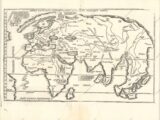
The printed versions of Ptolemy’s maps were in reality historical maps, and most of the great cartographers of the sixteenth and seventeenth centuries had published maps to illustrate Biblical history.
In the domain of science Edmund Halley had mapped the tides of the English Channel, and the lines of equal magnetic declination.
His celebrated ‘General chart’, with its “Halleyan lines”, published in 1701, was an important contribution to the study of terrestrial magnetism.
Some have seen in the maps of John Rocque, with their distinction between arable, pasture and wood, the forerunners of the ‘land use’ maps of today.
At the beginning of the nineteenth century, maps were being used systematically in the new science of geology.
William Smith, a pioneer in the science, using fossils to arrange the strata chronologically, had initiated the geological mapping of England and Wales.
His ‘Delineation of the strata of England and Wales with part of Scotland’, in fifteen sheets on a scale of five miles to one inch, was engraved and published by John Cary in 1815, with the geological data hand-coloured; the work was placed on a permanent footing by the establishment of the Geological Survey in 1835, which used the Ordnance Survey One Inch sheets as a base.
Humboldt, Perthes and the rise of thematic atlases
It was however the foundation in Germany of geography as a modern study which demonstrated the use of the maps as instruments for specialized research.
Both Alexander von Humboldt and Karl Ritter appreciated their value in understanding the distribution and inter-relation of phenomena on the earth’s surface, when they advanced the principle of causality as the mainspring of geographical research.
Humboldt in particular showed that cartographically a great variety of facts could be represented in an orderly and readily intelligible manner.
The voluminous results of his travels and studies in New Spain were accompanied by an ‘Atlas géographique et physique’, 1812, in which the beginning of this development is apparent.
The device of isotherms, or lines of equal temperature is due to him, and he also mapped the areal and altitudinal limits of plants and other phenomena.
His ideas were developed enthusiastically by several disciples, whose work was presented to the general public by the celebrated establishment of Justus Perthes at Gotha.
One of these was Adolf Stieler, who, after practical experience in survey, came forward with a somewhat grandiose plan for a general atlas.
His specifications included a convenient format; text to accompany each map; the greatest possible accuracy, clarity, and comprehensiveness; uniformity of projection and scale; good paper and printing; careful colouring—and a reasonable price.
The first fascicule of the famous ‘Hand-Atlas’, under the direction of Justus’ son Wilhelm, was issued in 1817; the first complete edition (seventy plates) appeared in 1830, with new editions appearing thereafter.
The Physikalischer Atlas and British responses
Perthes’ reputation attracted Heinrich Berghaus, whose co-operation produced the important ‘Physikalischer Atlas’ (first edition 1838; second 1852) designed to represent graphically the main phenomena of inorganic and organic nature according to their geographical distribution.
The second edition (eight parts, ninety-four maps) covered meteorology, hydrography, geology, terrestrial magnetism, plant geography, anthropography, and ethnography.
In Britain Alexander Keith Johnston produced an independent Physical Atlas (second ed. 1856) and a Royal Atlas (1859). August Petermann worked between Edinburgh, London and Gotha, publishing contemporary exploration results.
The Bartholomews (Johns and John George) advanced techniques (e.g. layer-colouring); J. G. Bartholomew planned a great Physical Atlas in five volumes (Vol. 3, Atlas of Meteorology, 1899; Vol. 5, Atlas of Zoogeography, 1911).
National Atlases and specialised thematic works
A later development was the National Atlas — atlases dealing with the physical and human factors of a particular country. Early examples: Atlas of Scotland (1895); Atlas of Finland (1st ed. 1899; 3rd ed. 1925) covering physiography, geology, climate, natural history, hydrology, flora, archaeology, demography.
The Atlas of Canada (1906; 1915) emphasized economic factors. The Atlas de France (French National Committee for Geography) and the Atlas of American Agriculture (O. E. Baker, 1936) are notable thematic compilations.
The Great Soviet Atlas of the World combined general and national atlas material (Vol. I 1937; Vol. II 1939) with population densities shown by proportionate circles and colour bands — highlighting ongoing problems in effectively showing population distribution (dot method vs. differential colouring).
National atlas gaps and wartime cartographic innovation
There is no National Atlas of Great Britain (despite recommendations); material exists in maps at 1:625,000 compiled by the Ministry of Town and Country Planning and published by the Ordnance Survey; an intended 1:1.25M atlas series has been announced but not completed.
During the war, efforts encouraged alternatives to the Mercator “flat” world map (north at top), e.g. R. E. Harrison’s Fortune Atlas “Look at the world” (orthographic projections, unusual orientations) and E. G. R. Taylor’s Air age world map (near-globe constructions).
Other specialised mapping projects and surveys
Other noteworthy projects: the Land Use Survey of Great Britain (initiated by Professor Dudley Stamp, 1930) publishing One Inch sheets in seven colours to show forest, meadow, arable, heathland, orchards, gardens, and unproductive land — valuable for wartime and regional planning.
Work based on the International Million map includes the Ordnance Survey Period Maps of Britain (prehistoric to seventeenth century) and initiatives by the American Geographical Society (including an eventual Atlas of Disease).
For representation of relief and lettering, the map of Europe and the Middle East produced by the Royal Geographical Society for the British Council is noted.
A new reformation of cartography — concluding remarks
A new “reformation of cartography” is in progress: from field techniques to printing machines, new methods are being applied and the cartographer’s sphere has widened immensely.
Efforts (especially during the last war) sought to improve public understanding of the value and limitations of maps. Many problems remain to be solved before the final chapter in the history of cartography is written.



This post is also on:
 Português
  English
  Deutsch
  Español
  Français