Towns and Culture in Agreste de Pernambuco: Traditions, festivals and natural beauty
The Agreste is an intermediate region in the interior of Pernambuco, located between the Mata and the Sertão.
The Agreste is characterised by a diversified economy, growing crops such as corn, beans and cassava, as well as livestock, both dairy and beef.

The state’s main dairy basin, the Agreste, has higher rainfall than the Sertão, with an annual average of between 800 and 1,000 millimetres, but it is also a region subject to periodic droughts.
It is divided into six micro-regions, which we’ll see below: Vale do Ipanema, Vale do Ipojuca, Alto Capibaribe, Médio Capibaribe, Garanhuns and Brejo Pernambucano.
In general, it has shallow, often eroded and depleted soils, which are suitable for growing cereals.
In addition, Agreste de Pernambuco offers attractions such as a mild climate, forest trails, waterfalls and natural pools, making it an ideal destination for tourists seeking adventure and leisure.

Climatic regions of Pernambuco
Pernambuco has three main climatic regions, which are
1. Tropical climate
Predominant in most of the state, especially in the Zona da Mata, with high temperatures and well-defined seasons: one dry and one rainy.
2. Semi-arid climate
Located in Sertão and Agreste, it is characterised by long periods of drought and high temperatures, with irregular rainfall.
3. Equatorial climate
Present in the Mata Norte region, characterised by high humidity and abundant rainfall throughout the year.
There are also local climatic variations, such as microclimates in mountainous areas or near bodies of water. In general, however, the three mentioned are the most important.
The state’s climatic diversity directly influences the vegetation, fauna and economic activities in each region.

Videos – Places of interest in Agreste Pernambuco




Tourist attractions in Agreste de Pernambuco
- City of Caruaru
- Catimbau National Park
- City of Bezerros
- City of Gravatá
- City of Garanhuns
- Fazenda Nova and the Passion of Christ
1. The city of Caruaru
Caruaru is considered the capital of Pernambuco’s Agreste region and is located 132 kilometres from Recife. The city competes with Campina Grande in Paraíba for the title of hosting Brazil’s largest São João festival.

Although the Campina Grande attracts more people on the 24 June, the festival in Caruaru lasts longer, starting on the first weekend in June and ending a month later.
The main venue for the festivities is the Pátio de Eventos Luiz Lua Gonzaga, where the Vila do Forró has been built, recreating a typical rural village during the June festivities.
During the festivities, quadrilhas, violeiros and repentistas take over the streets and the “bacamarteiros” perform an old tradition, swinging their bacamartes to the sound of xaxados.
Caruaru is home to the largest free market in the Northeast and the Casa do Mestre Vitalino Museum, which honours one of its most famous sons. The name “Caruaru” has its roots in the Tupi language, possibly derived from “kara” (fence) and “urú” (bird), interpreted as “fence of vultures”.
1.1 Caruaru Fair
The Caruaru Fair offers handicrafts, medicinal herbs, typical food and electronic products, occupying around 150,000 square metres in Parque 18 de Maio.

On Saturdays it is a free arts and crafts fair, while on Monday there is the Feira da Sulanca, where traders look for cheap clothes to resell.
1.2 Alto do Moura in Caruaru
The Alto do Moura neighbourhood, 7 kilometres from the city centre, is home to the studios of most of the city’s craftsmen, including Severino Vitalino, son of the famous Mestre Vitalino.

The museum created in his former residence, the Museu Casa do Mestre Vitalino, brings together works by the master and personal objects.
1.3 Tancredo Museum and Forró Museum
The Tancredo Neves Cultural Space, inaugurated in 1988, houses the Clay Museum, in honour of Mestre Zé Caboclo, and the Forró Museum, dedicated to Luiz Gonzaga.
The Clay Museum has a collection of 2,300 pieces, and the Forró Museum contains items relating to the life and career of the “King of Baião”.
1.4 Bom Jesus Hill
Caruaru is built around the 630 metre high Morro do Bom Jesus, where there are viewpoints, radio transmitters and a chapel, originally called Capela do Socorro.
2. Catimbau National Park
The Catimbau National Park was inaugurated in 2002 and although it is still little explored and lacks infrastructure, it is located in the Catimbau Valley, surrounded by the Buíque Mountains, 25 kilometres from Arcoverde.

The vegetation of the area, in the transition between the Agreste and the Sertão, includes caatinga, Atlantic forest, grasslands and cerrado, and is home to some 150 species of birds, such as the goldfinch, which is endemic to the northeast.
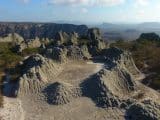
The main attractions of the park are the geological formations carved by time and the rock inscriptions. The rock walls have drawings in red, yellow and blue and are unique in any other protected area in Brazil.
The park is home to the country’s second largest archaeological site, Alcobaça. Although water is scarce, it is possible to cool off in the Wild Paradise, a spring that forms a spa with natural pools.
The 62,300 hectare Catimbau can be explored by hiking or in four-wheel drive vehicles, which must be accompanied by monitors from the local guides association. Access to the park is via the BR-232 motorway to Arcoverde and then the PE-076 motorway to Buíque, both of which are in very poor condition.
3. The city of Bezerros
The city of Bezerros is located between Caruaru and Gravatá – 27 kilometres from the former and 20 kilometres from the latter. Bezerros, in the Agreste region of Pernambuco, at kilometre 107 of the BR-232 highway, is synonymous with woodcarving and papangu.

In woodcuts, the main reference is the important woodcutter J. Borges, while Lula Vassoureiro stands out for making the famous colourful masks made of newspaper, a trademark of the city’s carnival festivities. Handicrafts are Bezerros’ calling card, and it’s worth visiting the artists’ studios and the headquarters of the Associación de Artesanos, which has a good range of pieces on sale.
Climbing the Serra Negra can be a pleasant activity, both for the scenery and to get to know the Cultural Centre.
3.1 José Borges Memorial
The man most responsible for Bezerros’ woodcut fame, José Borges – known as J. Borges – was born in the town over seventy years ago.

He is still active, although his production has slowed down due to his health and commitments abroad. In the memorial, a workshop, Mr Borges receives visitors, makes his pieces and teaches his children and grandchildren what he knows. Location: Av. Major Aprígio da Fonseca, 420, Centre.
3.2 Serra Negra Cultural Centre
In the village of Serra Negra, 10 kilometres from the centre of Bezerros, you’ll find the Cultural Pole, a building that contrasts with the surrounding green forest.
The site offers privileged views and has paths that are popular with visitors. The open-air amphitheatre regularly hosts shows and music concerts. Location: Vila de Serra Negra, s/n, Zona Rural.
3.3 Artisans’ Association
One of the best places to buy handicrafts in Bezerros is the Association of Artisans, which is housed in a building provided by the town hall and allows artisans to sell their work at lower prices.
As well as papangu masks, there are also pieces made from wood and textiles. Location: Rua Vigário Manuel Clemente, 123, Centro.
3.4 Pernambuco Handicraft Centre
A mixture of museum, workshop and shop, this centre rivals others of its kind in the large cities of the Northeast. The museum displays items from almost every craft-producing community in the state, and the workshop teaches woodcarving and mask making. Location: Av. Major Aprígio da Fonseca, 770, km 107 of BR-232, São Sebastião.
3.5 Tradition of the papangus
At the beginning of the 20th century, revelers from Bezerros began to take to the streets wearing masks made of paper from jerky wrappers and painted cardboard. Over time, the masks improved and the offering changed to angu, which gave rise to the name papangu.
Lula Vassoureiro’s masks are a traditional trademark of the Bezerros Carnival. In Vassoureiro’s workshop, you can buy papangus, matrices, dolls and other pieces made from the same material. Location: Rua Otávia Bezerra Vila Nova, 64, Santo Amaro 1.
4. The city of Gravatá
Rising 447 metres above sea level, with an average annual temperature of 21°C and full of restaurants serving fondue, Gravatá, 80 kilometres from Recife on the BR-232, is known as the “Switzerland of the Northeast”.

The origin of the name “Gravatá” is attributed to the Tupi language, where “gravatá” means “place where a tie is made” or “place of ties”, referring to the plant known as “gravata“, a vine that wraps itself around trees. Another interpretation suggests that the name may be related to the act of “engraving” or “sculpting”, although the connection with the plant is the most widely accepted.
The “European” climate coexists harmoniously with Brazilian traditions – its June Festivals attract many tourists, as does the Festa da Estação, held in August to mark the end of the Circuito do Frio. Four other municipalities – Garanhuns, Pesqueira, Triunfo and Taquaritinga – are taking part in the state government-sponsored event, which includes workshops, talks and musical performances at the Chuchre Mussa Zazar Events Centre.
The September Festival, promoted by the city’s main economic sectors – furniture, gastronomy, handicrafts and flower production – brings together the best that Gravatá has to offer in 1,500 square metres of stands.
4.1 Artisans’ Station
The Artisans’ Station, located in the city’s old railway station and run by the Gravatá Artisans’ Association, displays the work of around 60 artisans. The space is divided into two rooms with wood pieces, fabrics and canvases by local artists. Location: Rua João Pessoa, s/n, Centre.
4.2 Cruzeiro Hill
From the top of Cruzeiro Hill you can see a replica of Christ the Redeemer with his arms outstretched over the city. Inaugurated in July 1941, the monument is 7 metres high and has a base of 8 metres.

It can be reached in five minutes by car from Santana Church, or by taking the Staircase of Happiness, which has 365 steps and takes about 15 minutes. The view from the top is extraordinary, especially at sunset.
4.3 Furniture Centre
The Furniture Centre is home to 60 shops selling wooden furniture and decorations, as well as handicrafts. The items are not limited to local production; you can find pieces from various regions of the Northeast. Location: Rua Duarte Coelho.
5. The city of Garanhuns
Located 230 kilometres from Recife, Garanhuns is in the Agreste region of Pernambuco, with an average annual temperature of around 21°C, is nationally known as the birthplace of Luiz Inácio Lula da Silva, who was actually born in Caetés, a district of this municipality.

More than just the birthplace of the labour leader who became President of the Republic, Garanhuns is the largest mountain town in the Northeast and home to a Winter Festival that attracts attention from other regions of the country. The city is also home to a community of Quilombola descendants, Castainho, a remnant of the Quilombo dos Palmares.
The best view of the city is from the top of the Cristo Magano hill, whose postcard is the Flower Clock (Praça Tavares Correa, at the beginning of Av. Rui Barbosa), 4 metres in diameter.
From the capital of Pernambuco, Garanhuns can be reached via the BR-232 to km 150 (São Caetano) and then via the BR-423.
5.1 Winter Festival
The Winter Festival, held for the past fifteen years during the July Holidays, is one of the most important events in Pernambuco’s tourist calendar. For ten days, there are performances by artists and workshops in the fields of visual arts, dance, literature, fashion, heritage, music and theatre in different parts of the city.
Since 2001, the municipality of Castainho has been part of the programme, organised by the Ministry of Education of the State of Pernambuco andCulture/Fundarpe in partnership with the City Hall of Garanhuns.
6. Fazenda Nova and the Passion of Christ
Fazenda Nova, located 187 kilometres from Recife, has gained international fame as the home of the New Jerusalem Theatre City, which has the largest open-air theatre in the world, covering 100,000 square metres.

The city is also home to the Nilo Coelho Monumental Sculpture Park, which covers 60 hectares and contains 37 granite sculptures representing Northeastern culture.
The Passion of the Christ has been performed in New Jerusalem every year since 1968, attracting around 8,000 spectators to performances between the Saturday before Palm Sunday and Hallelujah Saturday.

With five hundred actors and modern technical effects, the performance lasts about two and a half hours, with the most popular session taking place on Passion Friday.
This theatrical tradition has its roots in the Middle Ages and was brought to Brazil by the colonists, becoming an important cultural event, especially in New Jerusalem.
Agreste de Pernambuco Tourist Guide

Publicações Relacionadas

Ricardo Brennand Institute — Castle Museum, Armory, and Art Gallery
Sights in Recife: 5 must-see attractions
The history of the Golden Chapel and the Third Order of Recife
Boa Viagem Beach (Recife) — A Complete Guide for Visitors
The best beaches in Pernambuco — a 5-day itinerary
Praia dos Carneiros voted one of the most beautiful beaches in the Northeast

7-Day Itinerary in Pernambuco with Historical Highlights

History and architecture of the Palácio do Campo das Princesas in Recife

Giant Puppets and Their Role in Olinda Carnival
Graça Church and Olinda Seminary Historical Significance
Monastery of São Bento de Olinda: A Historic Landmark
Olinda Cathedral: A Historical Landmark in Brazil
Franciscan Monastery of Olinda: A Historic Landmark
Igarassu: Discover the historic city of Pernambuco

Sugar mills on the outskirts of Porto de Galinhas PE

The oldest churches in Pernambuco and the first church in Brazil
Gravatá: Your Guide to the Best Attractions
Goiana: A Historical Treasure in Pernambuco
Main historical landmarks of Pernambuco and Recife

Main Tourist Attractions in Recife You Must Visit

Pernambuco's best beaches and their attractions
Vale do Catimbau National Park: Your Guide to Ecotourism
Santo Aleixo Island: A tourist paradise in Pernambuco
Interior of Pernambuco: Nature, Wine, and Tradition
Tracunhaém and Its Rich Clay Handicraft Tradition

Basilica of Our Lady of Penha: A Historical Overview
Church of Santa Teresa D'Ávila da Terceira Ordem do Carmo History
Kahal Zur Israel Synagogue — Jewish Museum and Cultural Centre (Recife)
Church of Nossa Senhora da Boa Viagem History
History of the Basilica of Our Lady of Mount Carmel in Recife
History of the Church of Our Lady of the Rosary of the Black Men
Golden Chapel: A Jewel of Brazilian Baroque
Sacred Recife and Religious Tourism in Recife, Pernambuco
Carne de Vaca Beach: A Hidden Gem in Pernambuco
Maria Farinha Beach: Activities and Attractions
Triunfo, Pernambuco: attractions, climate and things to do
This post is also on:
 Português
  English
  Deutsch
  Español
  Français