Diamantina is located 280 kilometres north of Belo Horizonte, via BR-040, and is the gateway to the Jequitinhonha Valley.
Its formation dates back to the 18th century, when it was called Arraial do Tijuco, and it grew out of the diamond exploitation, ruthlessly controlled by the Portuguese Crown: no one moved in the region without official permission.

Isolated from the rest of the colony, Tijuco prospered – for over a century it was the world’s largest producer of diamonds.
The town was given its present name in 1831, when it was experiencing its last years of splendour: by the end of the 19th century, the stones were becoming scarce and new mines were being discovered in South Africa.
From these times of wealth, Diamantina has a beautiful architectural ensemble that has been declared a World Heritage Site by Unesco.
Although its churches are not as opulent as those of Ouro Preto, they blend in absolute harmony with the colonial houses.
An important regional centre, it has managed the feat of keeping itself alive and always renewing itself, without compromising its memory: it is the quietest and best-preserved of the historic cities, still unaffected by the urban problems that haunt the Gold Circuit.
Video about Diamantina and the Story of Chica da Silva
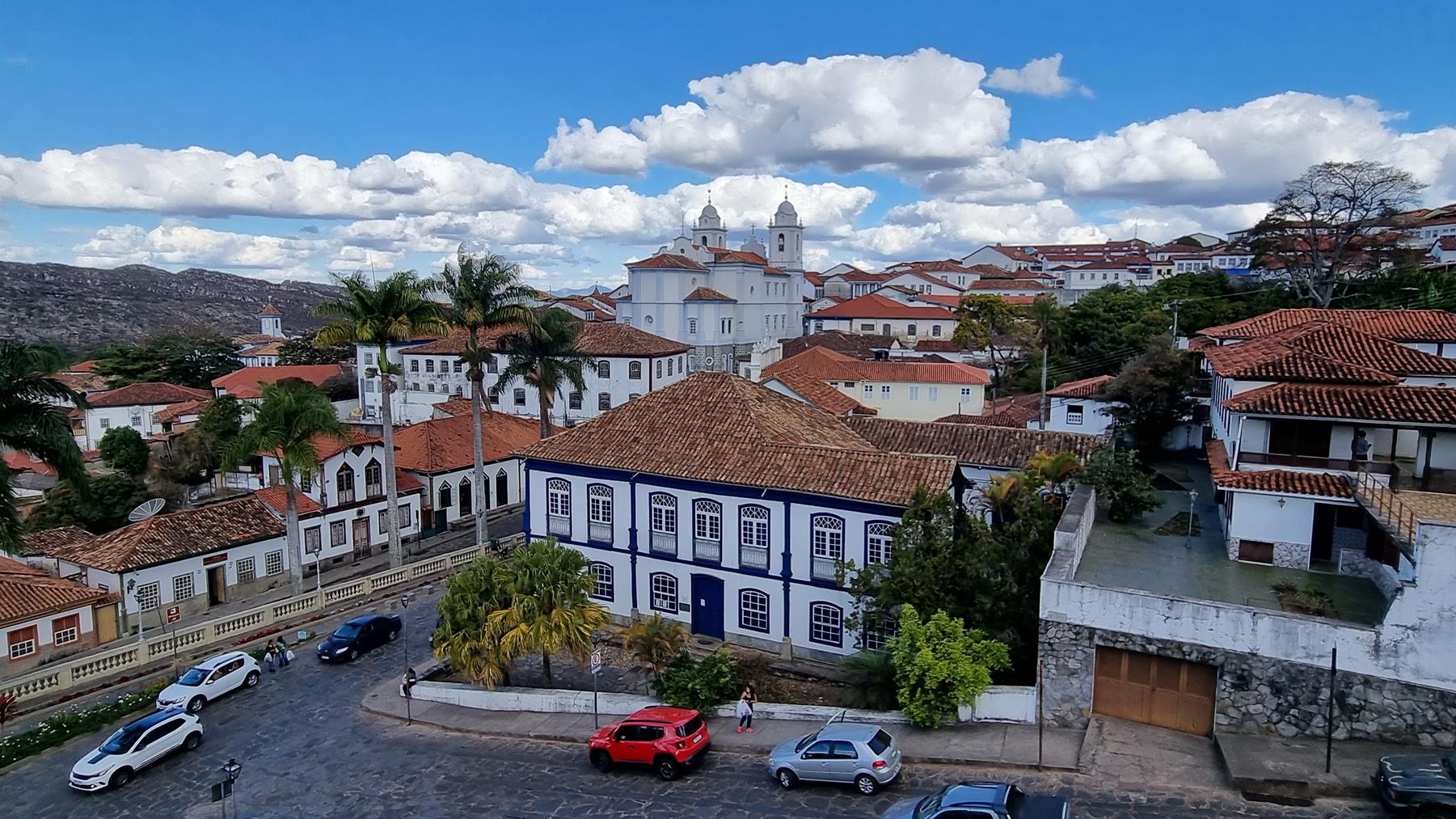

The architectural and urban complex of Diamantina
The city of Diamantina was founded with the discovery and exploitation of gold in the valley of the Tijuco stream in 1713 by the command of Jerônimo Gouveia, who, starting from Serro, followed the course of the Jequitinhonha River to the confluence of the Pururuca and Rio Grande streams.
The first settlements were founded in the place called Burgalhau (today Rua do Burgalhau, Rua do Espírito Santo and Beco das Beatas), but the city grew from 1720 as a result of the discovery of diamonds.
During this period of historical formation based on mining, the city of Diamantina preserved important cultural references from the colonial period and maintained a rich collection, above all architectural and urban.
Thus, the city centre of Diamantina has a configuration characteristic of cities of the colonial period, with an irregular pattern, with streets running transversally to the hillside, characterised mainly by parallel streets with slight variations in the opening or deviation of some alleys and narrow streets.
The city’s architectural complex includes monuments that are important in the history of Brazilian art and architecture in the 18th, 19th and 20th centuries, such as the churches of Mercês, Amparo, Carmo, Rosário, São Francisco de Assis and Senhor do Bonfim, Senhor do Bonfim, as well as the Casa do Forro Pintado, the Forum Building, the Municipal Market, the Diamond Museum, the Antônio Torres Library, the Chica da Silva House and the buildings designed by the architect Oscar Niemeyer: Hotel Tijuco, Faculdade Federal de Odontologia de Diamantina, Escola Estadual Professora Júlia Kubistchek and Diamantina Tênis Clube.
The city’s civil architecture is also a special reference, with a abundance of single-storey houses and a series of town houses. The Historic Centre of Diamantina is also exceptionally beautiful due to its composition with the Serra dos Cristais, forming one of the most important landscape ensembles in Minas Gerais.
Attractions and points of interest in Diamantina MG
- Carmo Church
- Bonfim Church
- Church of Our Lady of the Rosary
- Municipal Market (Tropeiros)
- Diamond Museum
- St Francis of Assisi Church
- Juscelino Kubitschek House
- Glória Walk
- Antônio Torres Library (Casa do Muxarabiê)
- Old Town Hall
- Chapel of Our Lady of Light
- Santa Izabel Theatre
- Chica da Silva House
- Diamantina Old Railway Station
- Diamantina Forum Building
- Church of Our Lady of Amparo
- Basilica of the Sacred Heart of Jesus
- Church of Our Lady of Mercy
- Metropolitan Cathedral of Diamantina – Santo Antônio da Sé
- Diamantina City Tour
1. Carmo Church

Built between 1760 and 1765 at the expense of the contractor João Fernandes, the Nossa Senhora do Carmo Church is a landmark in the urban landscape of the historic centre of Diamantina.
In addition to the historical context surrounding the builder and his history with Chica da Silva, the Nossa Senhora do Carmo Church stands out as the only one in the city without a front tower.
This solution gives a special grace to the building, one of the most important and well-preserved in Diamantina.
Inside, the impressive painting of the nave ceiling stands out, considered to be the masterpiece of the Portuguese painter and curator José Soares de Araújo, one of the most active in the Diamantina region.
See the exquisite carving of the altarpieces.
R.do Carmo, s/n, Centro..
2. Bonfim Church

Built by soldiers in the mid-18th century next to what is thought to have been a barracks, this church combines Baroque and Rococo elements.
Singular, it has a single altarpiece in the chancel, and the paintings, by an unknown author, reveal the influence of José Soares de Araújo’s style on the artists of the time.
Monsenhor Neves Square, s/n, Centre..
3. Church of Our Lady of the Rosary

One of the oldest churches in the city, it was built in 1731 and enlarged in 1772, retaining the original choir.
Its main attraction is the perspective painting of the chancel ceiling, with Our Lady of the Rosary surrounded by angels, by José Soares de Araújo, as well as the altarpieces and the painting of the transept arch.
It stands in the centre of a square paved with stone, and in its square there is a fountain, also in stone, from the 18th century.
Pça. Dom Joaquim Silvério de Souza, s/n, Centro..
4. Mercado Municipal (dos Tropeiros)

In 1835, Lieutenant Joaquim Cassimiro Lages built this building, which served as a residence and trading post, with a place to unload the goods transported by the tropeiros.
Today it houses the Municipal Market, where you can find agricultural produce, handicrafts, cheeses, sweets and cachaça. Some say that Oscar Niemeyer was inspired by the building’s arcades to design the Palácio da Alvorada in Brasília.
Pça. Bardo de Guaicuí, 451, Centro..
5. Diamond Museum

Located in the home of Father Rolim, one of the most influential inconfidentes, the museum traces the history of the diamond cycle in the region through objects used in everyday life in the 18th and 19th centuries.
Its collection includes household utensils, furniture, paintings, pictures and weapons, as well as tools and instruments used in diamond mining.
R. Direita, 14. Direita, 14..
6. St Francis of Assisi Church

The dominant style in the Church of St Francis, dating from 1775, is rococo – the beautiful carvings on the altars combine wood and gold. Take the opportunity to climb the bell tower, which is open to visitors.
However, it’s worth admiring the old building, with its sober façade and its single tower, built on a corner, high above the street.
R. São Francisco, s/n..
7. Juscelino Kubitschek’s house

The house where Juscelino Kubitschek, former president of Brazil, lived during his childhood and adolescence, on Rua São Francisco.
The building is made of pau a pique, a construction technique typical of the 18th century. The house has been turned into a museum and its rooms contain a library, personal objects, photos and the guitars used by the politician to participate in serestas.
8. Glória Walkway

The postcard of the city was built in 1876 to connect two buildings (one colonial and the other from the 19th century) that housed a nuns’ college. The aim was for the boarders to be able to move from one wing to another without being seen.
Consisting of two 18th and 19th century buildings connected by a passageway, it once housed the College of the Vincentian Sisters and is now the headquarters of the Casa da Glória Institute of the UFMG.
Rua da Glória, 297, Centro. 9.
9. Antônio Torres Library (Casa do Muxarabiê)
The site originally belonged to Lieutenant Joaquim Cassimiro Lages, who in 1835 built a building for his home and, next door, a ranch for the trade of muleteers.

Between 1881 and 1884, the town was dismantled as a result of the mining crisis.
In 1889, the current town market was built to improve the marketing of products in the town and to organise and modernise the town network.
10. Old Town Hall

Built between 1733 and 1735 as the headquarters of the Intendência dos Diamantes, it became a school in the second half of the 19th century.
The building has a stone staircase (at the main entrance), a gabled roof, ten windows on the upper floor and nine on the ground floor.
Inside, the gamela panelling of the hall on the second floor is striking. In the other rooms the oldest ceilings are in skirt and shirt.
11. Chapel of Our Lady of Light
Built on the initiative of a Portuguese woman, Dona Tereza de Jesus Perpétua Corte Real, in fulfilment of a promise she made to save herself from the Lisbon earthquake in 1755.

The construction, however, took place much later and was completed in 1819, according to documents that inform about the transfer of the Archconfraternity of the Glorious Patriarch St Francis from the Chapel of Amparo to the Chapel of Luz. The donation was completed five years later by Dona Maria Tereza.
The Portuguese lady who built the chapel attached it to a home and school for orphaned girls. When Dona Tereza de Jesus died in 1826, she was buried at the entrance to the chapel.
The Capela da Luz, like so many others, has had to undergo several renovations, but it has remained its style despite some alterations.
12. Santa Izabel Theatre

The Santa Izabel Theatre was built in 1841 and opened to the public the following year. The purpose of this theatre was to donate the proceeds to the city’s hospital, the Santa Casa de Caridade.
In 1912, the theatre was demolished to make way for a new building to house a theatre and cinema, on the old Rua Tiradentes – now the Rua Direita.
On the original site, in Cavalhada Velha, the Public Prison was built, an initiative of the municipality in partnership with the Government of Minas Gerais, with the aim of removing it from the city centre.
After decades, restoration work began on the building in 2007, culminating in the reopening of the Santa Izabel Municipal Theatre in 2010.
13. Chica da Silva’s house

This beautiful solarium was the residence of the slave Chica da Silva between 1763 and 1771. The house is now the headquarters of the National Institute of Historical and Artistic Heritage (Iphan). Inside the mansion you can admire the collection of paintings depicting the Black Queen.
Chica da Silva
There are frequent references in Diamantina to Chica da Silva, an enslaved woman born in the arraial of Tijuco around 1720. After her freedom she lived for about fifteen years with her master, the influential diamond merchant João Fernandes, with whom she had thirteen children.
Considered the most powerful woman in the Diamantino district, Chica became known for her mercurial nature, which earned her the nickname “Chica-que-Manda”. Her career – between the real and the legendary – inspired novels, films and soap operas and became one of the most striking symbols of the region’s history.
14. Diamantina’s Old Railway Station

The Central Railway of Brazil, which connected Diamantina with Corinto, Curvelo, Belo Horizonte and the coast, opened in 1914. The city’s railway terminal operated until the early 1970s, when the passenger trains were closed.
Today, the Old Station Building houses the Fire Brigade and marks the start of the Maria Fumaça Green Trail, a tourist route that recovers the region’s railway heritage.
15. Diamantina Forum Building

The building that now houses the Forum was built in the middle of the first half of the 18th century and was originally intended as a residence. It was notable for its imposing courtyard, a common feature of stately homes of the period.
16. Church of Our Lady of Amparo

The chapel, whose construction was completed in 1776, was built by the Brotherhood of the Pardos do Arraial do Tijuco. It has altars carved in the Baroque-Rococo style, especially the chalice-shaped pulpit and the 18th century images.
The finishing and decoration work is attributed to the painter and brother of the Order Silvestre de Almeida Lopes, including the painting and gilding of the chapel and the painting of the two altars of the transept, carried out in 1796.
Throughout the 19th century it underwent several renovations, including the demolition of the original stone tower in 1813, which eventually damaged the structure of the building. The tower was rebuilt five years later.
17. Basilica of the Sacred Heart of Jesus

Built at the end of the 19th century, this neogothic church is notable for its beautiful French stained glass windows and its soapstone altar table. The project was designed by Father Júlio Clavelin, who was also responsible for the plans for the Church of the Caraça Sanctuary in Santa Bárbara, also in the neo-Gothic style.
Praça do Sagrado Coração, 11 – Largo Dom João.
18. Church of Our Lady of Mercy

The construction of the Church of Our Lady of Mercy began on March 16, 1778 as a result of the devotion and organisation of the Brotherhood of Our Lady of Mercy, founded in 1772.
The confraternity arose from a split in the Brotherhood of Our Lady of the Rosary of the Blacks, from which the mulatto brothers separated with the decision to form a new confraternity, reaffirming their religious and social identity and autonomy in the context of the Tijuco Arraial.
19. Diamantina Metropolitan Cathedral – St Anthony of the See

The present Metropolitan Cathedral of Diamantina was built between 1932 and 1938 to replace the old Church of Santo Antônio do Tijuco, built around 1750 and demolished in 1932. The old church, which stood on the same site, faced Rua Direita, unlike the present building.
Although the original building has been completely replaced, some remaining elements have been preserved, such as the baroque side altars and individual pieces that recall the old ornamentation and the city’s colonial past.
20 Tour of Diamantina
The integrity of its buildings and the beauty of its urban layout enchant visitors to Diamantina.
A stroll through its streets can begin at the Metropolitan Cathedral (Praça da Matriz), a building from the 1930s which, although not of great architectural interest, is the heart of the city.
In the Rua da Quitanda, behind the Matriz, are terraced houses from whose balconies musicians appear during the evening open-air concerts of traditional music bands.
In front of the square is the City Hall Building (Praça Conselheiro Matta, 111), built in 1735 on the site of the former Intendência dos Diamantes. On the side of the square is the Casa do Muxarabiê (Rua da Quitanda, 50), whose window is covered by an Arabic-inspired grille, allowing the inhabitants to watch the street without being seen.
A little further on is the famous Beco do Mota, full of bars and studios that are part of the city’s cultural life. Near the Municipal Market is the Rua do Burgalhau, where you’ll find some of Diamantina’s oldest houses, dating back to the time of the city’s foundation.
In the House of Chica da Silva (Praça Lobo de Mesquita, 266), where the former slave lived between 1763 and 1771, you can also see Arab influences in the architecture, a sign of the cultural diversity that marks the local history.
Much more modest is the Casa de Juscelino (Rua São Francisco, 241), built in the pau a pique in the 18th century, which now houses a museum with photographs, personal objects and information about the former president Juscelino Kubitschek, who was born in the city. In the same street is the imposing Casarão do Fórum (Rua São Francisco, s/n), a fine example of 18th century architecture.

Publicações Relacionadas

Catas Altas MG - History and Monuments

Pico do Itacolomi - Attractions, history and itineraries

Sabará: A Journey Through Its Rich History

Summary of the history of Minas Gerais

Baroque of Minas Gerais in Focus: History, Techniques and Works

Tourist Attractions and History of the Caraça Sanctuary MG

Tourist attractions and routes in Serra do Cipó MG

Royal Road Route - History, routes and attractions

Tourist Attractions and History of Serro in Minas Gerais

São João del Rei MG - Attractions, History and Architecture

History and Monuments of Tiradentes MG

Little Church of Pampulha MG: history, architecture and religious importance

Church of Saint Francis of Assisi, Ouro Preto: Guide

Aleijadinho: Biography and works that shaped the Brazilian Baroque

Sanctuary of Bom Jesus de Matozinhos - History and Architecture

Mariana: A journey through time to colonial Brazil
Ouro Preto: Historic City of Tourist and Cultural Interest
This post is also on:
 Português
  English
  Deutsch
  Español
  Français