Oeiras, in Piauí, is a tourist destination that enchants with its rich history, culture and religious traditions. As the first capital of the state, the city preserves a great historical heritage, with colonial churches, mansions and cobbled streets.

Religious tourism in Oeiras – PI
The Easter Week in Oeiras is the biggest religious festival in the state and the period when the city receives the largest number of visitors.
In fact, the programme starts practically a month before Holy Week. There are masses, vigils, Stations of the Cross through the streets of the city and religious sightseeing tours.

Origin of the tradition
The Easter Week tradition in Oeiras has its roots in the cultural and religious influences brought by the Portuguese colonisers in the 18th century.
The city, founded in 1750, developed a strong Catholic devotion, which is reflected in the Easter celebrations. This is a time of deep reflection and spirituality, when the faithful relive the last days of Jesus Christ.
Processions and celebrations, such as the Procession of Bom Jesus dos Passos and the Fogaréu Procession, are manifestations of faith and local tradition.
Religious traditions
The religious traditions of Oeiras have their origins in the cultural and religious influences of the Portuguese colonisers, who established a strong Catholic presence.
In addition to the Easter Week, festivals such as the Feast of the Divine Holy Spirit and the Feast of St Sebastian reflect this cultural heritage.
Devotion to saints and processions, novenas and other celebrations are common in the city.
The influence of indigenous and African traditions has also contributed to the religious syncretism present in the region, where rituals and festivities incorporate aspects of different cultures and beliefs.
As a result, Oeiras’ religious traditions have become an important part of the city’s cultural identity, attracting both locals and visitors.
Religious events
The main manifestations are the Procession of Bom Jesus dos Passos, where thousands of people accompany the secular image of Bom Jesus through the streets of the Historic Centre, and the traditional Fogaréu Procession, accompanied only by men carrying lamps and candles, while the women stay in the churches and pray.

Feast of the Holy Spirit
Forty days after Easter, the Feast of the Divine Holy Spirit is celebrated, a Portuguese tradition that celebrates the coming of the Holy Spirit upon the apostles.
Cultural traditions
Oeiras is dressed in red and white. Every year a new house is chosen to house the image of the Divine. The chosen family is the resident of the image of the Divine for one year.

Oeiras Tourist Attractions

Oeiras Patrimonio Cultural

Oeiras - Berço da Fé06:59

Oeiras fazendas e Religiosidade03:22

Oeiras Museu de Arte Sacra03:14
História e Arquitetura de Oeiras PI53:32

Oeiras - Primeira Capital do Piauí04:38
1. Historic Centre of Oeiras and Tourist Attractions
- Mother Church of Our Lady of Victory
- Oeiras Museum of Religious Art
- House of the Seven Windows
- Church of Our Lady of the Rosary
- Church of the Immaculate Conception
- Sobrado Major Selemérico
- House of the Viscount of Parnaíba
- House of the Canon
- Town Hall and Jail
- Episcopal Palace
- Monument to Our Lady of Victory
- Gunpowder House
- Leônidas Melo Promenade
- Victories Square
- Steps of the Passion
- Gallery of the Divine Sacred Deer
- Sobrado João Nepomuceno
- Sobrado dos Ferraz
- Cinema Theatre
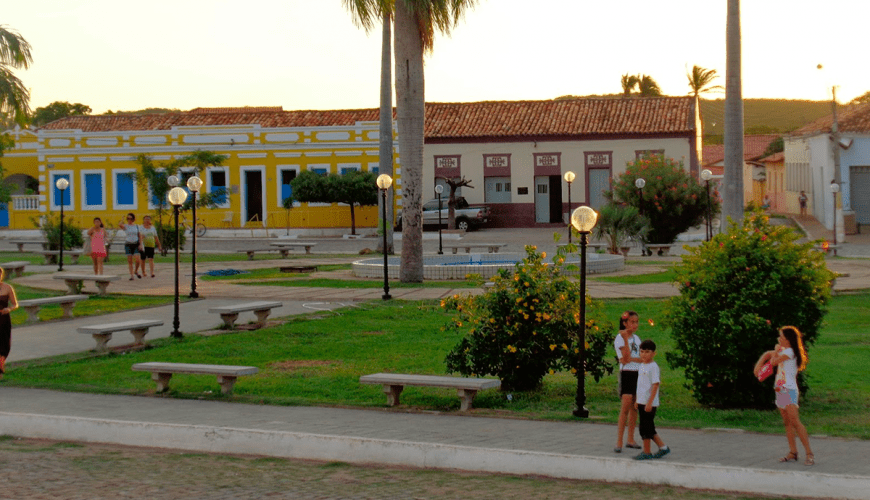
The historic centre is the heart of Oeiras, with colonial buildings and streets full of history.

1. Mother Church of Our Lady of Victory
This is the main church of the city and an architectural landmark, dating back to 1733. The church is a classic example of Baroque architecture in the Northeast of Brazil.

2. Oeiras Museum of Religious Art
Located in the old Town Hall and Prison, this museum houses an important collection of religious pieces, paintings and historical artefacts that tell the story of the city’s religious history.

3. Casa das Sete Janelas
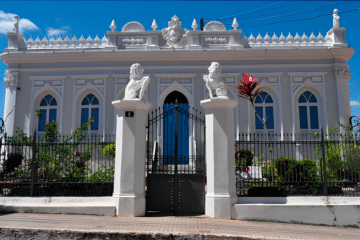
This is one of the most emblematic houses in Oeiras, known for its façade with seven windows. It is an excellent example of colonial architecture and is often photographed by visitors.

4. Church of Our Lady of the Rosary

Built in the 18th century. Former chapel of the First Charity Hospital of Piauí.
5. Church of Our Lady of the Conception
Located in Praça Mafrense, its construction began in the 19th century, but the work was not completed until 1942.
6. Sobrado Major Selemérico

Built by the President of the Province, Zacarias de Góis e Vasconcelos, during his government (1845-1847) as a residence for the Presidents of the Province. Today it houses the Historical Institute of Oeiras and the Major Selemérico Cultural Centre.
7. House of the Viscount of Parnaíba

This 18th century building was the residence of Brigadier Manuel de Sousa Martins, Viscount of Parnaíba, and the seat of the provincial government.
8. Canon’s House

It was built in 1836 by Brigadier Manuel de Sousa Martins for his son, Canon João de Sousa Martins, who was to be the parish priest of Nossa Senhora da Vitória for many years. It currently functions as a hotel pousada.
9. Town hall and jail

Built by Carlos César Burlamaque during his time in the provincial government in the 18th century. For many years it was the residence of Colonel João Batista Ferraz. From 1956 to 1996, it was the headquarters of the Oeiras Workers’ Circle. It currently houses the Town Hall of Oeiras.
10. Episcopal Palace
Built in the 19th century by João Nepomuceno Castelo Branco.

From the 1950s to 1976, it was the residence of provincial governors, a school group and a bishop’s residence. Today it houses the Oeiras Museum of Sacred Art (MAS). The Ponte Grande over the Mocha stream, built in 1846, was another of the governor Zacarias de Góis e Vasconcelos’ projects. Made entirely of stone and lime, it is the oldest bridge in Piauí.
11. Monument to Our Lady of Victory

Located in the Oeiras Nova district, it was built by the people and the municipal authorities in 1945.
It marks the 250th anniversary of the Cathedral Church and is 15 metres high and 165 metres long.
From the top of Morro do Leme you can enjoy a panoramic view of the city.
12. Gunpowder House
The first military building in Piauí and the third of its kind in Brazil. All made of stone to serve as an armoury during the time of the captaincy.

Listed by Iphan, this building dates from the 19th century. As the name suggests, it is really a house with only one room. It is very simple and was built with rough stones and cement mixed with cattle dung. Even after all this time, the house still has its original structure.
Only the roof has been changed.
As the only remaining colonial military building in Piauí, the Gunpowder House is a record, but more than that, it is an objectification of the struggle for independence. The place where the independence fighters kept their gunpowder weapons is one of the symbols of Piauí’s emancipation from the Portuguese crown.
It is located next to the sites of Pé de Deus and Pé do Cão, which have been carved into the lakeshore since the beginning of colonisation.
13. Leônidas Melo Promenade
Built in the 1940s, it houses the Oeiras Cinema, the Trade Association and the Oeiras Café. The buildings are artistically decorated, but do not contrast with the colonial complex.
14. Place of the Victories
Its beauty accompanies the passage of time. It is the scene of many festivities and events that are part of the history of Oeiras.
15. Passion Stairs
Five chapels scattered throughout the historic centre. They have been part of the town plan since 1809 and form the backdrop to the Via Crucis of Bom Jesus.
16. Gallery of the Divine Sacred Deer
Works by various artists from Piauí, with reinterpretations and impressions of the Oeiras Divine festival. Located in Praça das Vitórias.
17. Sobrado João Nepomuceno

The Sobrado was built in 1817 by Captain General João Nepomuceno de Castelo Branco as his residence.
But when you see it, you would never guess that it was built to house a family; it looks more like a public institution. And so it remained.
Later, the Sobrado was acquired by the government and housed the municipal administration, and after a while it was donated to the diocese to be used as the Bishop’s Palace.
Today, the Sobrado is home to the famous Oeiras Museum of Sacred Art. The museum houses works from the 18th to the 20th centuries from the churches of Nossa Senhora das Vitórias, Nossa Senhora do Rosário and Nossa Senhora da Conceição, as well as a small number from collectors.
Plaster images, polychrome wooden images, crucifixes, candlesticks, benches, confessionals, an altar that belonged to the church of Nossa Senhora do Rosário, among other objects and works, make up the old sobrado, the current museum.
18. Sobrado dos Ferraz

This is the oldest Sobrado in Piauí. It was built in 1810 as a town hall and prison, with the upper part being used by deputies and the lower part for prisoners.
When the capital became Teresina, the Sobrado was sold to Colonel João Batista Ferraz, who turned it into a residence.
In the 1950s, the place was bought by Father Balduíno. Today, the Sobrado is the seat of Oeiras Town Hall.
19. Cinema Theatre

Built in 1940, the Cine Teatro Oeiras was and still is the city’s most traditional cultural centre. With a cinema and a theatre hall, the Cine Teatro was declared a Historical and Artistic Heritage Site in 2011.
Over the years, it has been revitalised and modernised and is now a venue for various socio-cultural events, including musicals, plays and national concerts by artists known throughout the country.
These are just some of the important secular heritage sites you’ll find in Oeiras, all of which are open to visitors. Heritage sites that have stood the test of time and bear the historical marks of a people for the whole state and the whole country.
2. Religious festivities
Oeiras is famous for its religious celebrations, which attract tourists from all over Brazil, especially during Holy Week:
- Holy Week in Oeiras: Considered one of the oldest and most traditional in the country, Holy Week in Oeiras is marked by processions, masses and rituals that involve the local community and visitors. In particular, the Fogaréu procession is an impressive spectacle, with the city lit only by the flames of torches.
- Festa do Divino Espírito Santo: Celebrated 50 days after Easter, this festival is also an important event in the city, with processions and cultural manifestations that show the devotion of the people of Oeiras.
3. Culture and Handicrafts
Oeiras has a strong handicraft tradition, with typical products that reflect the local culture:
- Local Handicrafts: The city is known for its lace, embroidery and ceramics. These handicrafts are sold at local fairs and shops and make great souvenirs.
- Typical Cuisine: The cuisine of Oeiras is rich in the flavours of the Sertão. Dishes such as carne de sol, paçoca, capote (guinea fowl) and arroz de capote are traditional in the region and can be found in local restaurants.
4. Nature and ecotourism
In addition to its historical and cultural heritage, Oeiras offers beautiful natural landscapes and opportunities for ecotourism:
- Serra das Confusões: Close to Oeiras, this area is part of the National Park of the same name, offering trails, caves and a rich biodiversity. It’s a perfect destination for those who love outdoor adventure.
- Balneário Rio Canindé: A pleasant place to relax, with calm waters and picnic areas. It’s ideal for spending the day with family and friends.
History of Oeiras – PI
Oeiras has its origins in a chapel founded in 1695 and dedicated to Our Lady of Victory. The town of Oeiras became a village and county seat in 1712. It became the capital of Piauí in 1759 and was promoted to municipality in 1761. It was the capital until 1851.
Colonisation and Expeditions
The first settlers to enter the interior of what is now the state of Piauí settled on the banks of the Mocha River, where the village that would become Oeiras was founded, 320 kilometres from Teresina and 280 kilometres from São Raimundo Nonato.
Several expeditions attempted to explore the lands of present-day Piauí. Among them was the Domingos Afonso Mafrense expedition of 1674, which travelled throughout the south-central region and dominated the vast hinterland as far as the Parnaíba River.
Another expedition – from Pernambuco – influenced by Mafrense’s expedition, is said to have travelled through the Cabrobó hinterland. Both are thought to have entered the area where the seat of the municipality of Oeiras was later established.
Sesmarias and agricultural development
There are records of earlier applications for sesmarias by Mafrense, Julião Afonso Serra and others, covering the region from Parnaíba to the Serra do Araripe. It is also known that Mafrense founded several farms there, including Fazenda Cabrobó, where he lived. Here he organised a arraial of domesticated Indians.
The origins of Oeiras are linked to the development of agriculture in Piauí and the appearance of large cattle ranches. A settlement with a chapel attached to the parish of Cabrobó, in the diocese of Pernambuco, was established in the place known as “Mocha”, the name of a stream located there.
Elevation to parish and town
The settlement became a parish in 1696, under the auspices of Nossa Senhora da Vitória, and was promoted to town in 1712, under the name of Mocha. In 1758 it became the capital of the province of Piauí and in 1761 it was promoted to city.
Its name was changed in honour of the Count of Oeiras – the future Marquis of Pombal, the all-powerful minister of the Portuguese court of King José. Considered the oldest city in Piauí, the cradle of the state’s history and colonisation, it remained the centre of political decision-making until 1852, when the seat of government was transferred to Teresina.
Decadence and renaissance
Oeiras lost its status as capital and entered a period of decadence that lasted until the 1930s, when the export of carnauba wax eased the situation.
Festivities and culture
Oeiras is a point of pilgrimage for the faithful on various religious dates. The traditional Easter Week, the largest religious festival in the region, attracts people from all over Piauí, offering a unique spectacle of faith and popular religiosity.
The Procession of Bom Jesus do Passos, the Fogaréu Procession and the Descent from the Cross are some of the most important events in the First Capital. Not to mention the Cultural Expressions of its Folklore and Culture, with the Congos do Rosário standing out as one of the most beautiful Afro-Brazilian expressions.
Historical heritage
In 1697, a small wooden and adobe chapel was built in Oeiras, later replaced by the Church of Nossa Senhora da Vitória, whose construction was completed in 1733.
The church, now a national heritage site, still stands in the small town, which preserves some beautiful houses in its narrow streets. Also dating back to Oeiras’ origins is the Bom Jesus dos Passos procession, which gathers crowds of worshippers during the Easter Week.
How to get there
Oeiras is located about 300 kilometres from Teresina, the capital of Piauí. The city can be reached by motorway and there are buses between Teresina and Oeiras. The nearest airport is Teresina, from where you can hire a car or take a bus to the city.
Travel Tip
- Best time to visit: The best time to visit Oeiras is during religious festivals such as Holy Week and the Feast of the Divine Holy Spirit. However, if you prefer a quieter visit, consider visiting between June and August when the weather is milder.
Oeiras is a destination that combines history, culture and nature in an enchanting setting. Whether you want to explore its historical heritage, take part in religious celebrations or simply enjoy the tranquillity of the city, Oeiras offers an authentic experience of Piauí’s hinterland.
Oeiras PI Tourist Guide

Publicações Relacionadas
Serra da Capivara National Park: A Historical Journey
Explore the Archaeological Marvels of São Raimundo Nonato
Discover Pedro II: the enchanted Switzerland of Piauí
Sete Cidades National Park's Stunning Rock Formations
Poti River Canyon: Your Ultimate Ecotourism Guide
Kitesurfing in Barra Grande: The Ultimate Guide
Luís Correia: Explore the Best Beaches in Piauí
Canary Islands: Ecotourism in the Parnaíba Delta
Teresina: Explore Its Unique Geographic Location
Serra das Confusões National Park Travel Guide
Main Tourist Attractions in Piauí You Must Visit
Piauí: Discover Unique Tourism Experiences
Parnaíba Delta: Biodiversity and Ecotourism Hub
Piauí: A Guide to Its Stunning Attractions
This post is also on:
 Português
  English
  Deutsch
  Español
  Français